
Loading, please wait...
LOT 1846
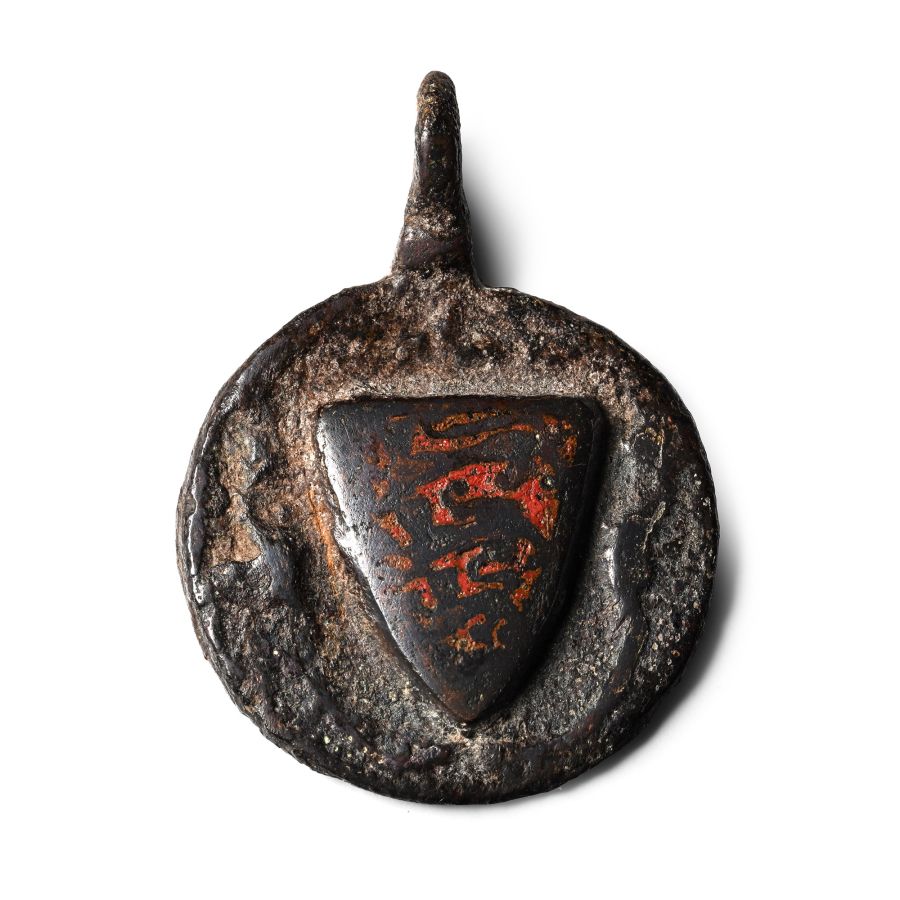
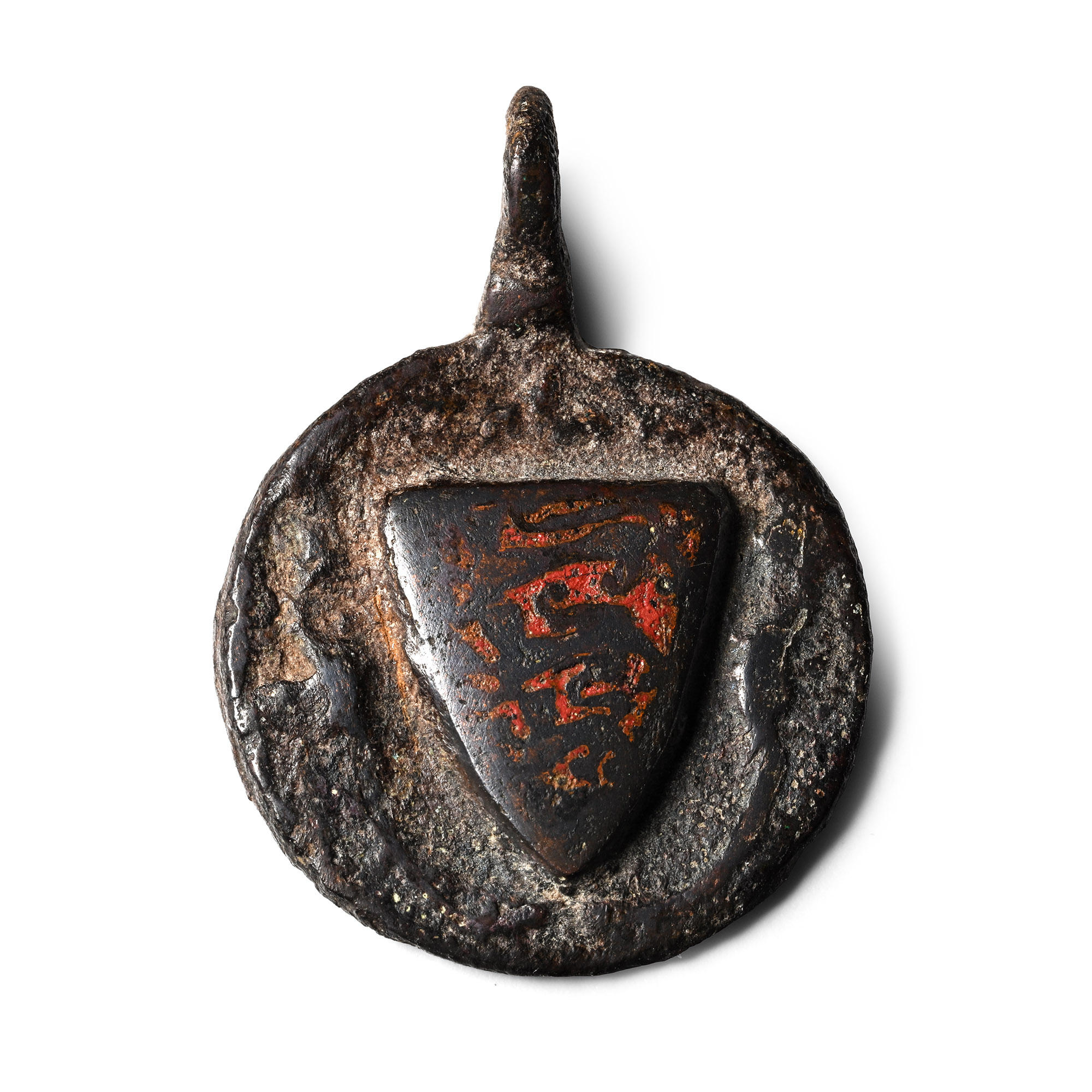
Medieval Knight's Bronze Heraldic Horse Harness Pendant with Shield
13TH-15TH CENTURY A.D.
1 1/4 in. (8.91 grams, 33 mm).
Discoid pendant with raised shield at the centre, possibly with three lions passant guardant for the coat of arms of England. [No Reserve]
ProvenanceFrom the private collection of Graham Slater (1927-2024), Cambridge, UK; formed 1980s-1990s.
CONDITIONTimeLine Auctions follows a vetting process to ensure the authenticity and legality of all items, reinforcing our commitment to integrity and responsible trading. Each antiquity, antique, and coin lot undergoes thorough examination by a vetting committee of at least ten external specialists, professional trade association members, scientists, and archaeologists: Our Vetting Process
AUCTIONS:
TimeLine is a leading auction house specialising in antiquities, ancient art, collectables, natural history, coins, medals, and books. Our auctions offer museums, collectors, historians, and enthusiasts the opportunity to acquire unique and historically significant pieces.
LOT 1846
Medieval Knight's Bronze Heraldic Horse Harness Pendant with Shield
Sold for (Inc. bp): £182
-
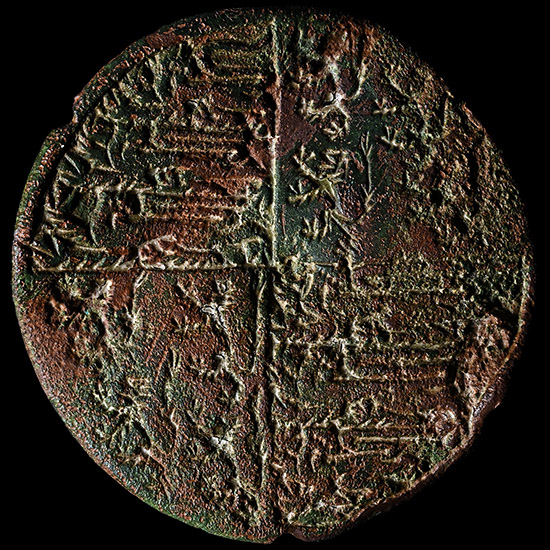
Royal Medieval Bronze Carriage Plate of Edward III and his Wife Queen Philippa of Hainault
England, 1327-1377 A.D.Sold for (Inc. bp): £546
Discoid appliqué, flat in section and slightly distorted; incuse heraldic detailing to obverse blazoned 'Quarterly 1st and 4th Gules three lions passant guardant [Or] 2nd and 3rd [Or] four lions rampant [in a quadrangle] the 1st and 4th Sable the 2nd and 3rd [Gules]'. 37.2 grams, 59 mm
Found Lowick, East Northamptonshire, UK. Accompanied by a copy of the British Museum's Portable Antiquities Scheme (PAS) report no.BH-7A9E2F.
The Royal College of Arms has identified these arms as belonging to King Edward III and his wife, Philippa of Hainault (r. 1327 - 1369). The terminus post quem for this piece is therefore 1327, the date of the marriage, and the likely terminus ante quem is Edward's death in 1377. A circular mount with the same fixing method, which bore the arms of the Bishopric of Ely, was found in Norfolk and is illustrated and described by Steven Ashley (2002: Fig. 20, p. 45, no. 196). The presence of the royal arms on this piece is likely to be a public display of allegiance to the throne rather than an indication of ownership on the part of the crown. -
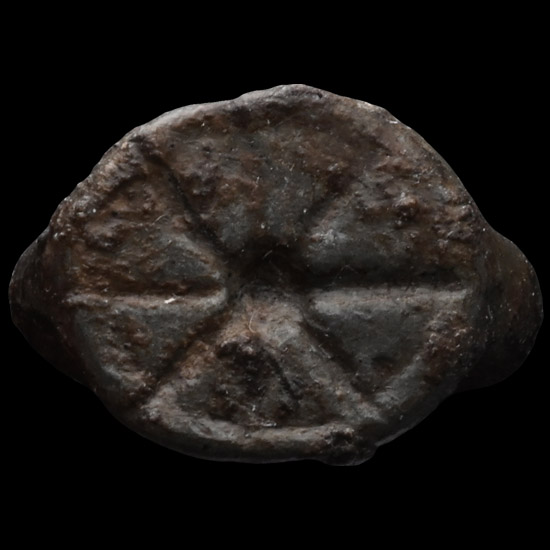
Medieval Bronze Seal Ring with Expanding Cross
England, circa 13th-14th century A.D.Sold for (Inc. bp): £52
Thick D-section hoop with integral disc bezel, incuse eight-armed cross dividing the field, central pellet. 7.95 grams, 19.81 mm overall, 11.69 mm internal diameter
Found Swineshead, Lincolnshire, UK. Recorded with UKDFD no.53303. -
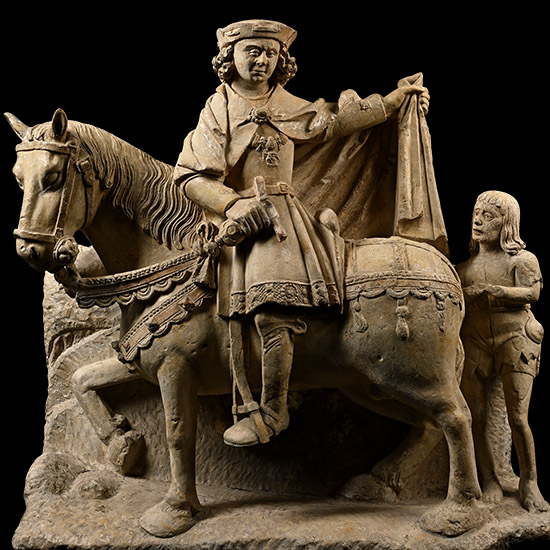
Large Medieval Carved Limestone of St Martin on Horseback with Cloak and Beggar
Flemish, 15th century A.D.Sold for (Inc. bp): £31,200
Carved in high relief, limestone scene depicting Saint Martin of Tours on horseback with his sword raised to cut off a portion of his military cloak to share it with a beggar; the saint wearing articulated armour buckled at his forearms and on his lower leg, with a billowing cloak draped across his shoulders; the horse shown in a contrapposto stance with one foreleg raised, with ornamental caparison and harness pendants; the beggar depicted with emaciated form wearing only underclothes, hands pressed together in supplication; to the reverse, traces of original fixing to a wall or architectural setting; restored. 108 kg, 78.5 cm high
Ex Richard Chester Master, Cirencester, UK. Kate Thurlow & Robin Thompson Collection, 21 October 1998. This lot has been checked against the Interpol Database of stolen works of art and is accompanied by search certificate number no.13384-259005.
The subject derives from the episode recorded by Sulpicius Severus in his Vita Sancti Martini (c. 397 A.D.), in which the young Roman soldier Martin, stationed at Amiens, divided his cloak to share it with a freezing beggar; that same night, he dreamt that Christ appeared to him wearing the half of the garment which he had given away. Martin subsequently converted to Christianity and eventually became Bishop of Tours, where he was venerated as one of the most important saints of early medieval Western Europe; his feast day is celebrated on 11th November. The present relief belongs to a tradition of Flemish devotional sculpture that flourished in the 15th century, when the prosperous towns of the Low Countries — Bruges, Ghent, Brussels, and Mechelen — became pre-eminent centres of religious carving exported across Northern Europe. Comparable examples to this piece are held in the collections of the Musée de Cluny, Paris, and the Rijksmuseum, Amsterdam.
