
Loading, please wait...
LOT 1810
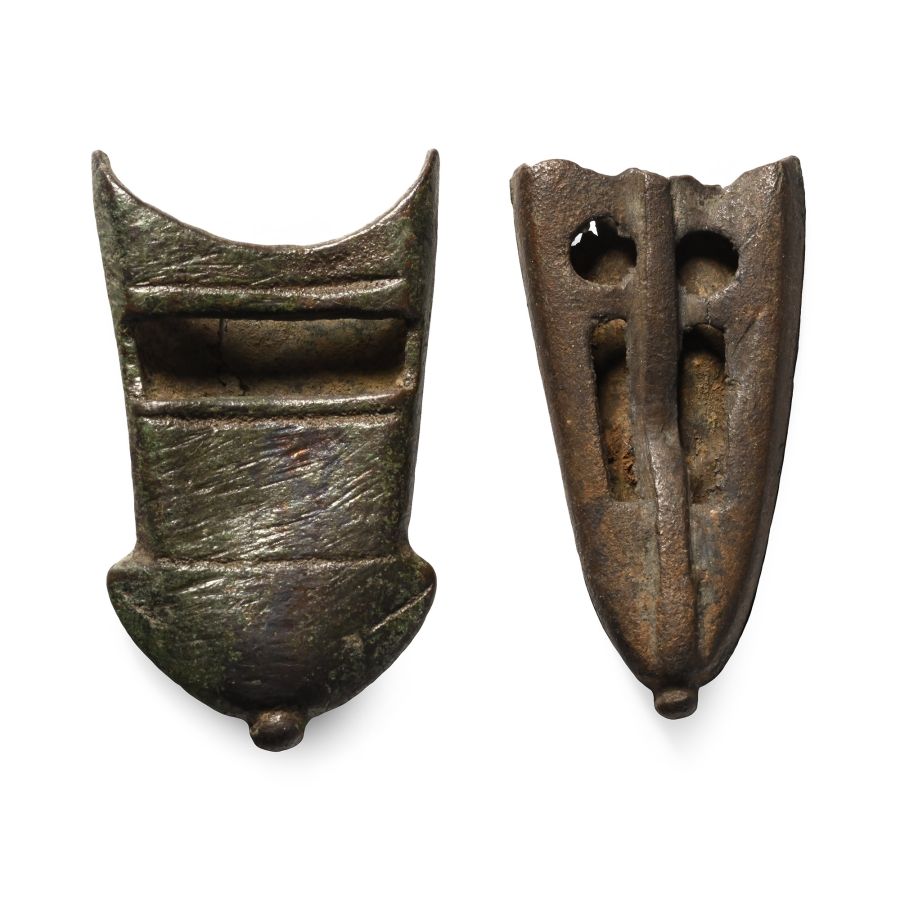
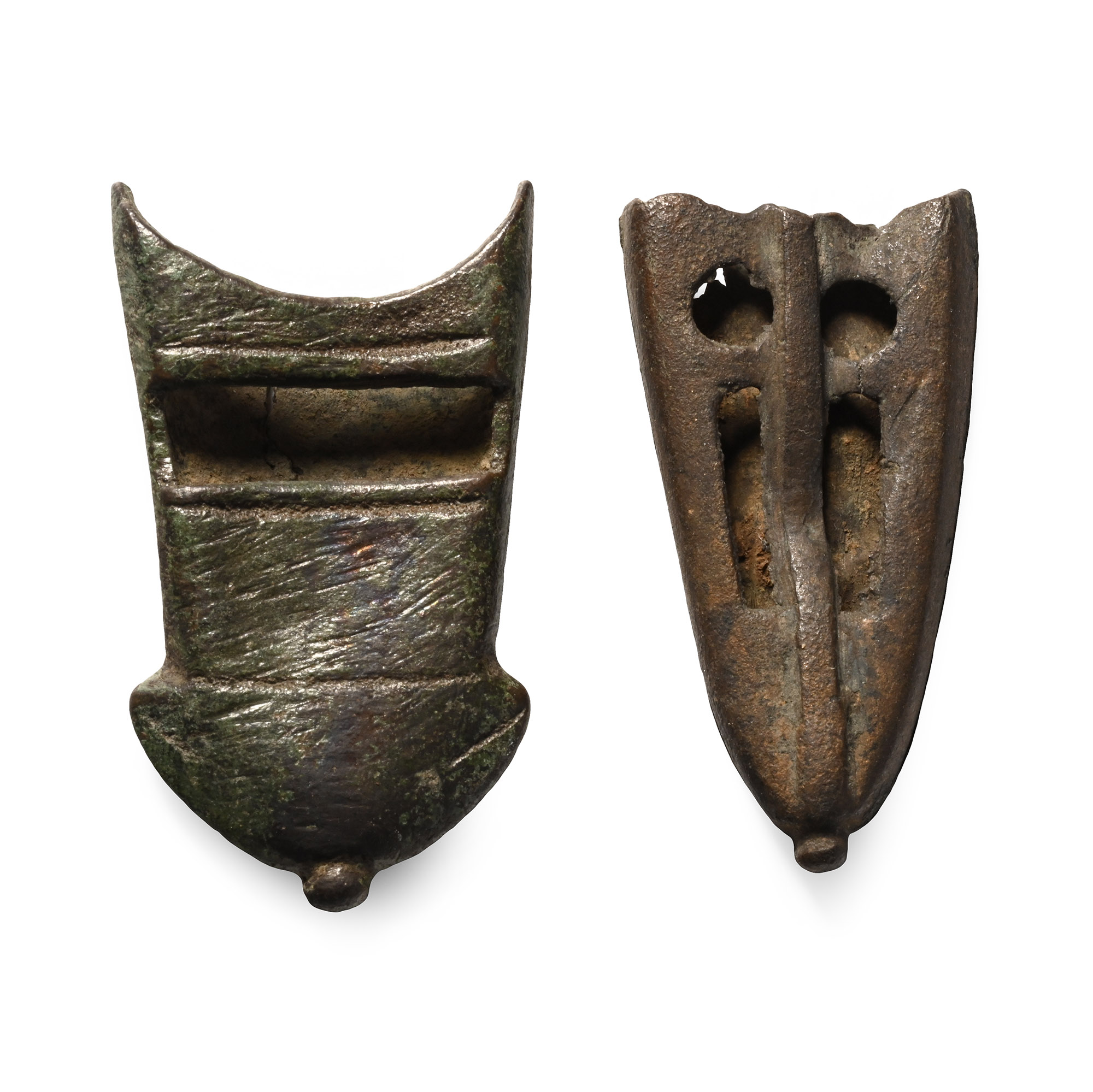
Medieval Knight's Bronze Dagger Chape Group
14TH-15TH CENTURY A.D.
1 1/2 - 1 5/8 in. (19.16 grams total, 39-42 mm).
Comprising of triangular-shaped with openwork single-face and bulb finial, tongue shaped with ribbed obverse and rectangular opening to the reverse. [2, No Reserve]
ProvenanceFrom the private collection of the late Graham Slater (1927-2024), Cambridge, UK, acquired 1980s-1990s.
CONDITIONTimeLine Auctions follows a vetting process to ensure the authenticity and legality of all items, reinforcing our commitment to integrity and responsible trading. Each antiquity, antique, and coin lot undergoes thorough examination by a vetting committee of at least ten external specialists, professional trade association members, scientists, and archaeologists: Our Vetting Process
AUCTIONS:
TimeLine is a leading auction house specialising in antiquities, ancient art, collectables, natural history, coins, medals, and books. Our auctions offer museums, collectors, historians, and enthusiasts the opportunity to acquire unique and historically significant pieces.
-
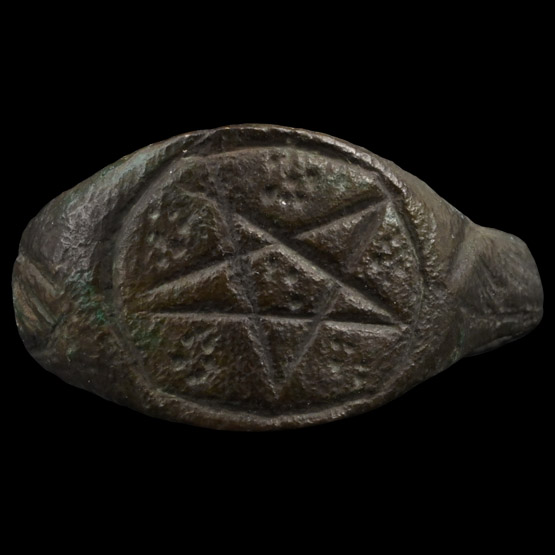
Medieval Bronze Ring with Pentagram
14th-16th century A.D.Sold for (Inc. bp): £111
With hatched panes to the hoop, ellipsoid bezel with incised pentagram reserved on a pointillé field. 4.11 grams, 24.04 mm overall, 20.95 x 18.74 mm internal diameter (approximate size British P, USA 7 1/2, Europe 16.23, Japan 15)
Ex German art market, 2000s. Acquired from an EU collector living in London. From the collection of a Surrey, UK, gentleman. -
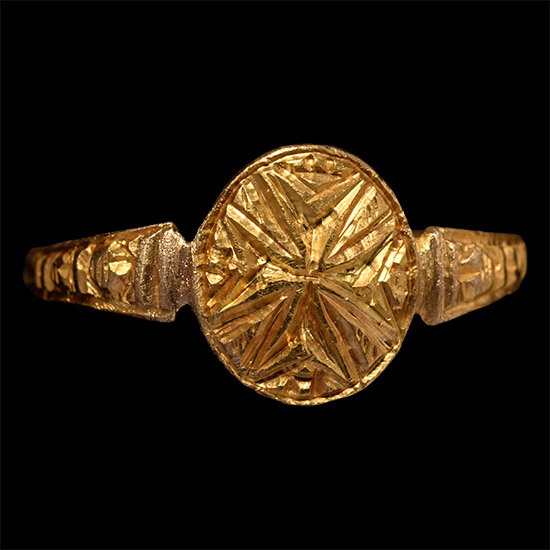
'The Dummer' Medieval Knight's Hospitaller Gold Ring
England, circa 1500-1540 A.D.Sold for (Inc. bp): £4,680
Featuring a sub-circular integral bezel decorated with an eight-armed Maltese cross with some incised decoration in its foils and a sub-circular border with traces of enamel in the field; the moulded shoulders bordered by a long triangle terminating with a long sub-oval indentation, slightly raised and decorated with two parallel lines and two circles with lines through the middle, possibly a stylised letter 'G', the shoulders tapering slightly to the narrowest section of the now straightened narrow and undecorated band. 1.21 grams, 18.40 mm overall, 16.62 mm internal diameter (approximate size British L 1/2, USA 6, Europe 11.87, Japan 11)
Found Dummer, Basingstoke and Deane, Hampshire, UK; declared as Treasure under the Treasure Act and disclaimed. Accompanied by a copy of a letter explaining that the Crown’s interest in this find has been disclaimed. Accompanied by a copy of the Report on find of Potential Treasure for H M Coroner no.2023 T292. Accompanied by a copy of the British Museum's Portable Antiquities Scheme (PAS) report no.HAMP-463CD7.
This motif is symbolic of membership in an Order of Knights Hospitaller, such as the Order of St John. In England, these Knights ceased to hold property after 1540 and the English Reformation. This suggests that the ring is from the earlier part of the sixteenth century. However, the letter 'G' is a prominent symbol of Freemasonry, where it typically stands for Geometry and/or God, the 'Grand Architect of the Universe'. -

Medieval Wooden Bench Finial in the Form of an Elephant and Castle
England, 15th century A.D.Estimate: £3,500 - 4,500 (+bp*)
Opening Bid: £1,750
Carved stylised elephant with elongated ears supporting a palanquin in the form of a caste with a carved cross, foliage motif to the reverse; mounted on a velvet-covered stand. 1.31 kg total, 34.2 cm including stand
Private collection, Europe. Acquired on the English art market. This lot has been checked against the Interpol Database of stolen works of art and is accompanied by search certificate number no.13088-248391.
The image of an elephant carrying warriors in a howdah originated from Alexander the Great's battle against King Porus's war elephants at the Battle of Hydaspes in 326 BC. This motif became widely known in European art through the spread of Bestiaries which were medieval texts combining natural history with moralising Christian stories. One of the most well known was Matthew Paris’s imagined depictions of elephants, most notable in this case is his war elephant illustrated in Chronica maiora II, circa 1240-1255 (Cambridge, Corpus Christi College, MS 016II). Another well known manuscript - The Rochester Bestiary, circa 1230-1240 (British Library, London, Royal MS 12 F.xiii) contains a miniature with a war elephant in the midst of battle, above another image of elephants supposedly in their natural habitat. Since very few live elephants were seen in Europe during the medieval period, their representations were often more imaginative than realistic. Other Medieval bench end carvings of elephants in English churches are known, amongst them are: St Peter and St Paul, Tuttington, Norfolk; St Andrew, South Lopham, Norfolk; St Edmund, South Burlingham, Norfolk; St Andrew, Holme Hale, Norfolk. Elephants can also be found on misericords, some examples can be found at: Cathedral Church of Saint Peter, Exeter; Cathedral Church of St Peter, Gloucester; and St Mary's Church, Beverley.
