
Loading, please wait...
_900x900.jpg "Medieval Iron Single-Handed Sword with Decorated Bronze Pommel")
_200x200.jpg "Medieval Iron Single-Handed Sword with Decorated Bronze Pommel")
.jpg "Medieval Iron Single-Handed Sword with Decorated Bronze Pommel")
LOT 0255
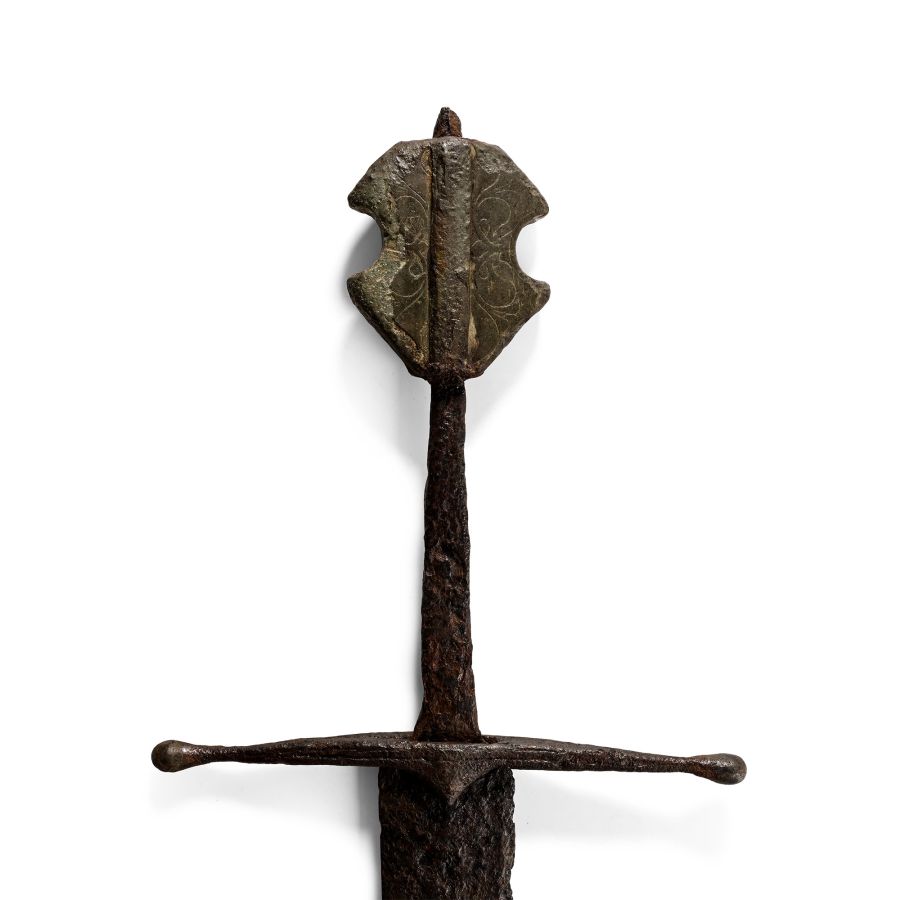
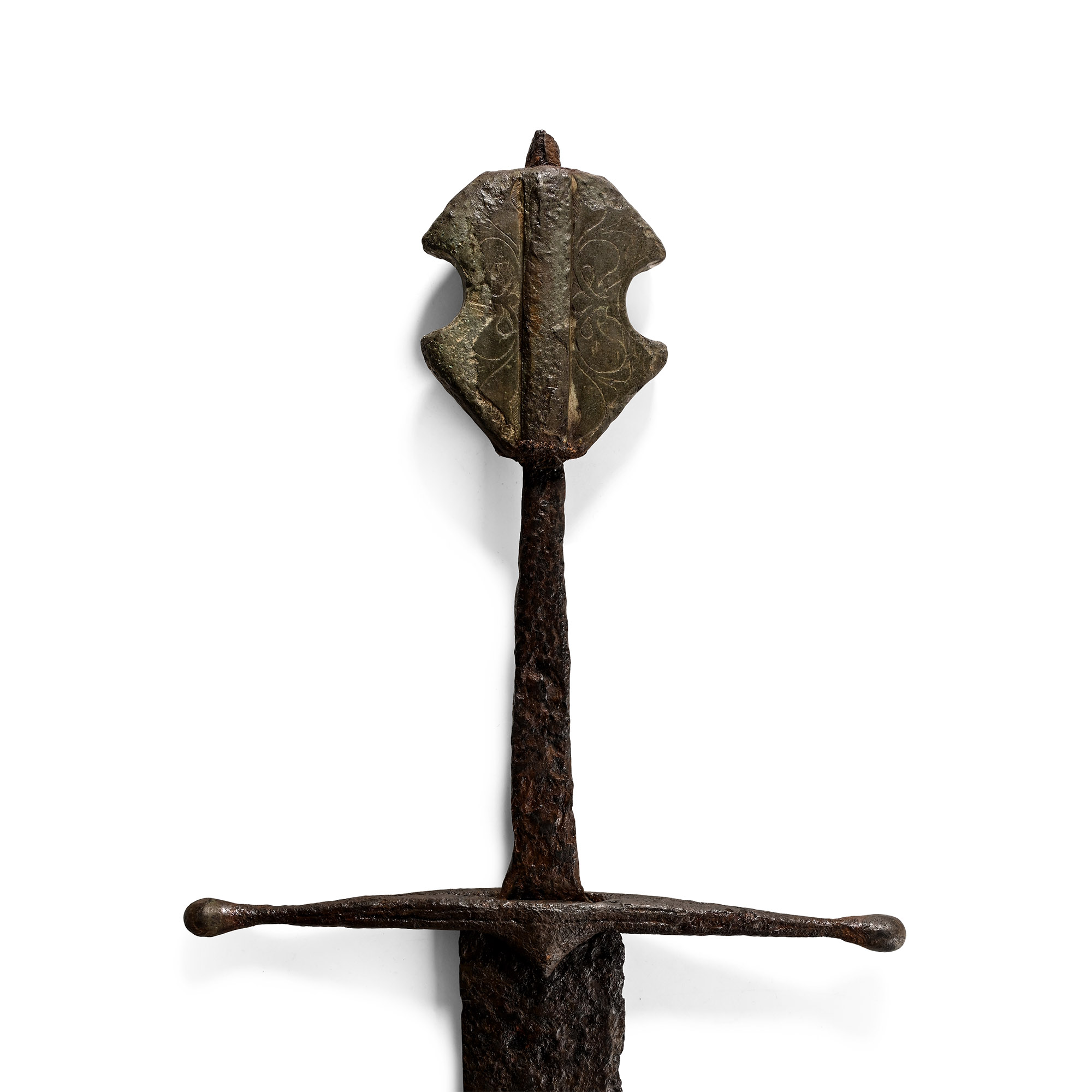
Medieval Iron Single-Handed Sword with Decorated Bronze Pommel
14TH-15TH CENTURY A.D.
41 3/8 in. (1.07 kg, 105 cm).
Longsword of Oakeshott's Type XVa, cross style 1, with two-edged lenticular-section piled blade with taper overall to a narrow point; quillons round in section with taper to ends and bronze lobe finials, median locket to lower edge; flat-section tang tapering to the upper end; the pommel a variant of Oakshott's Type V with median vertical band to each face, piriform block with lateral scoops.
ProvenanceFrom the private family collection of a lady, UK; acquired in Germany, mid-20th century.
Accompanied by an academic report by Dr Raffaele D’Amato.
This lot has been checked against the Interpol Database of stolen works of art and is accompanied by search certificate number no.13301-257660.
Cf. Oakeshott, R.E., The Archaeology of the weapons, London,1960; Oakeshott, E., The sword in the Age of the Chivalry, Woodbridge, 1964 (1994); Oakeshott, E., Records of the Medieval Sword, Woodbridge, 1991; Oakeshott, E., Sword in hand, London, 2001 (2007).
FootnotesThe Type XVa of Oakeshott has a blade similar to the Type XV, being generally more slender than its parent type, and having a grip which is much longer, ranging from seven to nine inches long or more. This style of sword appears to have been popular in the 14th century, based on surviving examples. Interesting is here the style of the quillons, which are rare: in style 11 the guard may be long or short, curved or straight, but always characterised by knobbed ends and a circular or rhomboidal in section. A sword found in the River Ouse in Surrey shows a similar blade, with a flat oval diamond section, and the outline is such that the sword could be regarded as of type XV, although many swords of type XVII are of the same shape and proportions.
CONDITIONTimeLine Auctions follows a vetting process to ensure the authenticity and legality of all items, reinforcing our commitment to integrity and responsible trading. Each antiquity, antique, and coin lot undergoes thorough examination by a vetting committee of at least ten external specialists, professional trade association members, scientists, and archaeologists: Our Vetting Process
AUCTIONS:
TimeLine is a leading auction house specialising in antiquities, ancient art, collectables, natural history, coins, medals, and books. Our auctions offer museums, collectors, historians, and enthusiasts the opportunity to acquire unique and historically significant pieces.
LOT 0255
Medieval Iron Single-Handed Sword with Decorated Bronze Pommel
Sold for (Inc. bp): £3,510
-
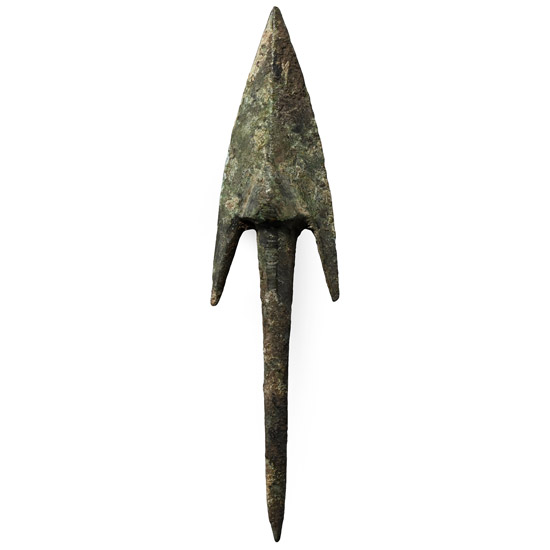
Large Phoenician Bronze Arrowhead
Levant, circa 1200-1100 B.C.Sold for (Inc. bp): £111
Broad and lentoid in section with spiked tang, elongated barbs, bulb to each face at junction with the head. 16.5 grams, 75 mm
From the private collection of Mr Brian Edwards, New Malden, Surrey, UK, formed from the late 1970s-early 1980s; thence by descent. Accompanied by the original collector's data sheet(s) with reference no.A10. -
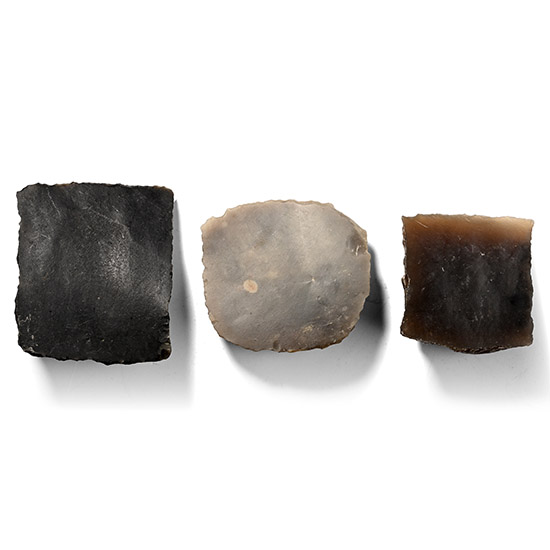
Knapped Musket Gun Flint Group
Circa 18th century A.D.Sold for (Inc. bp): £13
Comprising three gun flints, one tongue-shaped and the other two rectangular. 33.1 grams total, 29-36 mm
From the private collection of the late Mr M., a collector from Waterlooville, Hampshire, UK; late 1980s-early 1990s. -
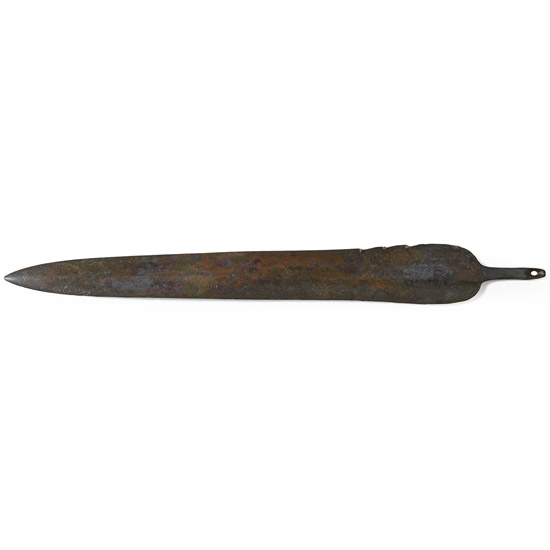
Western Asiatic Bronze Spear Blade
2nd-1st millennium B.C.Sold for (Inc. bp): £208
Comprising a tapering leaf-shaped blade with a raised midrib and a short tapering tang. 245 grams, 35 cm
Ex Abelita family collection, 1980s-2000s.
