
Loading, please wait...
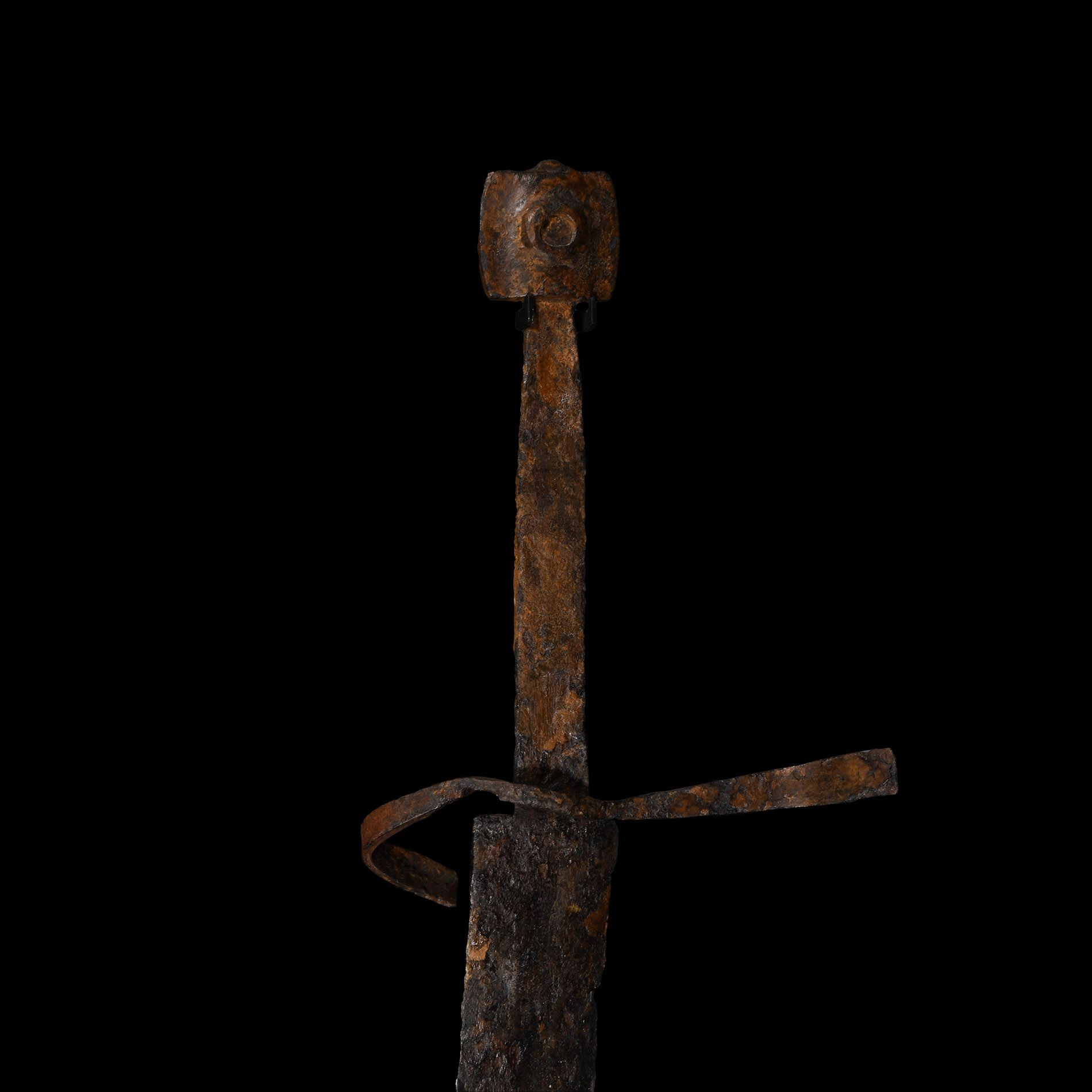
LOT 1092
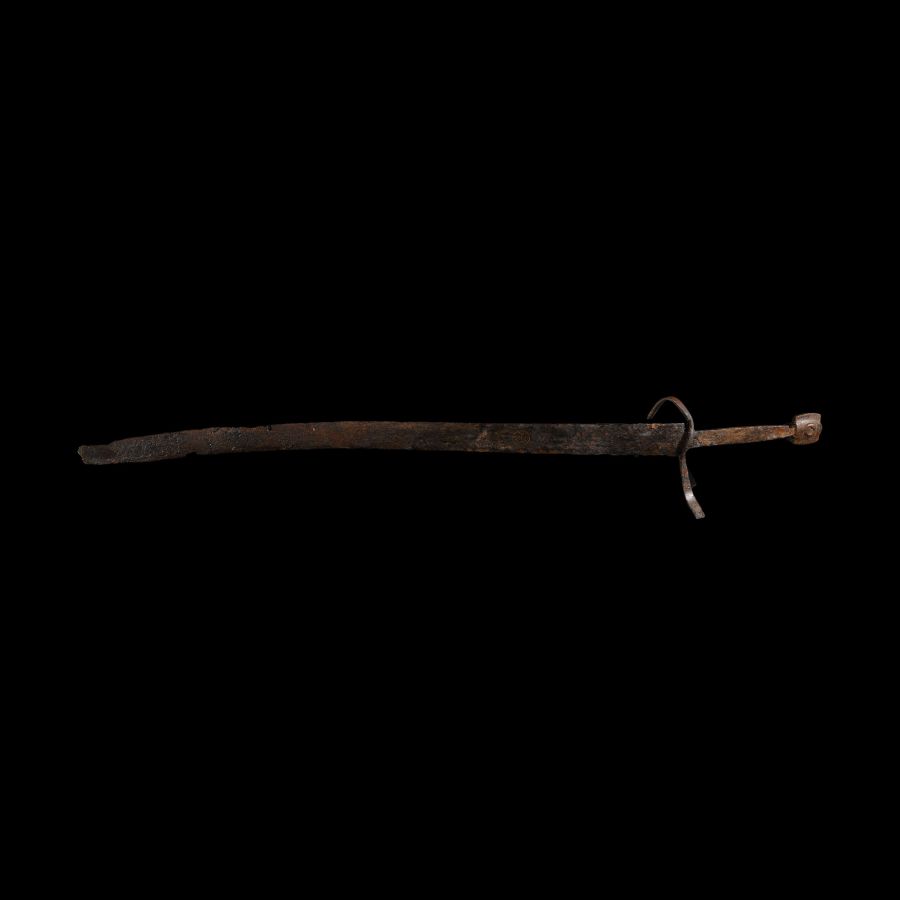
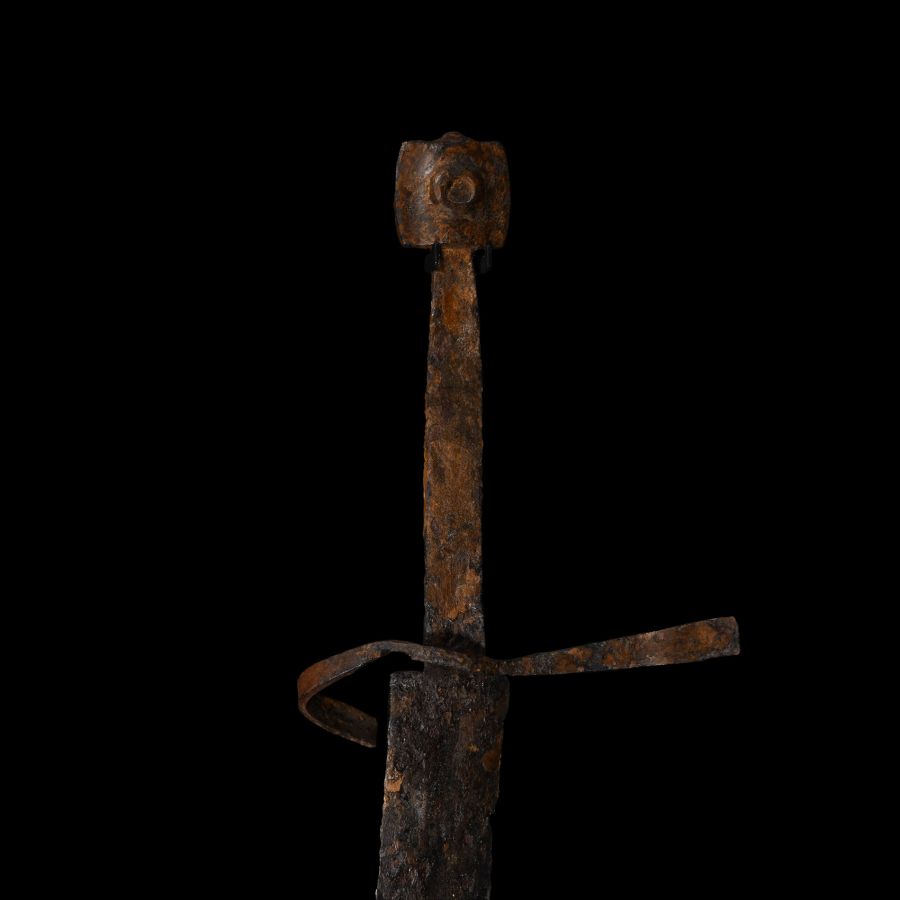
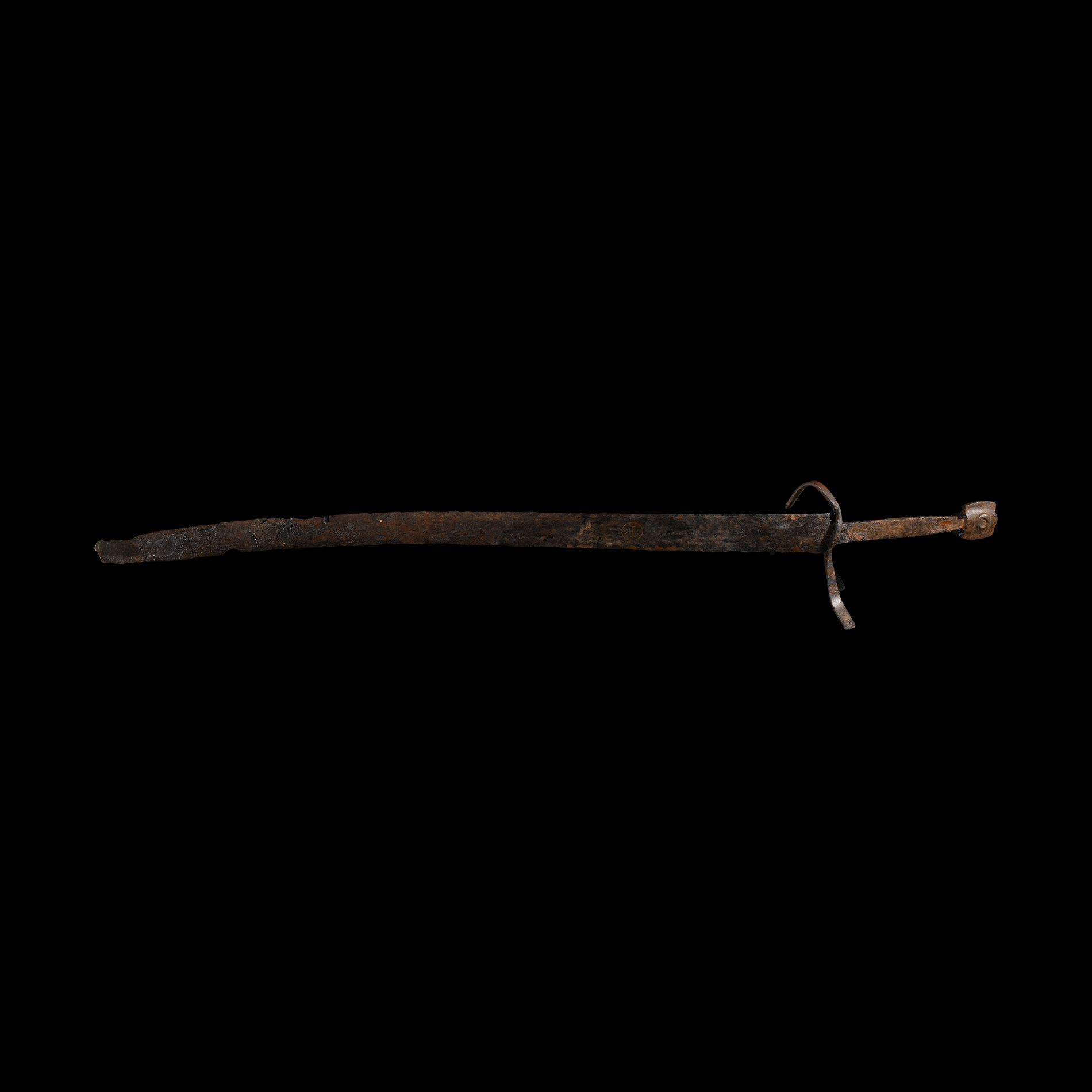
Medieval Iron Schiavonesca Type Sword with Latten Inlaid Crosses
CIRCA 15TH CENTURY A.D.
43 1/4 in. (1.7 kg total, 1.11 m).
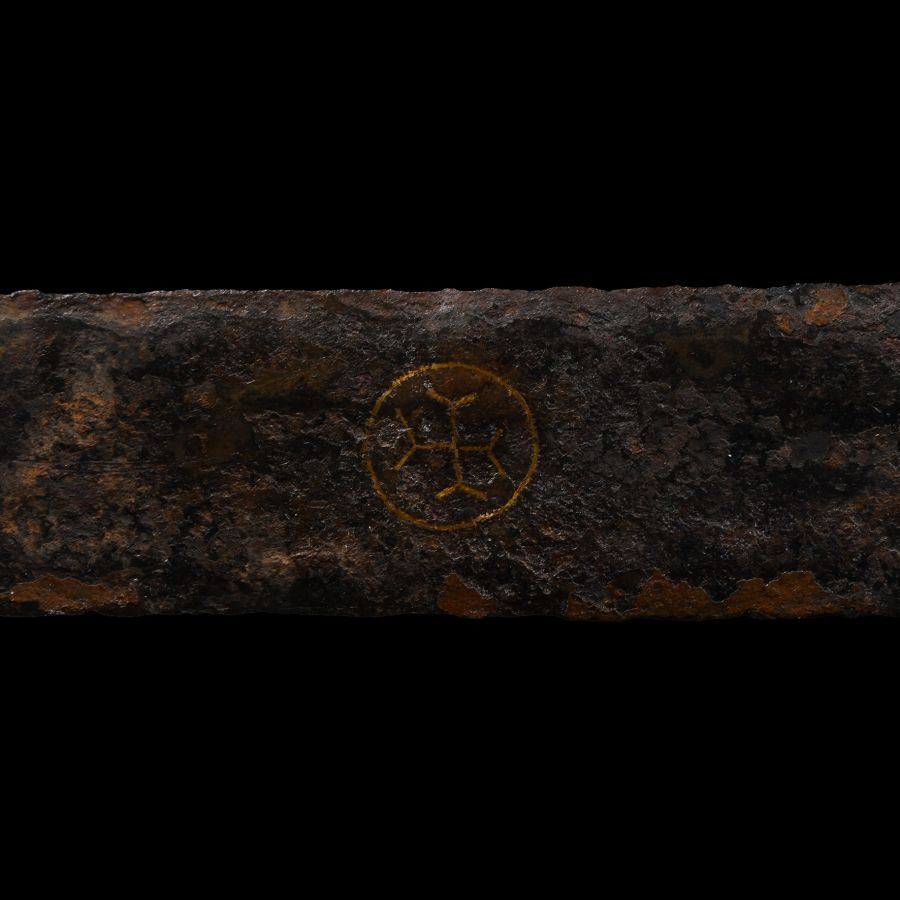
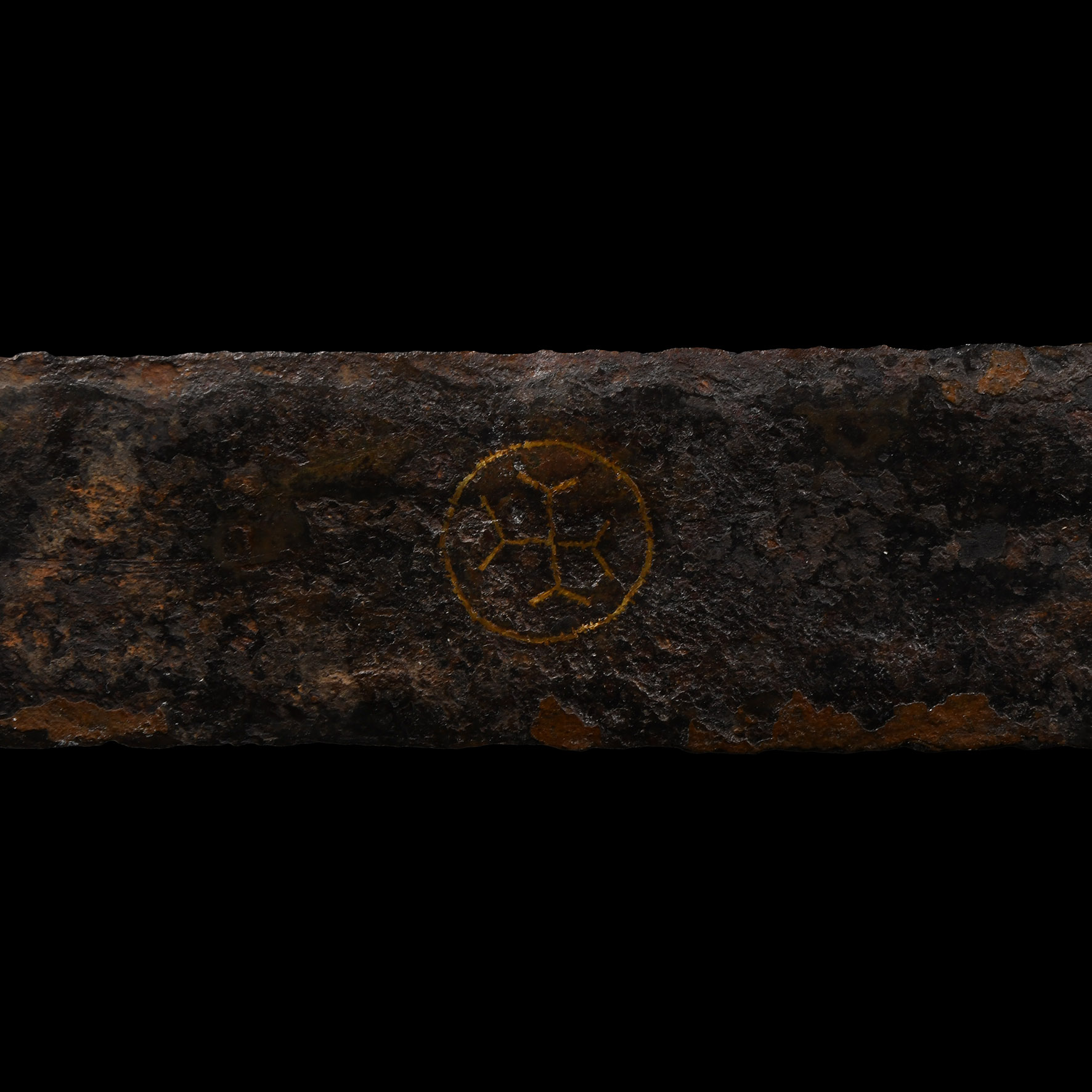
Comprising a broad double-edged parallel-sided blade, flat-section at the upper third with a very shallow central fuller, elliptical-section at the lower end; flat guard with scooped lower edge, D-section arms horizontally S-curved; 'cat's head' type pommel, rectangular with scrolled upper edge and integral central boss to both faces; on the upper part of the blade an engraved three-armed workshop mark and two possibly later added brass inlaid marks including a cross fourchee inside and the image of a sword to one side; mounted on a wall display mount.
ProvenancePrivate collection, Munich, Germany, 1970s.
Private collection, London, UK, 2014, acquired from the above.
See Aleksić, M., Mediaeval Swords from Southeastern Europe, material from 12th to 15th century AD, Beograd, 2007, especially cat. nos.273, pl.17, 2-3-4; similar swords at the armoury of the Ducal Palace in Venice, see Franzoi, U., L’Armeria del Palazzo Ducale a Venezia, Treviso, 1990, fig.41f., and in National Hungarian Museum, Budapest (inv. nr. 53.310, see Aleksić, 2007, cat.124).
FootnotesThe Schiavonesca sword was used by Dalmatian mercenaries serving in the Venetian state armies, and produced by the workshops of the Serenissima to which the marks probably belong. Many of these swords were produced in Dubrovnik, a Croatian city under Venetian rule. Oakeshott classified all the pommels of square shape in his Type Z. Certain morphological differences between them were individuated by Dr Aleksić as a criteria for distinguishing the distinct subtypes, in this case the type Z3 for the upper crenelleted edge. The cross-guards of type 12b, like in this case, have symmetrically and horizontally sharply bent arms in the opposite directions. The 'cat's head' pommel is also found on surviving examples of cross-hilted swords of the 14th century which can be traced into the hands of Slavonic soldiers stationed in southern Europe, employed in the European armies of this period. The independent representation of the cross fourchee usually inscribed in a circle is rather frequent on the swords with type 12 cross guards and type Z pommels from Hungary, Northern Balkans and the neighbouring regions (Aleksić, 2007, p.122).
CONDITIONTimeLine Auctions follows a vetting process to ensure the authenticity and legality of all items, reinforcing our commitment to integrity and responsible trading. Each antiquity, antique, and coin lot undergoes thorough examination by a vetting committee of at least ten external specialists, professional trade association members, scientists, and archaeologists: Our Vetting Process
AUCTIONS:
TimeLine is a leading auction house specialising in antiquities, ancient art, collectables, natural history, coins, medals, and books. Our auctions offer museums, collectors, historians, and enthusiasts the opportunity to acquire unique and historically significant pieces.
LOT 1092
Medieval Iron Schiavonesca Type Sword with Latten Inlaid Crosses
Estimate £500 - 700€580 - 810 (for guidance only)$680 - 950 (for guidance only)
-
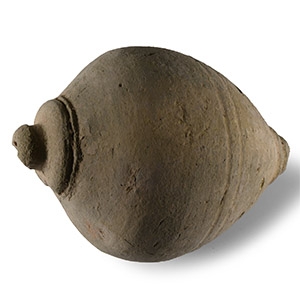
Byzantine 'Greek Fire' Ceramic Fire Bomb or Hand Grenade
Circa 11th-14th century A.D.Sold for (Inc. bp): £144
With a piriform body and domed mouth with two indented lines decorating the mid section; intended to be filled with explosive liquid and wick, used as a hand grenade. 964 grams, 15.5 cm high
Acquired 1980-2015. Ex Abelita family collection. Accompanied by an academic paper by military specialist Dr Raffaele D'Amato, dated 15 July 2019 and titled 'Eastern Roman Empire - Greek Fire Bomb or Hand Grenade (μεσαίον kακάβιον) 9th-11th century AD'.
Apart from the use of siphons or manual flame-throwers called cheirosiphona, special Roman soldiers employed terracotta grenades, in the form of small jars, abundantly evidenced in archaeological excavations. Such were the γανωτα, vessels (sometimes also in bronze) used for Greek fire. They were called μεσαία kακαβιά or κυτροκακάβια where the former had a bulbous shape and the latter a more cylindrical form. -
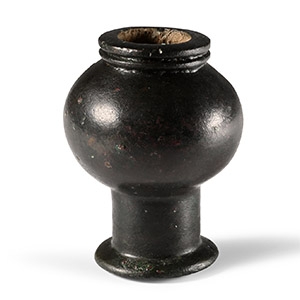
Luristan Sar-e Gorz Luristan Bronze Macehead
14th-13th century B.C.Estimate: £200 - 300 (+bp*)
Opening Bid: £111
With plain globular body, extended to a small raised ring encircling the top of the mace-head, circular short shaft expanding to a circular flat base. 279 grams, 70 mm high
Acquired 1980-2015. Ex Abelita family collection.
Caucasian stone and bronze maces were distinguished by modestly finished, clean processed and predominantly close-to-ball shapes (with a variety of surface finishing, ranging from the smooth, ribbed, lobular forms to the rounded with protrusions and spikes), and the Western Iranian maces, especially the Luristan ones, notable for the variety of different forms. Similar mace-heads, probably realised in Luristan, decorated the head of the sceptres of Assyrian kings like Tukulti-Ninurta I (1243-1207 B.C.). -
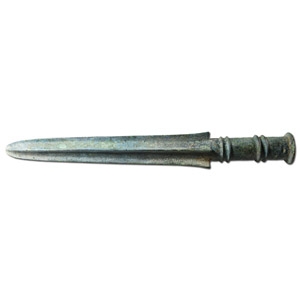
Chinese Bronze Military Flag or Banner Finial
Circa 5th-3rd century B.C. or laterSold for (Inc. bp): £468
Composed of a socketted blade divided into six sections with sharp grooves, the shaft with four circumferential bands. 873 grams, 34 cm
Ex old English collection. London art market, pre 2000. Property of a London, UK, gentleman.
The Chinese, having adopted the use of chariot from the west, judging by the monuments and literature used it primarily for archery combat, as evidenced by the absence of spearheads in chariot burials of the Yin Kingdom. But already from the early Zhou Dynasty chariot warriors used a spear. Massive Yin spears were the weapon of dense infantry formations. The shape of our specimen, probably used as standard finial, recalls that of a spear from Zhongzhoulu, Luoyang, Prov. Henan, dated at the 5th-4th centuries B.C., and of two spears from the Zheng fortress of Xinzheng Country, dated to the 4th-3rd century B.C.
