
Loading, please wait...
_900x900.jpg "Medieval Iron Kidney Dagger")
_200x200.jpg "Medieval Iron Kidney Dagger")
.jpg "Medieval Iron Kidney Dagger")
LOT 1097
Medieval Iron Kidney Dagger
LATE 15TH CENTURY A.D.
18 1/8 in. (307 grams, 46 cm).
Featuring a wedge-shaped blade and a lobed handle; the hilt fitted with an iron plate bending down to form points on each side of the blade, pommel with a discoid brass plate decorated with an incised flower motif.
ProvenanceAcquired 1960s-1990s.
Late Alison Barker collection, a retired London barrister.
Cf. Tarassuk, L. & Blair, C., Complete Encyclopaedia of Arms & Weapons, London, 1982, p.156, item 5, for a late 15th century version of the type.
FootnotesThe term 'ballock dagger' was used in medieval times to describe a dagger with a grip bearing a considerable resemblance to a phallic symbol. It was also called 'kidney dagger' during the Victorian times. The constant characteristic is the presence of two roundish and symmetrical bulbs at the guard, with the grip itself emerging upward between them and flaring slightly towards the top, sometimes being surmounted by a cap.
CONDITIONTimeLine Auctions follows a vetting process to ensure the authenticity and legality of all items, reinforcing our commitment to integrity and responsible trading. Each antiquity, antique, and coin lot undergoes thorough examination by a vetting committee of at least ten external specialists, professional trade association members, scientists, and archaeologists: Our Vetting Process
AUCTIONS:
TimeLine is a leading auction house specialising in antiquities, ancient art, collectables, natural history, coins, medals, and books. Our auctions offer museums, collectors, historians, and enthusiasts the opportunity to acquire unique and historically significant pieces.
-
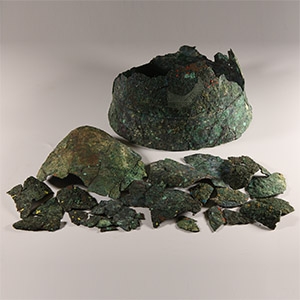
Greek Fragmentary Bronze Pilos Helmet
5th-4th century B.C.Sold for (Inc. bp): £2,015
Conical in shape, comprising a thick hammered bowl and broad rim with carination to the upper edge; remains of crest at brow and rear; a restoration project. 951 grams total, 1-24.5 cm
Ex Axel Guttmann Collection of Ancient Arms and Armour, Germany [1944-2001]. with Hermann Historica, 13 October 2010, lot 2169 [Part].
This type of helmet (called ‘bell-helmet’ by Connolly, 1981, p.70), named pilos after the Greek felt cap (in the Laconian shape, but distinguished from the cap by the noticeable point and the shape of the rim), had a conical shape and was pointed or rounded at the top. Its introduction was linked with the streamlining of Hoplite equipment, and it soon the replaced the closed Corinthian helmet. The helmet was widespread in the Greek and Mediterranean world from the last quarter of the 5th century B.C. and was widely used by continental Greeks, South Italian Greeks and Italic people, Etruscans, and even Romans. -
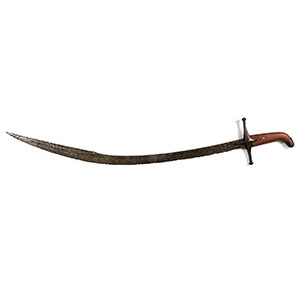
Polish Iron Sabre
17th century A.D.Sold for (Inc. bp): £2,470
Single-edged cutting blade, comprising a cross-shaped hand guard, the blade with a wide curvature widening towards the point, three grooves on the blunt side; later replaced wooden handle with Persian pommel and cross guard. 709 grams, 89.5 cm
Ex private collection of Mr M.B., Mainz, Germany, since the 1980s. Acquired from the above, 2004. This lot has been checked against the Interpol Database of stolen works of art and is accompanied by search certificate number no.11940-210918.
This sabre blade belongs to no. IIa of Zablocki's classification with a blade of variable curvature and double-edged pronounced yelmen. These sabres were used in the 17th and in the first half of 18th century A.D. -
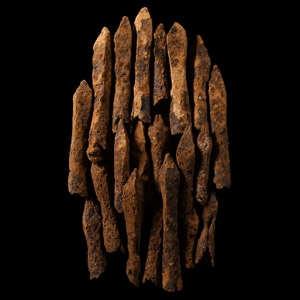
Medieval Iron Crossbow Bolt Group
Circa 12th-15th century A.D.Sold for (Inc. bp): £143
Mainly comprising socketted bolts with tapering a facetted square-section tips. 798 grams total, 5.7-10 cm
Acquired 1990s-early 2000s. East Anglian private collection.
