
Loading, please wait...
LOT 0266
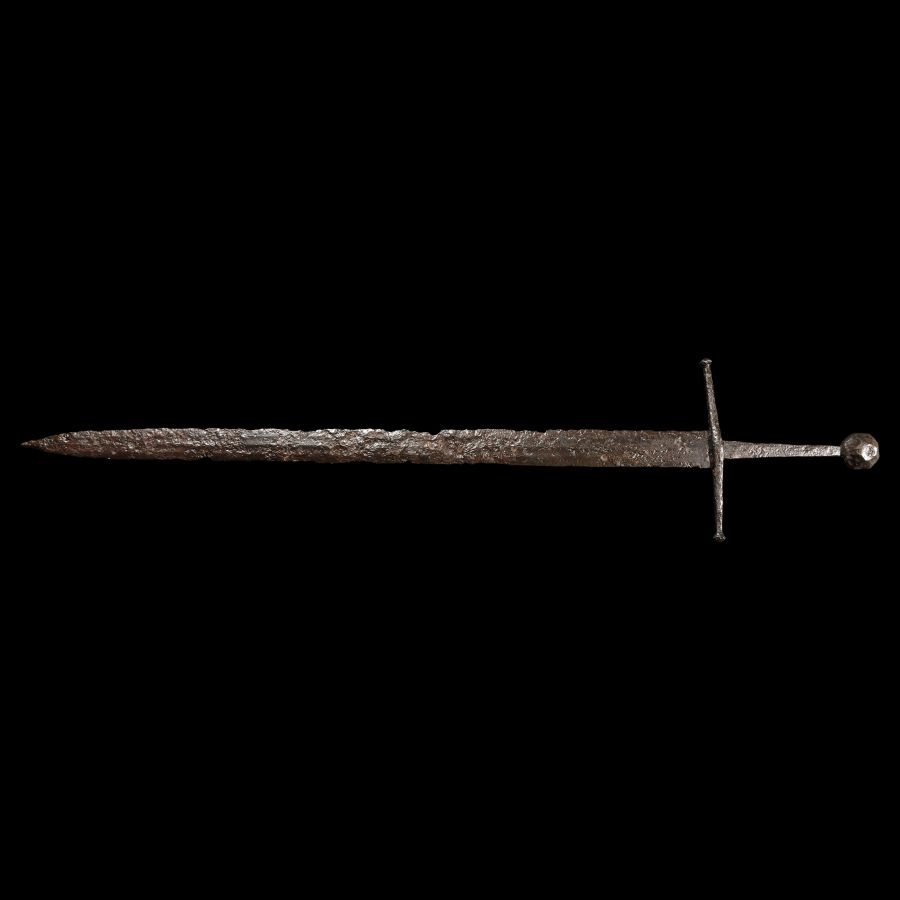
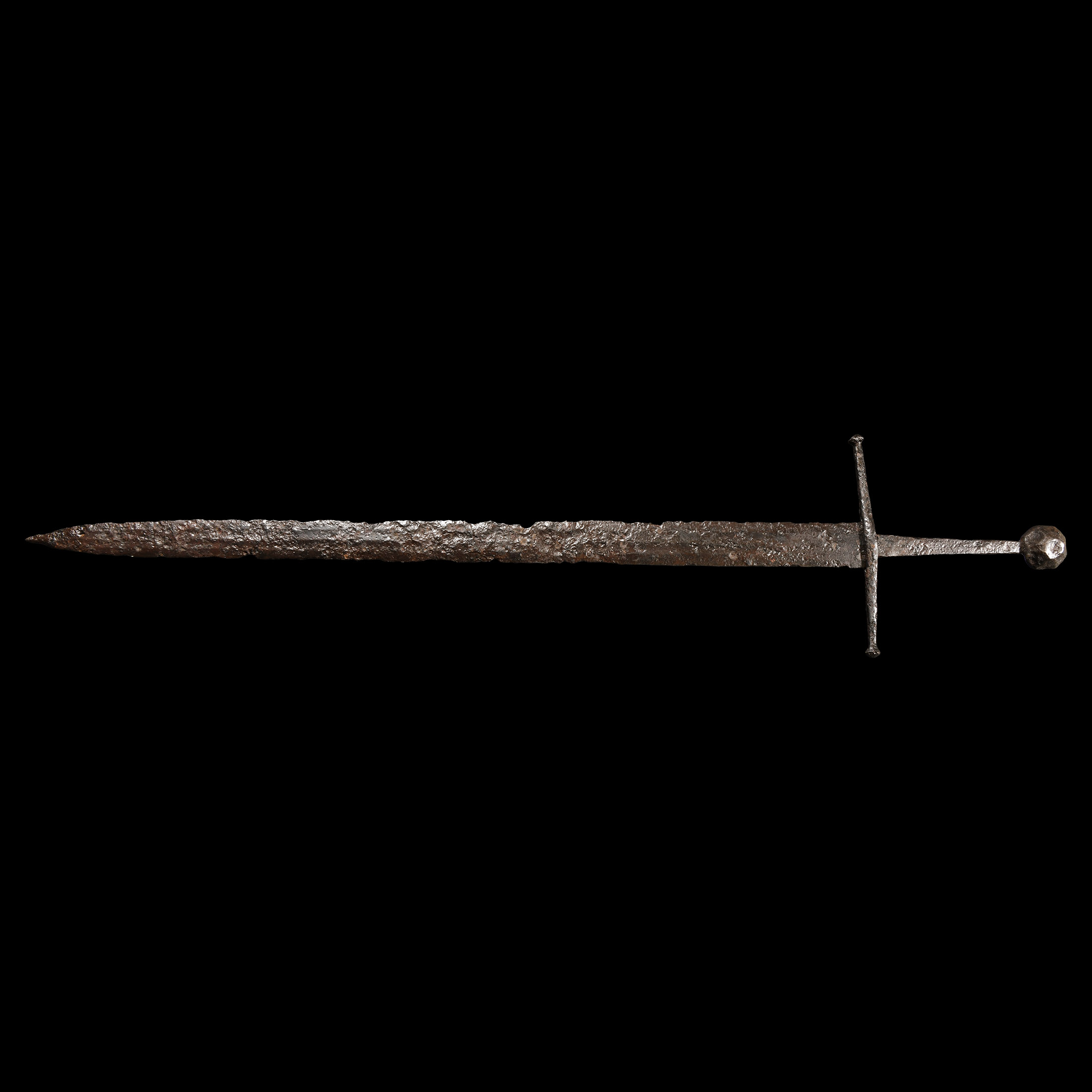
Medieval Iron Hand and Half Sword with Polyhedral Pommel
LATE 14TH-EARLY 15TH CENTURY A.D.
39 3/8 in. (1.26 kg, 1 m).
Of Oakeshott's Type XVIIIa or b, cross style 11, pommel style I1; strongly tapering pointed blade with straight edges and evident battle nicks; straight cross guard, long grip and an octagonal pommel. [No Reserve]
ProvenanceFrom the private collection of a London gentleman, from his grandfather's collection formed before the early 1970s.
LiteratureSee Oakeshott, R.E., The Archaeology of the weapons, London, 1960; Oakeshott, E., The sword in the Age of the Chivalry, Woodbridge, 1964 (1994); Oakeshott, E., Records of the Medieval Sword, Woodbridge, 1991; Oakeshott, E., Sword in hand, London, 2001 (2007); similar specimen in Oakeshott, 1991, p.187, sword formerly in the collection D’Acre Edwards, now on loan to the Royal Armouries (pommel T.5, facetted and cross-style of type 4).
FootnotesThis magnificent example was well-suited to a cut-and-thrust style of fighting, a logical development of the Oakeshott XVI typology. This is mainly visible in the specimens of typology XVIIIb, typical of English effigies and brasses between 1370-1425. Because the previous types of swords were practically useless against the fully armoured man-at-arms, Western European warfare needed a sword capable of piercing the weak points of the enemy's protective equipment, leading to the development of types XV, XVI and XVII, and eventually of type XVIII. The subtypes XVIIIa and b had a longer blade, and type XVIIIb was a very long-gripped bastard sword. This word (often referred to as ‘hand-and-a-half sword’) was applied through the late Middle Ages to the long-gripped weapons. Marc de Vulson, writing on the occasion of a duel fought in 1549 before Henry II of France, stated 'Deux epées bâtardes, pouvant servir à une main ou à deux' (two bastard swords able to serve with one hand or with two).
CONDITIONTimeLine Auctions follows a vetting process to ensure the authenticity and legality of all items, reinforcing our commitment to integrity and responsible trading. Each antiquity, antique, and coin lot undergoes thorough examination by a vetting committee of at least ten external specialists, professional trade association members, scientists, and archaeologists: Our Vetting Process
AUCTIONS:
TimeLine is a leading auction house specialising in antiquities, ancient art, collectables, natural history, coins, medals, and books. Our auctions offer museums, collectors, historians, and enthusiasts the opportunity to acquire unique and historically significant pieces.
LOT 0266
Medieval Iron Hand and Half Sword with Polyhedral Pommel
Sold for (Inc. bp): £2,860
-
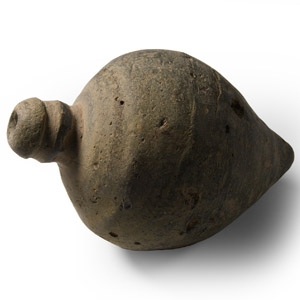
Byzantine 'Greek Fire' Ceramic Fire Bomb or Hand Grenade
9th-11th century A.D.Sold for (Inc. bp): £156
Piriform body with domed filler-hole, raised vertical flanges to the shoulder; intended to be filled with explosive liquid and wick, used as a hand grenade. 500 grams, 12 cm
Acquired 1980-2015. Ex Abelita family collection. Accompanied by an academic paper by military specialist Dr Raffaele D'Amato, dated 15 July 2019 and titled 'Eastern Roman Empire - Greek Fire Bomb or Hand Grenade (μεσαίον kακάβιον) 9th-11th century AD'.
Apart from the use of siphons or manual flame-throwers called cheirosiphona, special corps of Roman soldiers employed terracotta grenades, in the form of small jars, abundantly evidenced in archaeological excavations. Such were the γανωτα, vessels (sometimes also of bronze) used for Greek fire. They were called μεσαία kακαβιά or κυτροκακάβια where the former had a bulbous shape and the latter a more cylindrical form. -
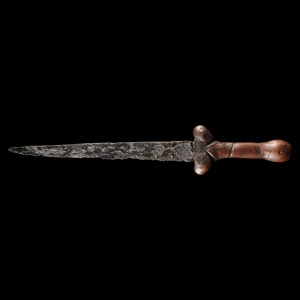
Medieval 'Thames' Iron Kidney Dagger
14th-15th century A.D.Sold for (Inc. bp): £260
The tapering blade with a single cutting edge; replica wooden handle with bulbous guard and pommel. 94 grams, 29.2 cm
Found on the Thames foreshore at Vintry, Southwark, London, UK. -
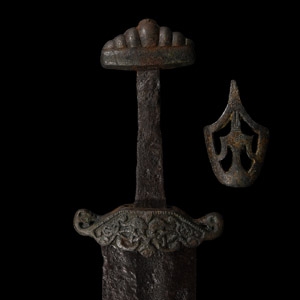
Viking Iron Sword with Cross Guard Surmounted by Interlaced Dragons
9th-11th century A.D.Sold for (Inc. bp): £8,450
Comprising a double-edged cutting blade with tapering fullers and hefty tang; the bronze cross guard in Jellinge style with dragon head finials and a central human face to the lower edge; the pommel with seven lobes; accompanied by a bronze openwork chape with central bird motif decorated with stamped ring-and-dot design. 900 grams, 89.5 cm
From the private collection of a London gentleman, from his grandfather's collection formed before the early 1970s. Accompanied by an academic report by Dr Raffaele D’Amato. This lot has been checked against the Interpol Database of stolen works of art and is accompanied by search certificate number no.11821-206859.
The blade of the sword is very similar to Petersen Type K; the hilt is a typical Type K, but having seven rather than five lobes to the pommel. The chape, the parallels of which are mostly of late 10th and early 11th centuries, is probably a later addition, possibly reworked to be fitted to the sword.
