
Loading, please wait...
LOT 1855
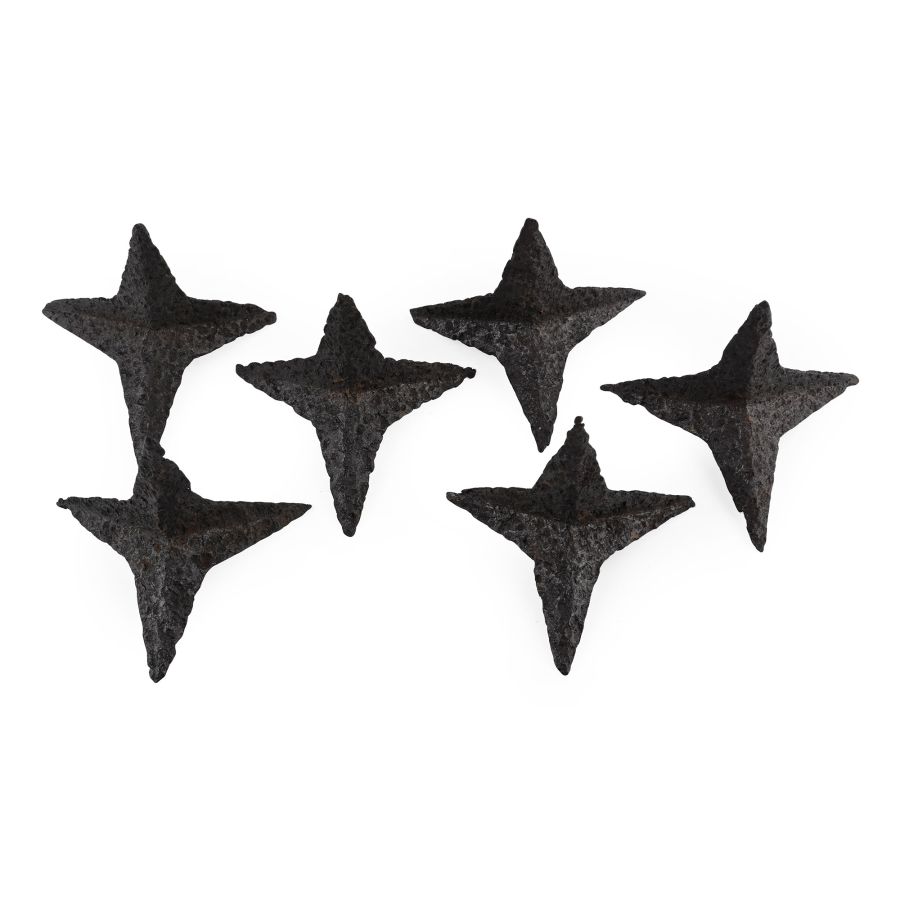
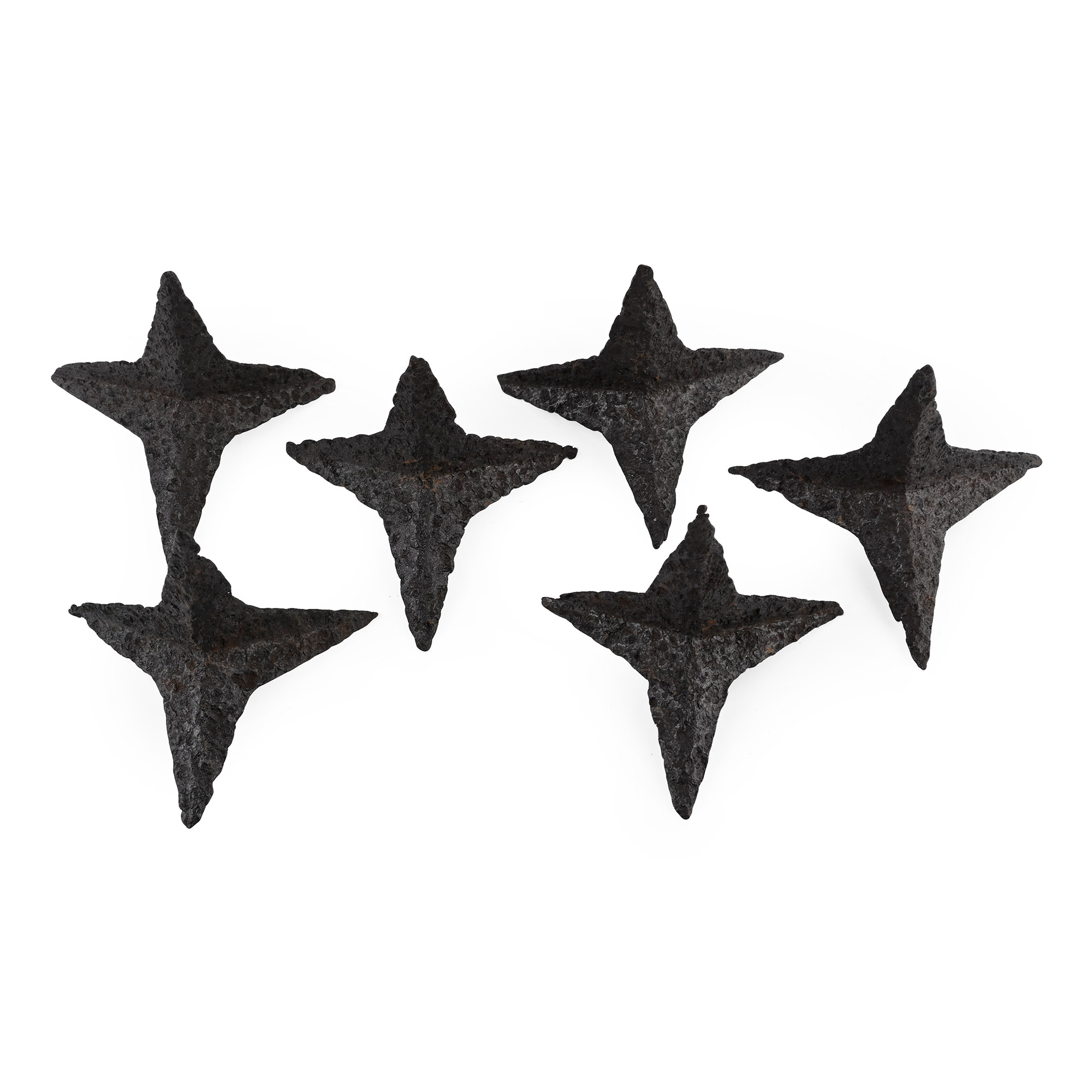
Medieval Iron Caltrop Anti-Cavalry Group
15TH CENTURY A.D.
3 3/8 - 3 1/2 in. (195 grams total, 85-87 mm).
Comprising six caltrops, hand-forged with square-section spikes. [6, No Reserve]
ProvenanceFrom the private collection of a London gentleman, from his grandfather's collection formed before the early 1970s.
LiteratureCf. Trapp, Graf, O., & Scalini, M., L'Armeria Trapp di Castel Coira-The Armoury of the Castle of Chuburg-Die Churburger Rustkammer, Fagnana, 1995-1996, p. 297 (vol. 1), for similar medieval German caltrops; Žákovský, P., ‘Caltrop. Contribution to the knowledge of one neglected weapon’ in Studia Minora Facultatis Philosophicae Universitatis Brunensis, M 12-13, 2007-2008, pp.115-132, fig.9, no.1 (type IIIa of Žákovský classification).
FootnotesP. Žákovský has been able to classify medieval caltrops, mainly from the 13th to 15th centuries A.D., based on their morphology, into four main typologies, each with different variants. Caltrops with single-pointed spikes, whose interpretation, however, is often ambiguous, belong to type I. The other three types represent classic four-pointed caltrops, and individual types in this group differ from one another just in their cross-section.
CONDITIONTimeLine Auctions follows a vetting process to ensure the authenticity and legality of all items, reinforcing our commitment to integrity and responsible trading. Each antiquity, antique, and coin lot undergoes thorough examination by a vetting committee of at least ten external specialists, professional trade association members, scientists, and archaeologists: Our Vetting Process
AUCTIONS:
TimeLine is a leading auction house specialising in antiquities, ancient art, collectables, natural history, coins, medals, and books. Our auctions offer museums, collectors, historians, and enthusiasts the opportunity to acquire unique and historically significant pieces.
-
.jpg)
Urartian Bronze Helmet with Embossed Decoration
9th-7th century B.C.Sold for (Inc. bp): £6,500
A Caucasian or Urartian helmet of domed profile, hammered from a single sheet of metal; radiating rows of small repoussé bosses with interstitial rows connecting larger examples; shallow recess at the forward edge; old accession label to inner face 'AG334'; later pseudo-inscription; some restoration. 1.5 kg total, 41 cm including stand
Ex Axel Guttmann Collection of Ancient Arms and Armour, Germany [1944-2001], AG 334, 1990. with Hermann Historica, Munich, Germany, 2008. Private collection, New York, USA. Accompanied by an academic report by Dr Raffaele D’Amato. This lot has been checked against the Interpol Database of stolen works of art and is accompanied by search certificate number no.13262-254403.
The Urartian craftsmen were especially famous for their metalworking skills. However, the shape of this helmet differs considerably from the usual pointed Urartian examples, and shows a strong influence from the Scythian and Moeotic military headgear, which is not surprising if we consider that Urartu had been at war with the Scythian tribes of Caucasus since the 7th century B.C. The remainder of the helmet is its bowl, embossed and decorated, and an unusual recess on the front part. The helmet was used with a padded cap, which probably formed an integral part of the same headgear. -
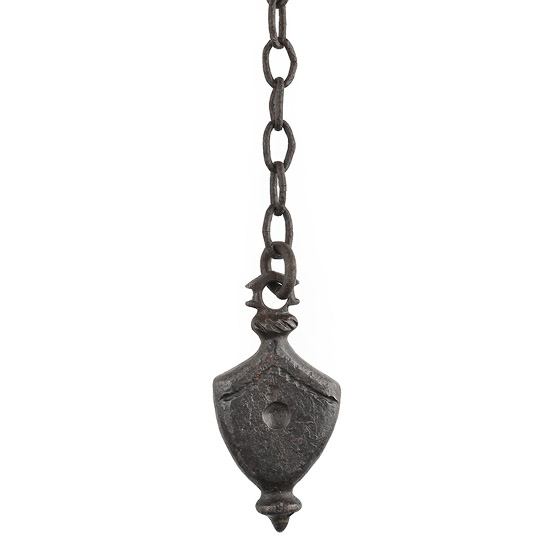
Medieval Socketted Iron Tournament Flail
Circa 15th century A.D.Sold for (Inc. bp): £676
Comprising: tubular socket with segmented lower ends pieced to accept attachment pins, decorative ring above; short length of chain with butted iron links; heater shield-shaped striker with knop finial and torque to the neck, punched design of a chevron and central pellet; one face with possible maker's mark above the pellet. 364 grams, 52.1 cm
Ex North American private collection, 1970s-1990s. -
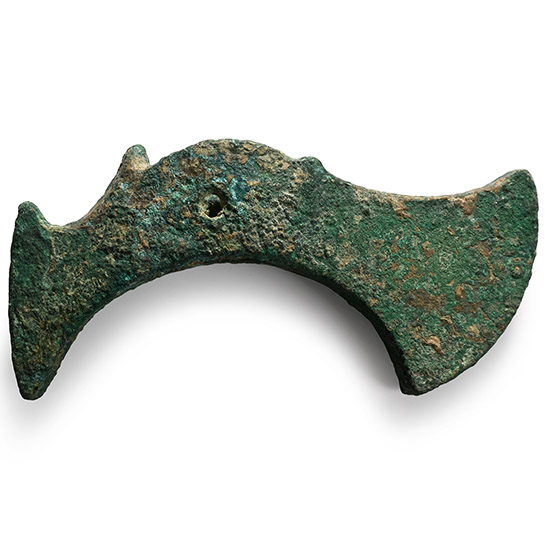
Bactrian Bronze Axehead
3rd-2nd millennium B.C.Estimate: £300 - 400 (‡+bp*)
Opening Bid: £150
With curved flaring cutting edge, characteristic curving shape and narrow socket, blade end squaring off, shaft hole pierced on both sides. 227 grams, 10.6 cm
Acquired in the mid 1980s-1990s. Private collection, Switzerland, thence by descent. Private collection, since the late 1990s.
These collared axes have the specific feature of being equipped with variously shaped rear extensions. The provenance of this typology is clearer than others: these axes came from Margiana and southern Bactria. Gonur Depe and Susa yielded a rather atypical and probably imported example. P. Amiet suggests that they were an adoption of Elamite material, from conceptual and institutional models. They would have developed from the end of the 3rd and the beginning of the 2nd millennium B.C.
