
Loading, please wait...
LOT 1539
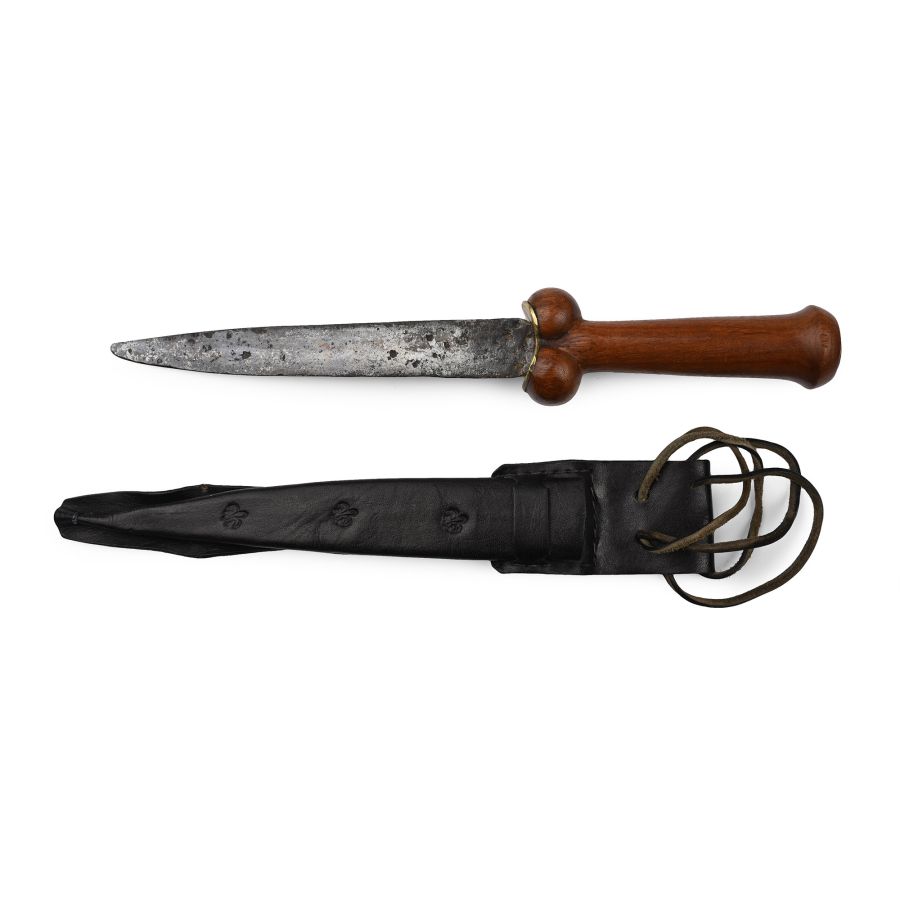
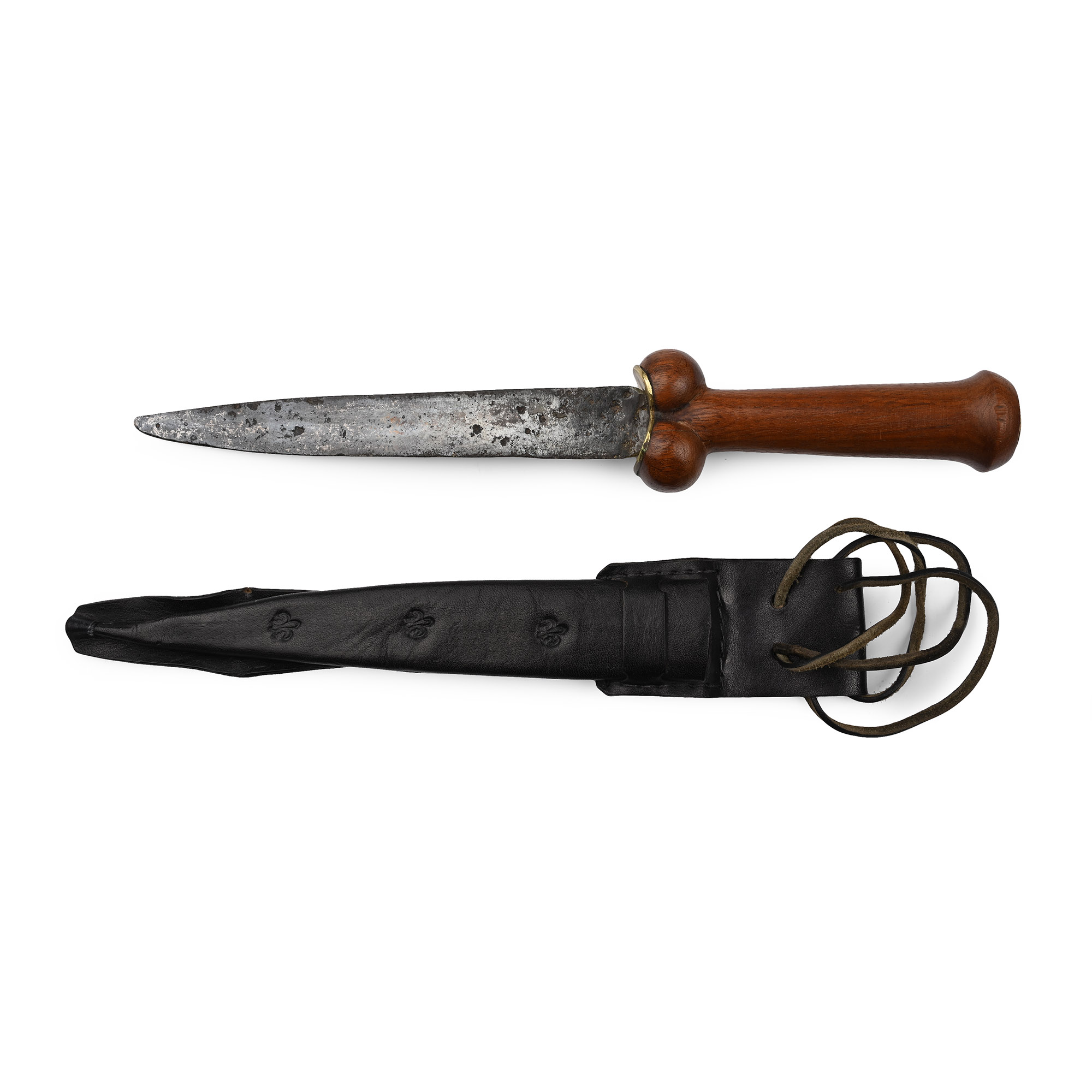
Medieval Iron Ballock Dagger with Reproduction Hilt and Sheath
15TH CENTURY A.D. AND LATER
14 3/8 in. (222 grams, 36.5 cm).
The tapering blade with a single cutting edge; modern replica leather scabbard decorated with 'fleur de lys' and wooden handle with bulbous guard and pommel. [No Reserve]
ProvenanceFrom the collection of the famous author, writer and speaker, Gordon Bailey, Essex, UK; formed since 1968.
From the private collection of a Kent, UK, gentleman.
This lot is accompanied by an illustrated lot declaration signed by the Head of the Antiquities Department, Dr Raffaele D'Amato.
Cf. Mills, N., Medieval Artefacts, Witham, 2003, p.95, for a similar 15th century specimen of ballock-kidney dagger with a bone handle.
FootnotesThe term 'ballock dagger' was used in medieval times to describe a dagger with a grip bearing a considerable resemblance to a phallic symbol. It was also called 'kidney dagger' during the Victorian times. The constant characteristic is the presence of two roundish and symmetrical bulbs at the guard, with the grip itself emerging upward between them and flaring slightly towards the top, sometimes being surmounted by a cap.
CONDITIONTimeLine Auctions follows a vetting process to ensure the authenticity and legality of all items, reinforcing our commitment to integrity and responsible trading. Each antiquity, antique, and coin lot undergoes thorough examination by a vetting committee of at least ten external specialists, professional trade association members, scientists, and archaeologists: Our Vetting Process
AUCTIONS:
TimeLine is a leading auction house specialising in antiquities, ancient art, collectables, natural history, coins, medals, and books. Our auctions offer museums, collectors, historians, and enthusiasts the opportunity to acquire unique and historically significant pieces.
LOT 1539
Medieval Iron Ballock Dagger with Reproduction Hilt and Sheath
Sold for (Inc. bp): £247
-
.jpg)
Luristan Bronze Blade Group
14th-10th century B.C.Sold for (Inc. bp): £143
Tanged spearheads with foliate blades, one with accentuated midrib and bent tang, another with squared shoulders and bent tang, the third with slender blade and narrow tang with fastening hole. 342 grams total, 18.7-27 cm
Acquired 1980-2015. Ex Abelita family collection. This lot is accompanied by an illustrated lot declaration signed by the Head of the Antiquities Department, Dr Raffaele D’Amato. This lot is accompanied by an illustrated lot declaration signed by the Head of the Antiquities Department, Dr Raffaele D'Amato.
Spearheads with large foliate blades and bent tangs were excavated in the Marlik Royal cemetery by Dr Negahban, see for example in tomb 47, Trench XXIIE. They were the evolution of a typology which began much earlier in Mesopotamia and the fertile crescent, the type 4 of the Stronach classification, with straight tang and square section, usually thickened at the base with a button tang. The foliate blade was wide and exaggerated in some specimens excavated at Marlik. -
.jpg)
Post Medieval Iron Dagger with Bronze Hilt
17th century A.D.Sold for (Inc. bp): £247
Comprising a triangular two-edged blade with median chamfer, ricasso at the rear, quillons formed as two vertical rings on short arms, wooden grip with most of the hatched mounting ring, rectangular pommel with raised panel to each face. 276 grams, 42.2 cm
Previously acquired at a UK auction in the 1990s. Acquired from an Oxfordshire antiques centre. Property of a Berkshire, UK, collector. This lot is accompanied by an illustrated lot declaration signed by the Head of the Antiquities Department, Dr Raffaele D'Amato.
Swords and daggers with a square pommel became fashionable in the early 16th century, a Central European fashion. The edges of the present weapon do not ever appear to have been sharpened, so this may have been a parade-piece. -
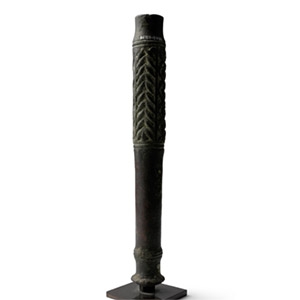
Mesopotamian 'Chrysler Museum' Bronze Macehead with Incised Decoration
Early 2nd millennium B.C.Estimate: £1,000 - 1,400 (+bp*)
Opening Bid: £500
Tubular in plan with low-relief braided panel and undulating lines; scooped profile at each end and securing collar; mounted on a custom-made stand. 647 grams total, 25.6 cm including stand
Ex Chrysler Museum of Art, Virginia, accession no.NP.68.62.M. with ArtAncient, 2010. Private collection, London, UK. This lot is accompanied by an illustrated lot declaration signed by the Head of the Antiquities Department, Dr Raffaele D'Amato.
