
Loading, please wait...
LOT 1184
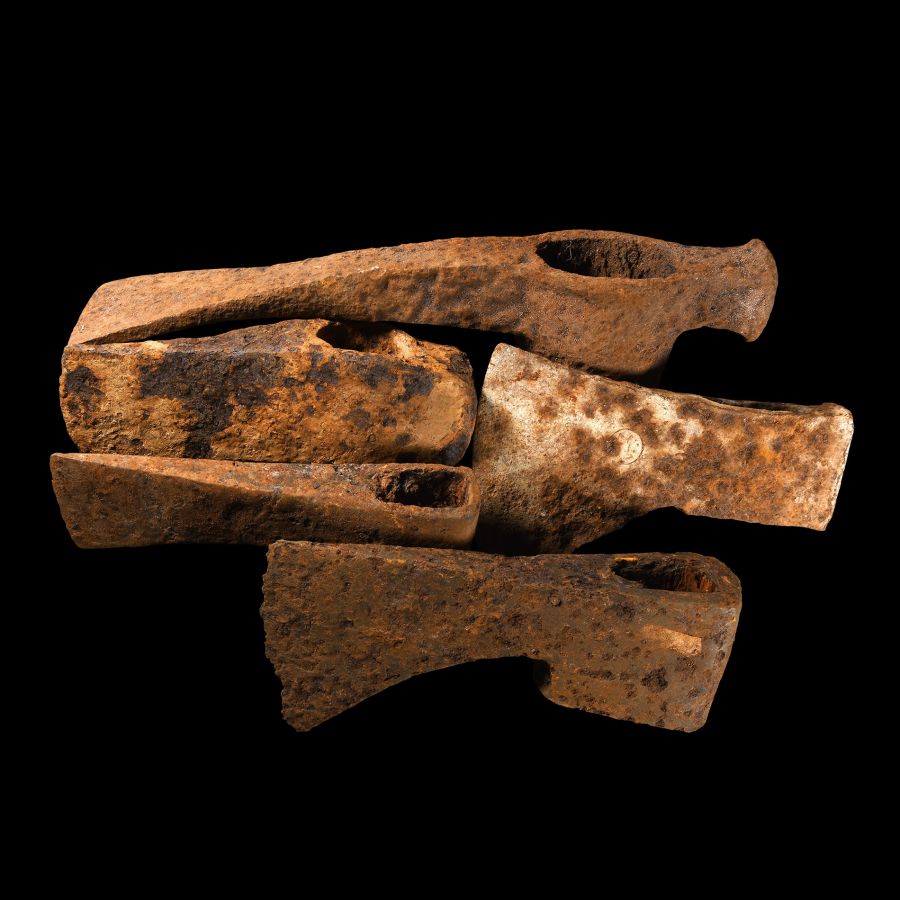
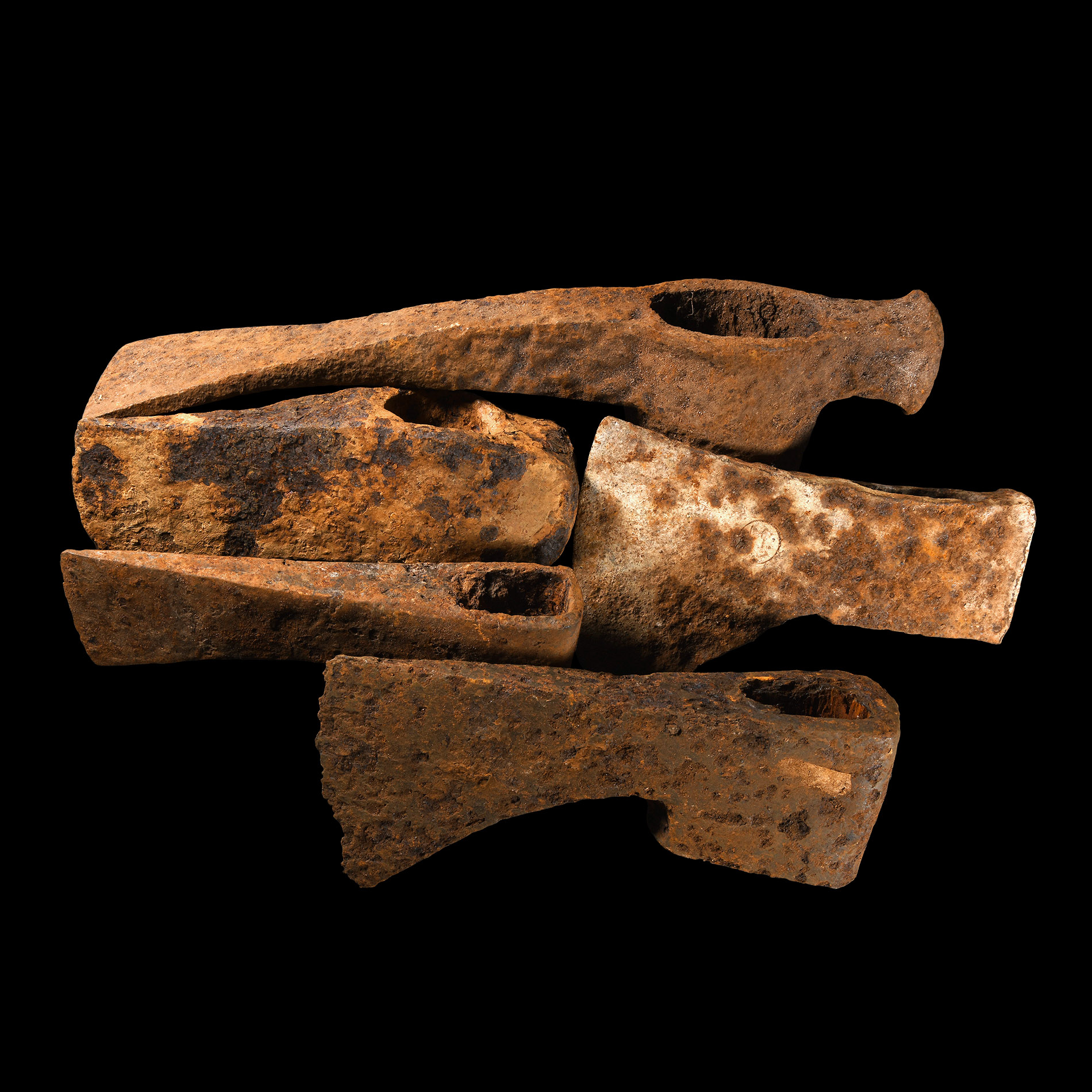
Medieval Iron Artefact Collection
14TH-18TH CENTURY A.D.
6 1/4 - 11 3/4 in. (5.48 kg total, 16-30 cm).
Comprising axeheads of different types, together with a pickaxe with a small hammer-style butt. [5]
ProvenanceAcquired 1990s-early 2000s.
East Anglian private collection.
Cf. The 18th Century Material Culture Resource Center Date, 18th Century Material Culture. Axes, Hatchets, & Tomahawks, 2015, p.22 (late 17th century), 23 (early 18th century), for similar.
FootnotesVarious axes of similar types have been recovered from the colonies of the New World. One of our specimen seems to be a French hatchet marked with a cross and circle, like the one found in the estate of Tom Wnuck.
CONDITIONTimeLine Auctions follows a vetting process to ensure the authenticity and legality of all items, reinforcing our commitment to integrity and responsible trading. Each antiquity, antique, and coin lot undergoes thorough examination by a vetting committee of at least ten external specialists, professional trade association members, scientists, and archaeologists: Our Vetting Process
AUCTIONS:
TimeLine is a leading auction house specialising in antiquities, ancient art, collectables, natural history, coins, medals, and books. Our auctions offer museums, collectors, historians, and enthusiasts the opportunity to acquire unique and historically significant pieces.
-
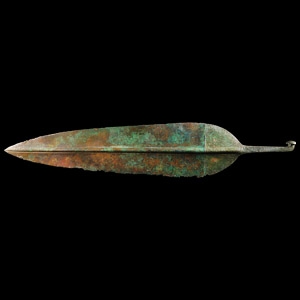
Heavy Western Asiatic Leaf-Shaped Spearhead
14th-10th century B.C.Estimate: £600 - 800 (+bp*)
Opening Bid: £300
The leaf-shaped ovate blade with rounded, gently curved shoulders and raised midrib, flat rectangular-sectioned tang tapering to a sharply bent end with a fastening button. 844 grams, 46.2 cm
Acquired 1980-2015. Ex Abelita family collection.
Similar spearheads were excavated in the Marlik Royal cemetery by Dr Negahban, see for example in tomb 47, Trench XXIIE. They were the evolution of a typology which began much earlier in Mesopotamia and the fertile crescent, the type 4 of the Stronach classification, with straight tang and square section, usually thickened at the base with a button tang. The foliate blade was wide and exaggerated in some specimens excavated at Marlik. -
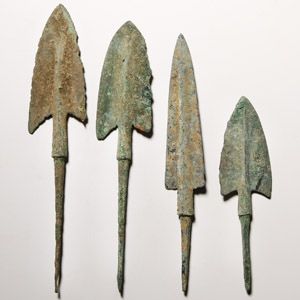
Marlik Bronze Arrowhead Group
12th-10th century B.C.Sold for (Inc. bp): £156
Comprising four tanged arrowheads, with large bronze elongated triangular blades and raised midrib, sharp central groove, cylindrical stem with handle for the shaft; three with barbed shoulders and convex sides. 106 grams total, 10.2-15.2 cm
Acquired 1980-2015. Ex Abelita family collection.
Some of these arrowheads seem to belong to the type V, subcategory type C, according to the classification of Khorasani and Negahban. In the four categories of triangular bronze arrowheads from Luristan, Marlik and Northern Iran individuated by Negahban, subtypes C and D of type V are larger arrow or javelin heads, C with barbed shoulders and D with round shoulders. -
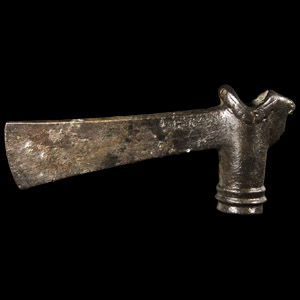
Luristan Bronze Socketted Axe
13th-7th century B.C.Estimate: £180 - 240 (+bp*)
Opening Bid: £90
The cylindrical socket with collared base and upper face of zoomorphic form, possibly representing a gaping snake's mouth; wedge-shaped axehead with convex cutting edge. 271 grams, 14 cm
Acquired 1980-2015. Ex Abelita family collection.
