
Loading, please wait...
LOT 1027
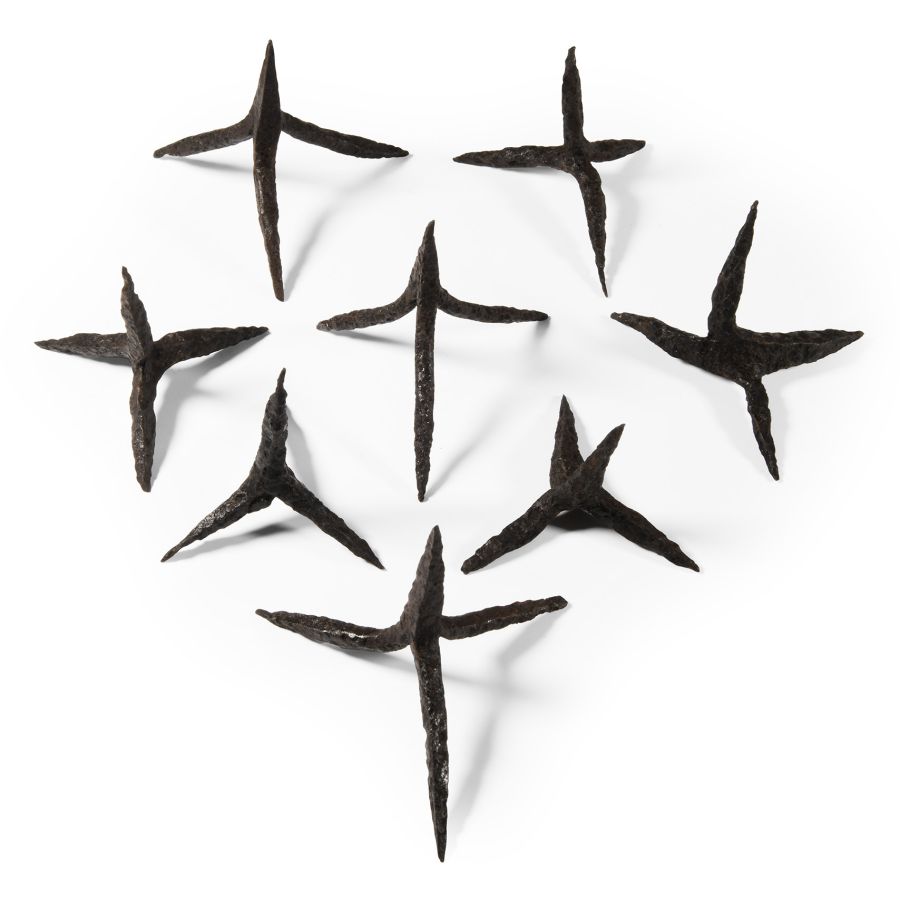
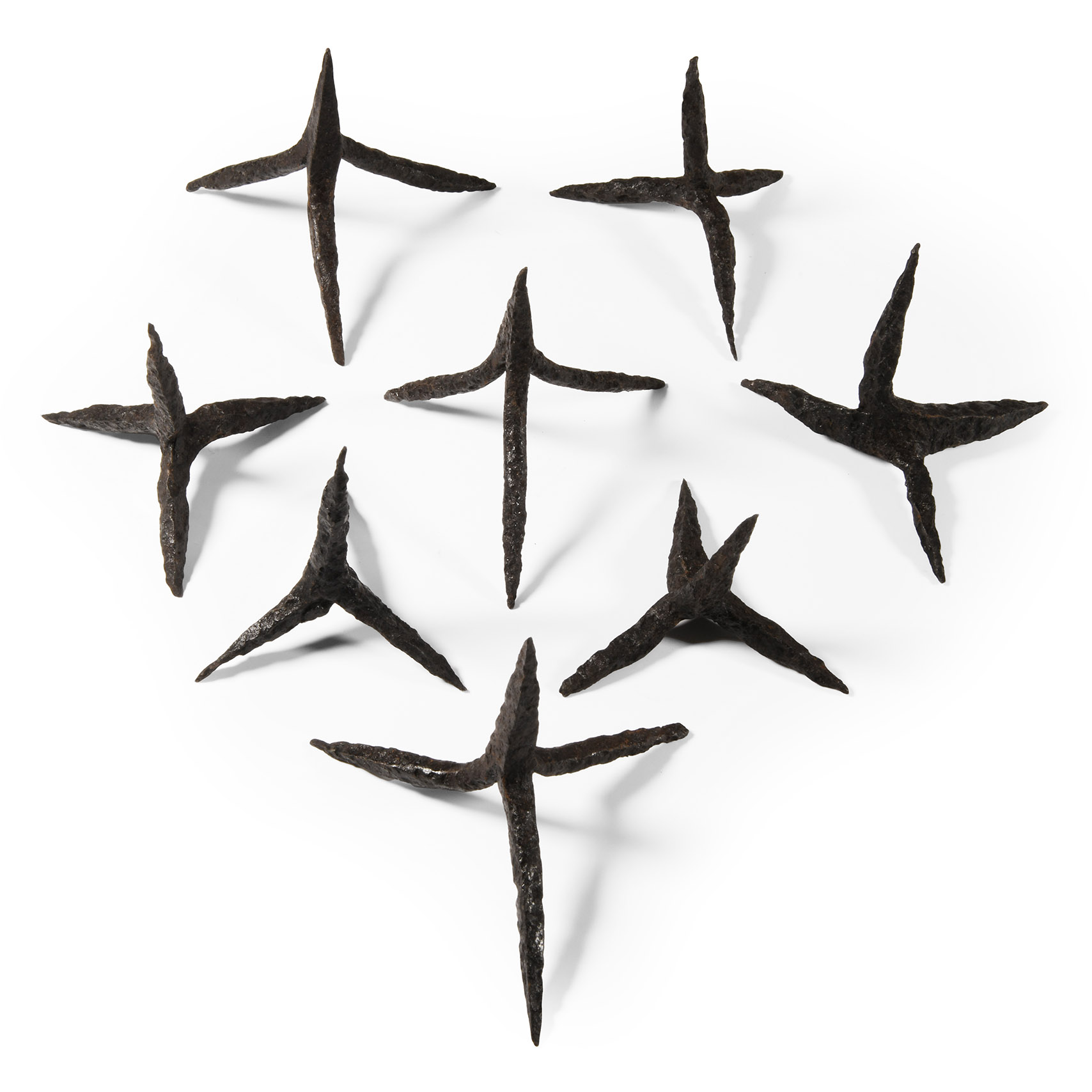
Medieval Iron Anti-Cavalry Caltrop Group
13TH-15TH CENTURY A.D.
3 - 3 3/4 in. (398 grams total, 76-95 mm).
Comprising eight caltrops, hand-forged with square-section spikes. [8, No Reserve]
ProvenanceFrom the private collection of a London gentleman, from his grandfather's collection formed before the early 1970s.
LiteratureCf. Žákovský, P., ‘Caltrop. Contribution to the knowledge of one neglected weapon’ in Studia Minora Facultatis Philosophicae Universitatis Brunensis, M 12-13, 2007-2008, pp.115-132, fig.9, no.4 (type 3 of Žákovský classification).
CONDITIONTimeLine Auctions follows a vetting process to ensure the authenticity and legality of all items, reinforcing our commitment to integrity and responsible trading. Each antiquity, antique, and coin lot undergoes thorough examination by a vetting committee of at least ten external specialists, professional trade association members, scientists, and archaeologists: Our Vetting Process
AUCTIONS:
TimeLine is a leading auction house specialising in antiquities, ancient art, collectables, natural history, coins, medals, and books. Our auctions offer museums, collectors, historians, and enthusiasts the opportunity to acquire unique and historically significant pieces.
-
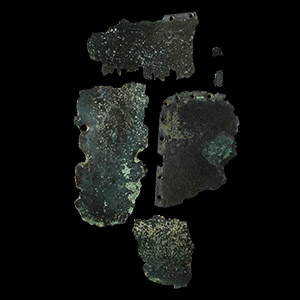
Roman Bronze Armour Sections for Limbs
3rd-4th century A.D.Sold for (Inc. bp): £221
Comprising four large plate sections from a segmented armour for arm (manica) or leg, three with pierced attachment holes to the edges, rounded extremity. 54 grams total, 6-12 mm
Found Northern Europe. UK private collection. Acquired from Redhouse Antiques Centre, York, 2005. Property of a Nottinghamshire gentleman.
On the Adamclisi monument, at least thirteen Roman legionaries and three standard-bearers have the right arm covered by an armoured sleeve (manica). It is likely that this laminated protection of the arm, derived from that worn by the gladiators, was introduced in the Imperial army in the early first century A.D., and extended to the legionaries fighting during the Dacian Wars. Domitian’s militia had already experienced the importance of protecting the arms from enemy falces. Modern scholars however do not consider this the only and exclusive reason for the introduction of this part of equipment to the Roman army between 21 and 70 A.D. The armoured sleeve can often be seen on weaponry trophies of 1st century A.D., not only on those linked with the revolt of Sacrovir, like that of Scafa, but also those related to the civil wars, like the armoury assemblage of Split, where the manica is even furnished with laminated gauntlet. This combat item can also be seen on legionary tombstones like those of Sextus Valerus Severus and Gaius Annius Salutus, both from Mainz; and legionaries of Legio XXII Primigenia, who were based in Mogontiacum between 43-70 A.D. Their tombstones show manicae as part of the decorative edge of weaponry surrounding the inscription of the tombstone. Severus' manica shows eleven plates and a hand shaped section of four plates. As suggested by Paul Brown all this clearly places the manica as being used by Roman legions around 21-70 A.D., with a widespread use throughout the empire at the time of the Dacian Wars. In the following period its use continued: a monument of Legio XIII Gemina, from Apulum (now Alba Julia) still shows a legionary of early third century in lorica segmentata combined with a manica like his predecessors of Adamclisi. Several specimens have been found in all the territories of the Empire, especially in England (Carlisle, Newstead), Austria (Carnuntum), Spain (Santa Marina de Leon), and of course in Romania (Ulpia Sarmizegetusa Trajan). However, we cannot exclude that our fragments are related to the limb armour of Roman heavy cavalryman, the cataphractarius or clibanarius. The peculiarity of the pieces is that they had rounded edges, and were certainly fixed to a leather backing. Also Ammianus (XVI,8) speaks about the lamminarum circuli (circles of laminated sheets) protecting the Roman heavy cavalrymen of the Imperial Guard. -
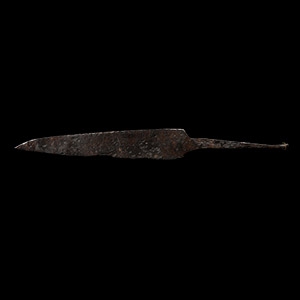
Tudor Period Iron Dagger
16th century A.D. or laterEstimate: £80 - 100 (+bp*)
Opening Bid: £40
Comprising a single cutting edge and tang. 155 grams, 28.5 cm
Acquired 1960s-1990s. Late Alison Barker collection, a retired London barrister. -
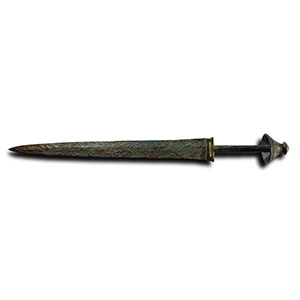
Amarlu Bronze Dagger with Bell-shaped Pommel
Late 2nd millennium B.C.Sold for (Inc. bp): £715
With solid cast hilt, straight horizontal guard with turquoise inlay; plain narrow grip with conical hollow cast mushroom pommel decorated with dots and lines; wide shallow midrib on the blade tapering to a sharp tip. 505 grams, 52 cm
Ex old English collection. London art market, pre 2000. Property of a London, UK, gentleman.
Moorey and Khorasani dated swords with mushroom pommels to the end of the second millennium B.C. The weapon belongs to Category IX of the Khorasani classification, the ones with a mushroom or bell-shaped pommel. A similar example is in the National Museum of Iran, Tehran.
