
Loading, please wait...
_900x900.jpg "Medieval Horse Harness Pendant Group")
_200x200.jpg "Medieval Horse Harness Pendant Group")
.jpg "Medieval Horse Harness Pendant Group")
LOT 1313
Medieval Horse Harness Pendant Group
CIRCA 13TH-17TH CENTURY A.D.
1 - 2 1/4 in. (48.4 grams total, 26-56 mm).
A mixed group of horse harness pendants comprising: a discoid pendant decorated with an eagle within beaded circles; an openwork lozengiform frame with four bulbous terminals, the upper one pierced with suspension loop above; a discoid pendant with stylised star motif, suspension loop above; large stylised rosette with domed centre, pierced with suspension loop above; fitting with a tapering body, semi-circular head and two roughly rectangular arms with scalloped edges, rivet hole to each, hook to head. [5, No Reserve]
ProvenanceFound Suffolk, UK.
CONDITIONTimeLine Auctions follows a vetting process to ensure the authenticity and legality of all items, reinforcing our commitment to integrity and responsible trading. Each antiquity, antique, and coin lot undergoes thorough examination by a vetting committee of at least ten external specialists, professional trade association members, scientists, and archaeologists: Our Vetting Process
AUCTIONS:
TimeLine is a leading auction house specialising in antiquities, ancient art, collectables, natural history, coins, medals, and books. Our auctions offer museums, collectors, historians, and enthusiasts the opportunity to acquire unique and historically significant pieces.
-
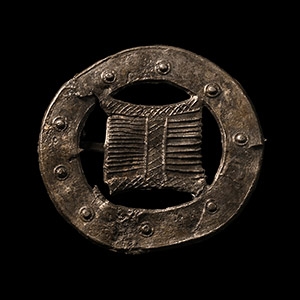
Published Medieval 'Thames' Saint Blaise of Canterbury Pilgrim's Badge
Circa 14th-15th century A.D.Sold for (Inc. bp): £546
An openwork lead pilgrim's badge displaying the wool-combe emblem of St Blaise of Canterbury within a pelletted roundel; complete with pin. 2.92 grams, 30 mm
Found on the Thames foreshore, London, UK. Acquired on the UK antiques market between 1974-1985. Albert Ward collection, Essex, UK.
St Blaise is believed to have been a bishop located somewhere in Asia Minor who was martyred in the early 4th century by beheading, following a period of torture with iron combs which later became his emblem. Canterbury, where his shrine stood behind the high altar and near to that of Saint Thomas Becket, claimed to have relics directly associated with Blaise, and miracles attributed to the saint continued to attract pilgrims into the 15th century. -
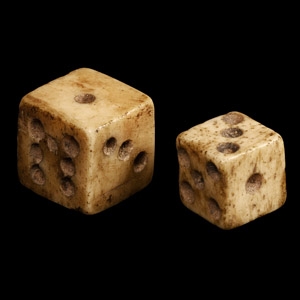
Medieval 'Thames' Bone Dice Pair
14th-16th century A.D.Sold for (Inc. bp): £130
A pair of differently sized bone dice with recessed dot numbering, configured: 1:4; 2:6; 3:5 and 1:6; 2:5; 3:4. 3.28 grams total, 8-10 mm
Found on the Thames foreshore, London, UK. Acquired 1960s-1990s. From the late Alison Barker collection, a retired London barrister. -
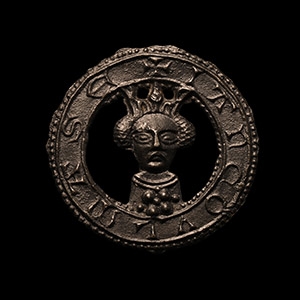
Medieval 'Thames' Crowned Bust Pilgrim's Badge
Circa 14th-15th century A.D.Sold for (Inc. bp): £715
An openwork lead badge composed of a crowned facing male bust within a roundel bearing the inscription '+ IANCOVLMASE'; complete with pin. 1.78 grams, 22 mm
Found on the Thames foreshore, London, UK. Acquired on the UK antiques market between 1974-1985. Albert Ward collection, Essex, UK.
This enigmatic inscription has been found on other similar badges, but is yet to be satisfactorily understood. It is possibly associated with the cult of Edward the Confessor or representing the head of John the Baptist.
