
Loading, please wait...
LOT 1280
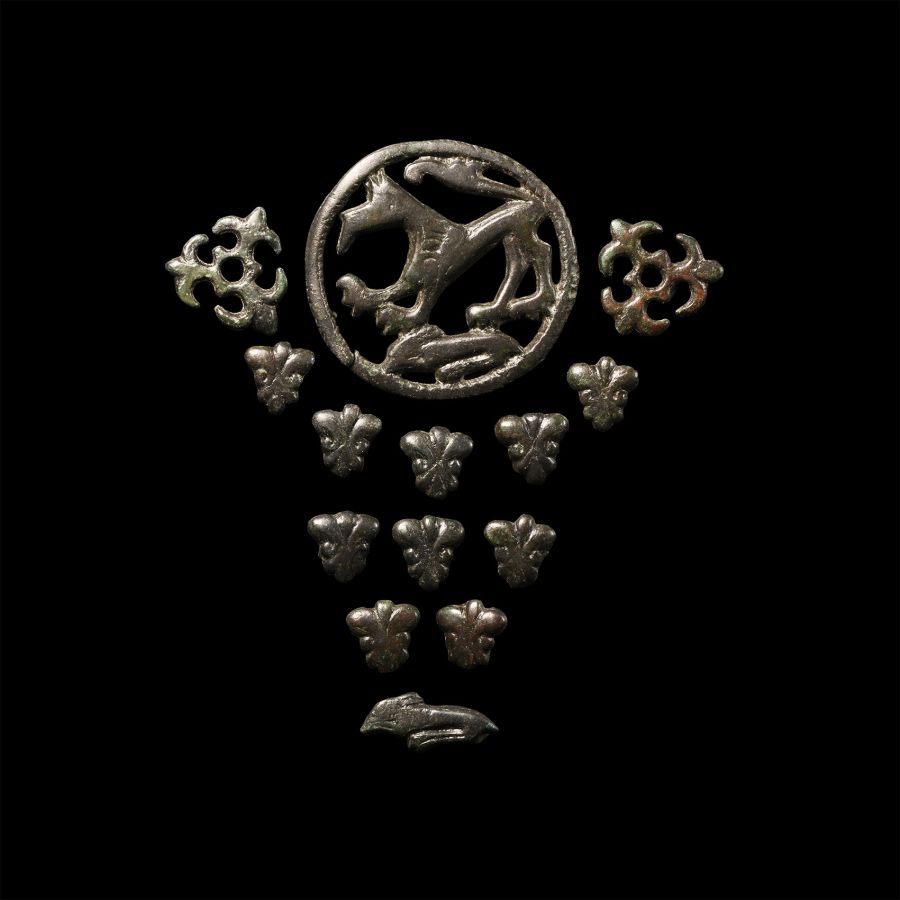
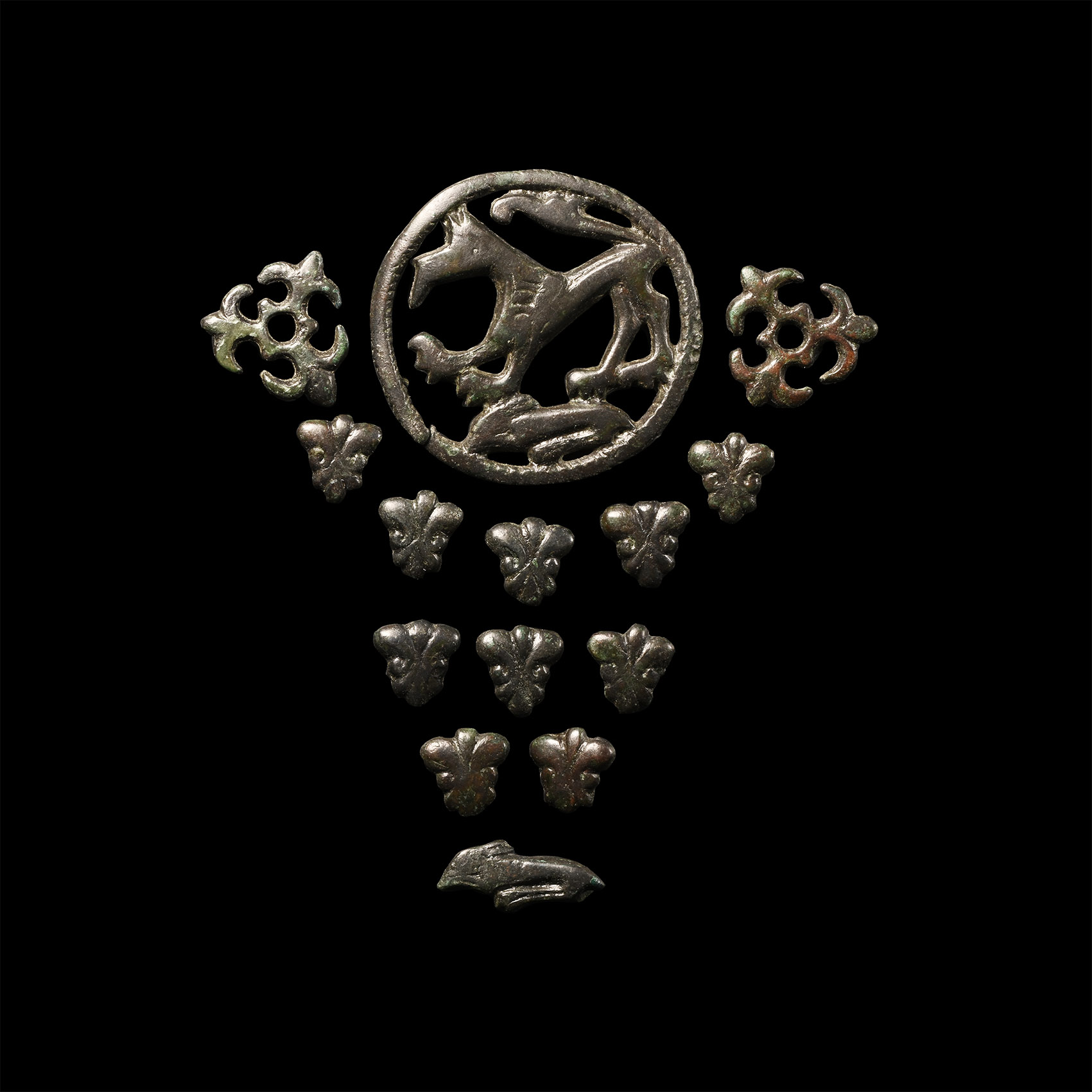
Medieval Horse Harness Mount Group
CIRCA 14TH-15TH CENTURY A.D.
1/2 - 1 3/4 in. (32.1 grams total, 12-46 mm).
A group of bronze horse harness mounts comprising: a medallion with openwork design portraying a griffin pouncing on a hare within a decoratively notched frame, mounting lugs to reverse; a stylised running hare mount with two mounting lugs to reverse; two attachments with three stylised fleur-de-lys radiating from a central opening, mounting lugs to the reverses; ten stylised floral mounts, broadly triangular in plan with scrolled detailing, mounting lugs to reverse of each. [14]
ProvenanceNorth American collection, 1990s-2000s.
Property of a Surrey gentleman.
TimeLine Auctions follows a vetting process to ensure the authenticity and legality of all items, reinforcing our commitment to integrity and responsible trading. Each antiquity, antique, and coin lot undergoes thorough examination by a vetting committee of at least ten external specialists, professional trade association members, scientists, and archaeologists: Our Vetting Process
AUCTIONS:
TimeLine is a leading auction house specialising in antiquities, ancient art, collectables, natural history, coins, medals, and books. Our auctions offer museums, collectors, historians, and enthusiasts the opportunity to acquire unique and historically significant pieces.
-
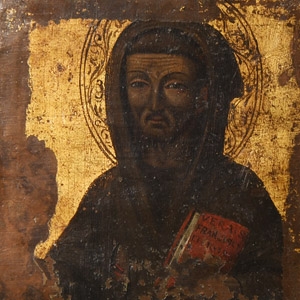
Cretan Icon of Saint Francis of Assisi
15th century A.D.Sold for (Inc. bp): £1,170
An icon from a possible triptych of Veneto-Cretan School depicting nimbate Saint Francis of Assisi, wearing the brown habit of the Franciscan order, fitted with a hood, facing towards the right, a red book in his left hand with the inscription Vera S. Francisci effigies(true portrait of Saint Francis); mounted in a perspex display frame. 152 grams, 20 cm high
Property of a London lady, part of her family's collection.
With the conquest of Crete by the Venetians, Latin saints were introduced to Byzantine iconography. Saint Francis was one of the most beloved Latin saints among the Cretan faithful, depicted in the iconography of Cretan Orthodox churches, including the Panaghia Kera of Kritsa (13th-14th century A.D.). This figure was probably part of a triptych, having at the centre the image of the Mother of God with the Child, or a Desis. The placement of Francis in this icon would suggests the owner’s strong affiliation with the Franciscan order, which had a strong presence on Crete from the 13th century onwards. It was believed that Saint Francis himself stopped on the island on his way to the Holy Land in 1219. -
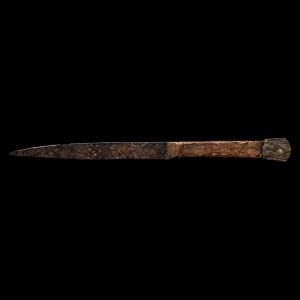
Medieval Knife with Bronze Pommel and Veiled Figure
Circa 1500 A.D.Estimate: £200 - 300 (+bp*)
Opening Bid: £100
A scale tanged knife with iron blade and single cutting edge, wooden scales, bronze pommel incised with a veiled female figure to one face and a male figure to the other; remains of gilding to the neck of the handle. 22.7 grams, 18.2 cm long
Acquired 1960s-1990s. Late Alison Barker collection, a retired London barrister. -
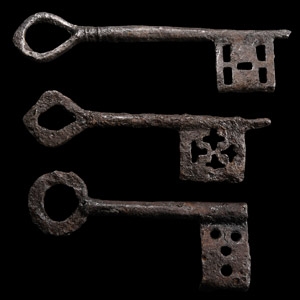
Medieval Large Key Group
Circa 12th-14th century A.D.Sold for (Inc. bp): £247
A mixed group of iron door keys comprising: one with solid shank, lozengiform bow, rectangular bit with elaborate piercings and three wards; one with hollow shank, circular bow, long rectangular pierced bit and two long wards; one with solid shank, ellipsoid bow, rectangular pierced bit and three wards. 126 grams total, 10.5-13.6 cm
Acquired 1971-1972. From the collection of the vendor's father. Property of a London, UK, collector.
