
Loading, please wait...
_900x900.jpg "Medieval Gold Stirrup Ring with Sapphire")
_200x200.jpg "Medieval Gold Stirrup Ring with Sapphire")

.jpg "Medieval Gold Stirrup Ring with Sapphire")
LOT 0320
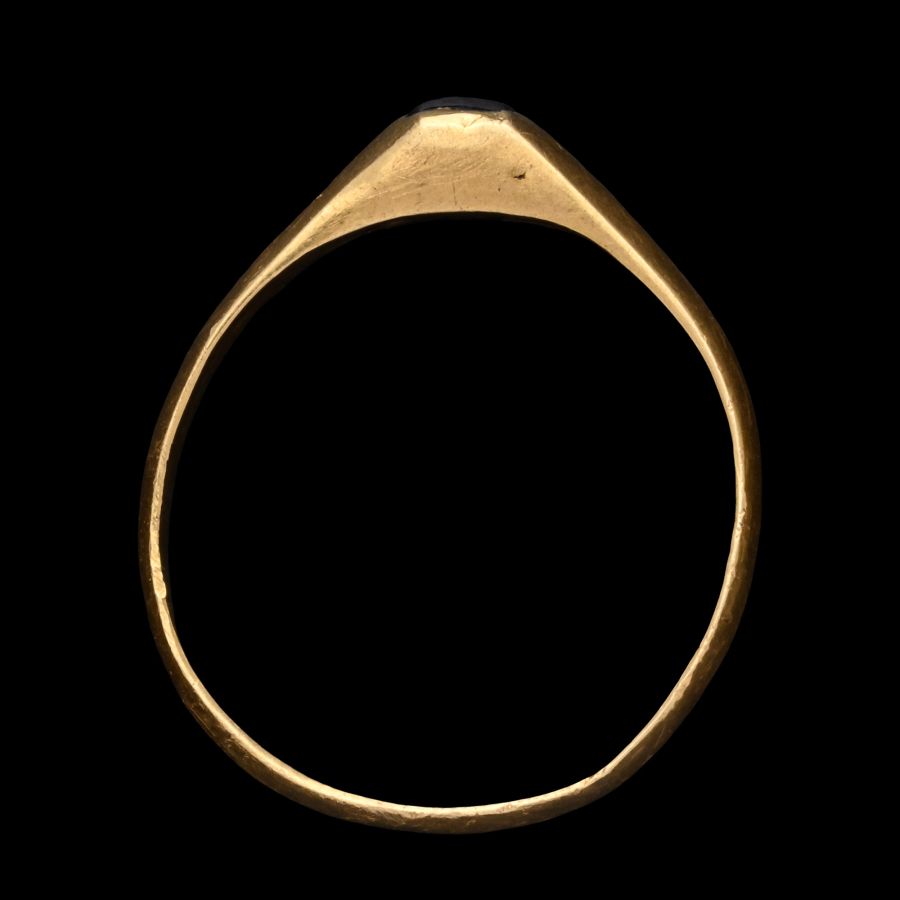
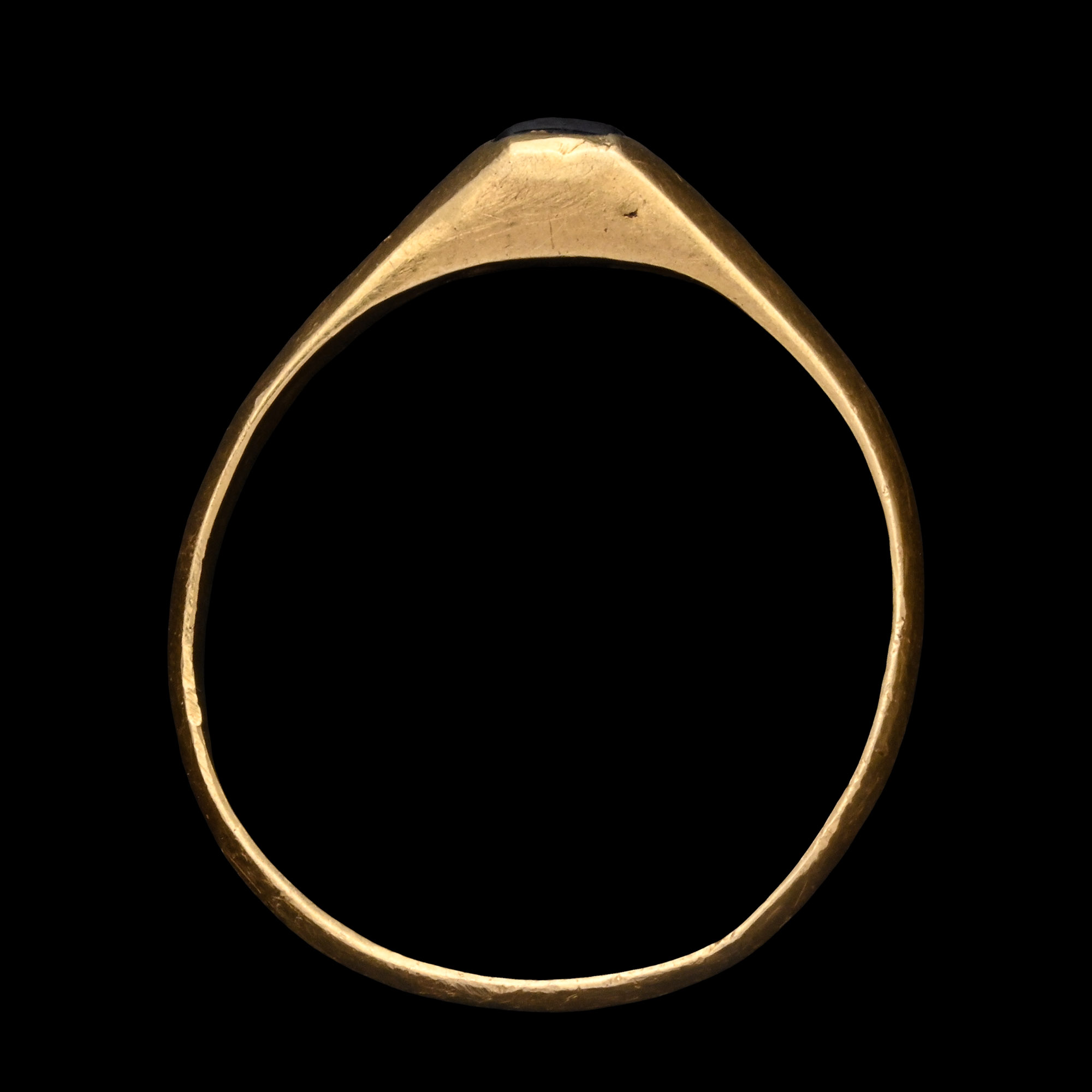
Medieval Gold Stirrup Ring with Sapphire
13TH-14TH CENTURY A.D.
7/8 in. (2.24 grams, 23.70 mm overall, 18.14 x 19.03 mm internal diameter (approximate size British Q, USA 8, Europe 17.49, Japan 16)).
Slender keeled hoop and a high bezel set with a polished sapphire cabochon.
ProvenanceAcquired on the European art market.
This lot has been checked against the Interpol Database of stolen works of art and is accompanied by search certificate number no.13389-258004.
Cf. Chadour, A.B., Rings. The Alice and Louis Koch Collection, volume I, Leeds, 1994, item 565, for a similar ring.
FootnotesThe style of the ring is known as a stirrup ring due to the resemblance the form has to stirrups on a horse. During the Middle Ages, gemstones were often associated with magical and protective properties that they were believed to possess. Gemstones could protect against evil or poisons, as well as heightening the individual’s characteristics and strengths. Sapphires were frequently worn by Bishops and other clergy due to their ability to promote their bearer’s chastity and piety. Sapphires were believed to be able to change colour if the wearer acted sinfully or lacked faith; it was because of this belief that jewels set with sapphires were worn as symbols of honesty and devout faith.
CONDITIONTimeLine Auctions follows a vetting process to ensure the authenticity and legality of all items, reinforcing our commitment to integrity and responsible trading. Each antiquity, antique, and coin lot undergoes thorough examination by a vetting committee of at least ten external specialists, professional trade association members, scientists, and archaeologists: Our Vetting Process
AUCTIONS:
TimeLine is a leading auction house specialising in antiquities, ancient art, collectables, natural history, coins, medals, and books. Our auctions offer museums, collectors, historians, and enthusiasts the opportunity to acquire unique and historically significant pieces.
LOT 0320
Medieval Gold Stirrup Ring with Sapphire
Estimate £2,000 - 3,000€2,320 - 3,480 (for guidance only)$2,700 - 4,050 (for guidance only)
-
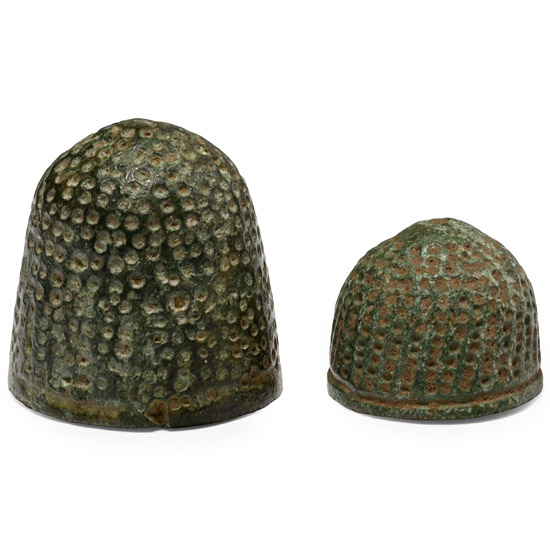
Medieval Bronze 'Beehive' Thimble Group
Circa 14th-15th century A.D.Sold for (Inc. bp): £39
Pair of thimbles with pellet decoration, and a narrow plain band to the lower edge. 13.4 grams total, 16-21 mm
Acquired on the UK art market. Property of a Lancashire, UK, collector. -
.jpg)
Medieval Wooden Bench Finial in the Form of an Elephant and Castle
England, 15th century A.D.Estimate: £3,000 - 4,000 (+bp*)
Opening Bid: £1,500
Carved stylised elephant with elongated ears supporting a palanquin in the form of a castle with a carved cross, foliage motif to the reverse; mounted on a velvet-covered stand. 1.31 kg total, 34.2 cm including stand
Private collection, Europe. Acquired on the English art market. This lot has been checked against the Interpol Database of stolen works of art and is accompanied by search certificate number no.13088-248391.
The image of an elephant carrying warriors in a howdah originated from Alexander the Great's battle against King Porus's war elephants at the Battle of Hydaspes in 326 BC. This motif became widely known in European art through the spread of Bestiaries which were medieval texts combining natural history with moralising Christian stories. One of the most well known was Matthew Paris’s imagined depictions of elephants, most notable in this case is his war elephant illustrated in Chronica maiora II, circa 1240-1255 (Cambridge, Corpus Christi College, MS 016II). Another well known manuscript - The Rochester Bestiary, circa 1230-1240 (British Library, London, Royal MS 12 F.xiii) contains a miniature with a war elephant in the midst of battle, above another image of elephants supposedly in their natural habitat. Since very few live elephants were seen in Europe during the medieval period, their representations were often more imaginative than realistic. Other Medieval bench end carvings of elephants in English churches are known, amongst them are: St Peter and St Paul, Tuttington, Norfolk; St Andrew, South Lopham, Norfolk; St Edmund, South Burlingham, Norfolk; St Andrew, Holme Hale, Norfolk. Elephants can also be found on misericords, some examples can be found at: Cathedral Church of Saint Peter, Exeter; Cathedral Church of St Peter, Gloucester; and St Mary's Church, Beverley. -
.jpg)
Medieval Silver Ring with Heraldic Bezel
Circa 15th-16th century A.D.Sold for (Inc. bp): £85
Comprising a D-section hoop and teardrop bezel with median zigzag band between curved and rectilinear motifs, possibly birds 10.45 grams, 25.05 mm overall, 18.79 mm internal diameter (approximate size British P 1/2, USA 7 3/4, Europe 16.86, Japan 16)
Ex German art market, 2000s. Acquired from an EU collector living in London. From the collection of a Surrey, UK, gentleman.
