
Loading, please wait...
LOT 1322
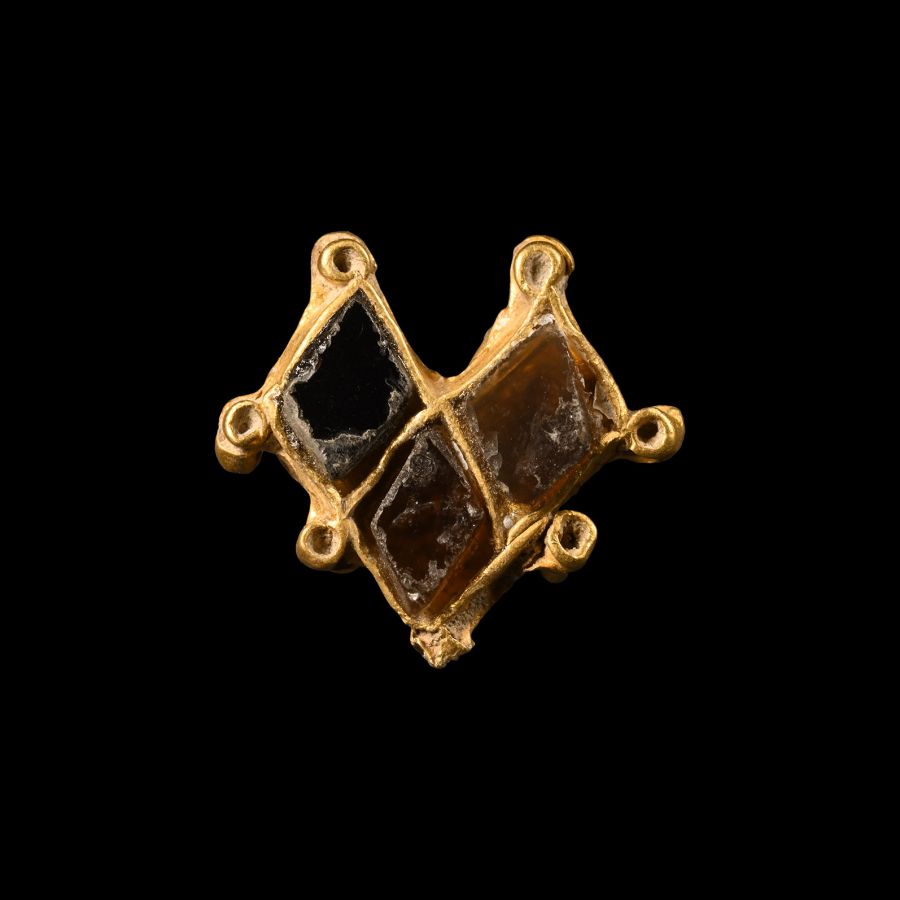
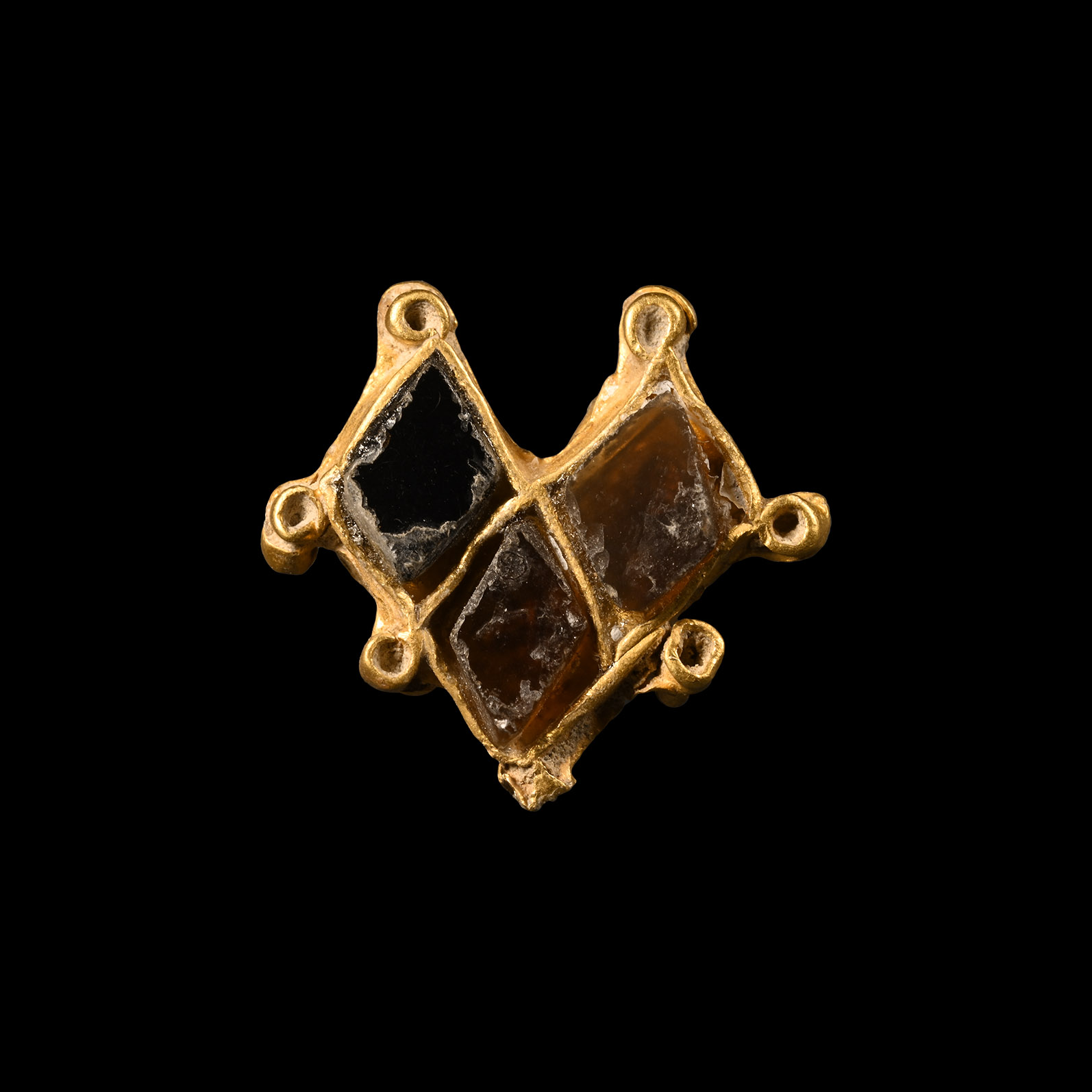
Medieval Gold and Garnet Necklace Element
14TH-16TH CENTURY A.D.
1/2 in. (1.48 grams, 14 mm).
A necklace element comprising a gold frame with seven cylindrical loops to accept threads; three lozengiform cells each with an inset garnet cloison.
ProvenanceAcquired 1970-2010.
Collection of a late Japanese gentleman.
TimeLine Auctions follows a vetting process to ensure the authenticity and legality of all items, reinforcing our commitment to integrity and responsible trading. Each antiquity, antique, and coin lot undergoes thorough examination by a vetting committee of at least ten external specialists, professional trade association members, scientists, and archaeologists: Our Vetting Process
AUCTIONS:
TimeLine is a leading auction house specialising in antiquities, ancient art, collectables, natural history, coins, medals, and books. Our auctions offer museums, collectors, historians, and enthusiasts the opportunity to acquire unique and historically significant pieces.
-
Large Medieval 'Thames' Pilgrim's Badge Collection
Circa 14th-15th century A.D.Sold for (Inc. bp): £98
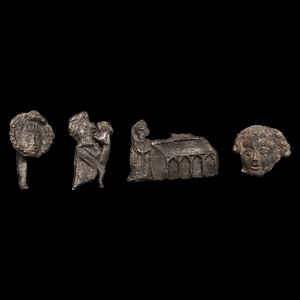
A mixed group of lead-alloy pilgrim's badge fragments comprising: a standing figure beside the nave of a church; a facing mask with curly hair; a profile figure with hands raised to the chin in prayer; a pin with discoid plate, facing mask within a beaded border (perhaps John the Baptist). 7.5 grams total, 16-25 mm
Found on the Thames foreshore, London, UK. Acquired on the UK antiques market between 1974-1985. Albert Ward collection, Essex, UK. -
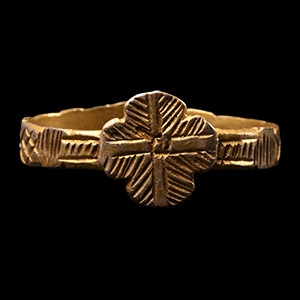
Medieval Silver-Gilt Fede Ring
13th-14th century A.D.Sold for (Inc. bp): £351
A silver-gilt fede ring composed of a flat-section hoop with expanded bottom section and quatrefoil bezel; the hoop engraved with alternating vertical and horizontal hatched panels with expanded central section crudely engraved with clasped hands; bezel engraved with a cross embellished with cross-hatching in each quarter of the field. 2.69 grams, 24.69 mm overall, 22.78 mm internal diameter (approximate size British X, USA 11 1/2, Europe 26.23, Japan 25)
Found near Brookland, Kent, UK, 2007. Property of a Kent gentleman. Accompanied by a copy of the British Museum's Portable Antiquities Scheme (PAS) report no. KENT-299A33. Accompanied by a copy of two letters from the British Museum and report for HM Coroner for Treasure case T493. Accompanied by a valuation letter and another from Peter D Spencer. Accompanied by a provisional treasure valuation for the Treasure Valuation Committee.
The quatrefoil bezel is in the form of a truelove (paris quadrifolia) as the plant was called in Middle English. Two fifteenth-century wills include the bequest of rings in the shape of a truelove: in 1407 an anulum argenti operatum cum uno trewlove [silver ring fashioned with a truelove] and in 1464, unum anulum argenti et deauratum cum uno trew lofe [a silver and silver-gilt ring with a truelove] On seals the device is most often accompanied by the legend LEL AMI AVET [you have a true love] confirming its identification with faithful love, and on a matrix recently unearthed [PAS database SWYOR-B7EDA9] the characteristic four veined leaves are surrounded by the posy, IS SVI FLVRE/ DE FINN AMVVR [I am the flower of perfect love]. -
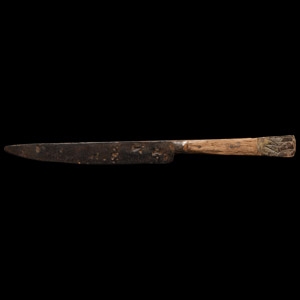
Medieval Knife with Bronze Pommel and Veiled Figure
Circa 1500 A.D.Estimate: £200 - 300 (+bp*)
Opening Bid: £100
A scale tanged knife with iron blade and single cutting edge, wooden scales, bronze pommel incised with a veiled female figure to each face. 34.8 grams, 19 cm long
Acquired 1960s-1990s. Late Alison Barker collection, a retired London barrister.
