
Loading, please wait...
LOT 0351
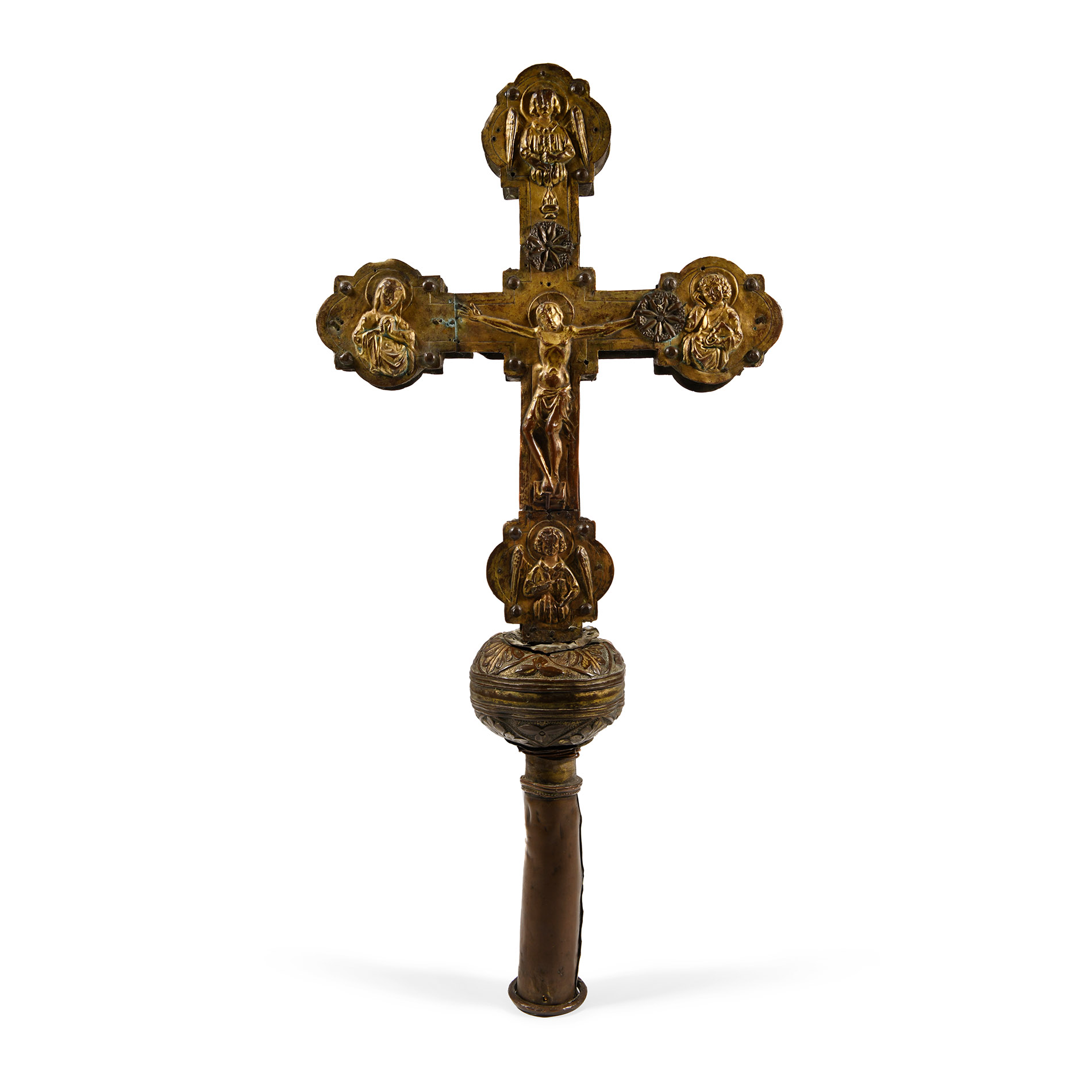
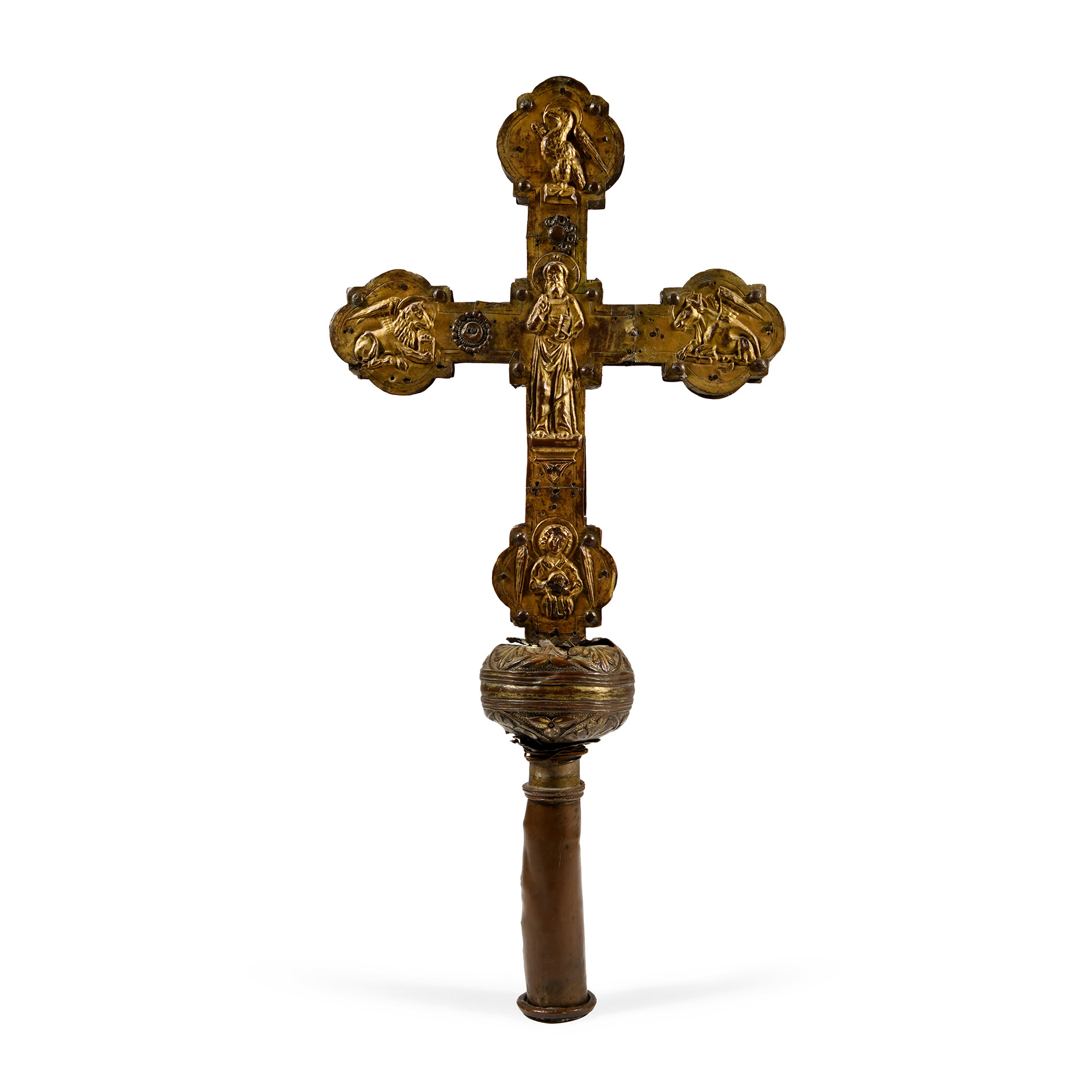
Medieval Gilt Bronze Processional Cross
15TH-16TH CENTURY A.D.
20 3/4 in. (920 grams, 52.5 cm).
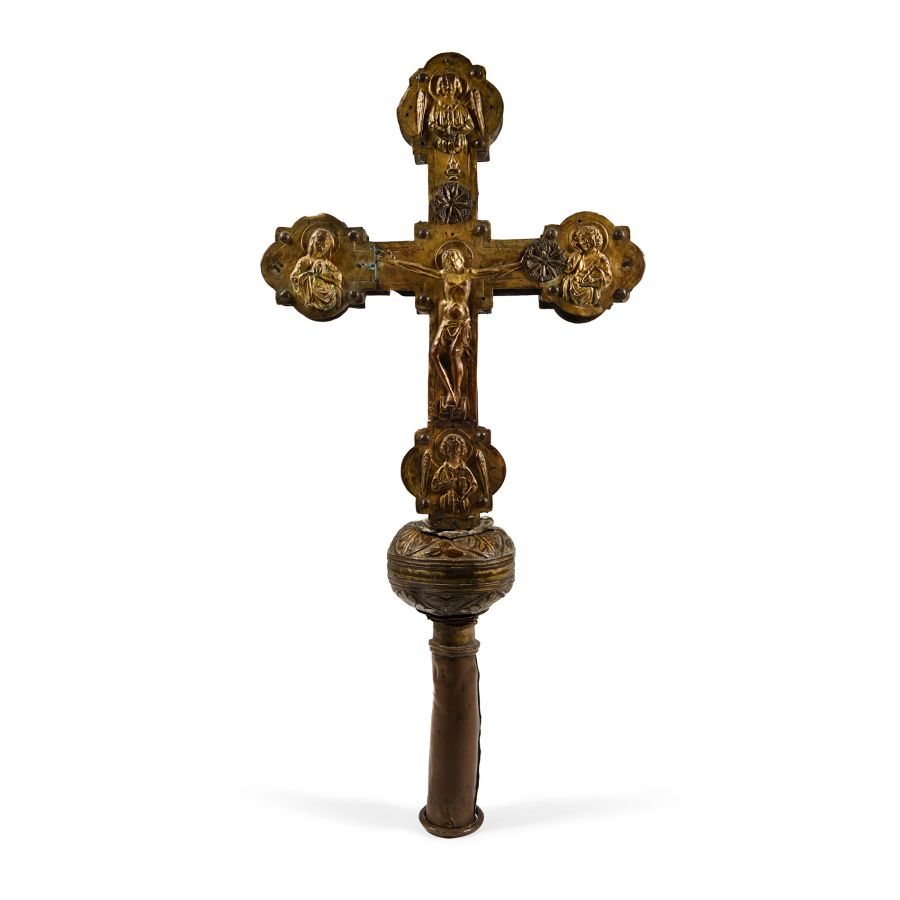
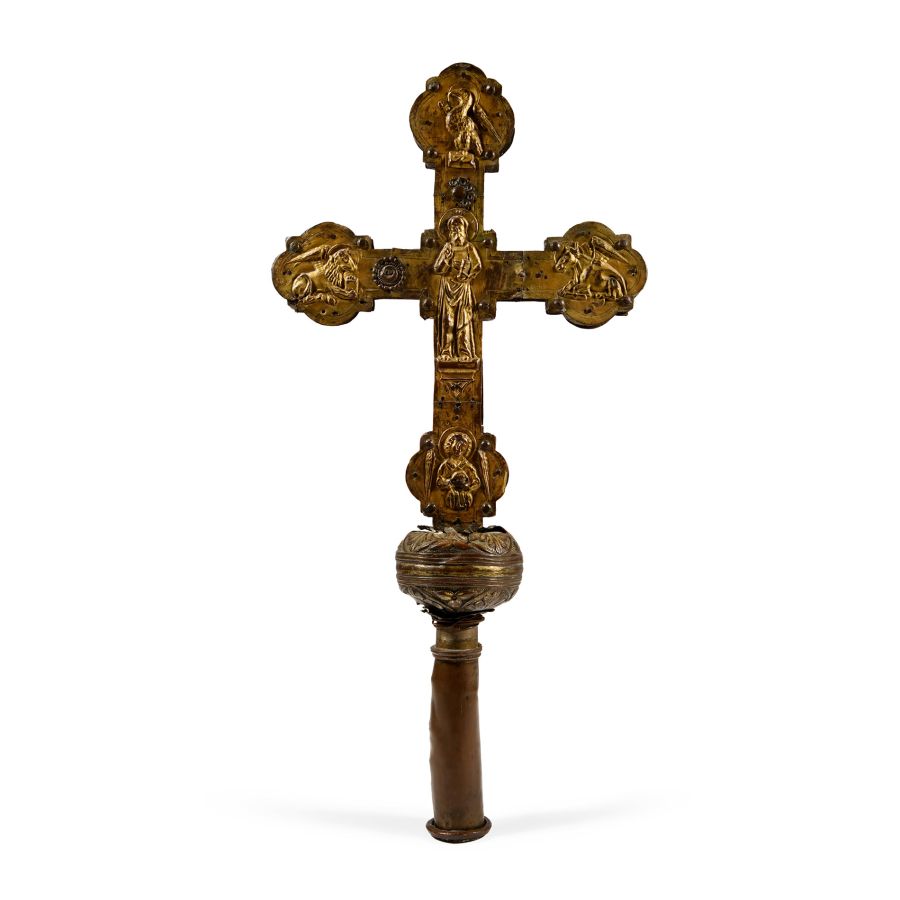
With wooden core to which the embossed sheets have been attached; the obverse with a central nimbate Corpus Christi, an applied rosette above and to the left arm; an angel to the finial of the upper and lower arm with Mary and St John the Evangelist to the side arms; the reverse with a central figure of Jesus holding the Gospel and making the sign of blessing; each finial of the arm with the symbols of the Evangelists (eagle, angel, lion and ox); the cross resting on a floral sphere with a socket below.
Provenancewith Adolphe Goumaz, Pully, Switzerland.
Ex private collection.
Accompanied by an academic report by Dr Raffaele D’Amato.
This lot has been checked against the Interpol Database of stolen works of art and is accompanied by search certificate no.11804-206500.
Cf. Mezzacasa, L.M., ‘Per un corpus di croci astili tra Veneto e Trentino (secoli XIV-XV)’, in Hortus Artium Medievalium, 19 (2013), pp. 433-447, figs.1, 5, 6, 16, 26.
FootnotesThe metal sheets of the cross seem to be 15th century A.D. North Italian work. The four Evangelists are depicted with a human face at the front of the cross, and in animal forms at the reverse.
CONDITIONTimeLine Auctions follows a vetting process to ensure the authenticity and legality of all items, reinforcing our commitment to integrity and responsible trading. Each antiquity, antique, and coin lot undergoes thorough examination by a vetting committee of at least ten external specialists, professional trade association members, scientists, and archaeologists: Our Vetting Process
AUCTIONS:
TimeLine is a leading auction house specialising in antiquities, ancient art, collectables, natural history, coins, medals, and books. Our auctions offer museums, collectors, historians, and enthusiasts the opportunity to acquire unique and historically significant pieces.
-

Medieval Iron Artefact Group
14th-16th century A.D.Sold for (Inc. bp): £33
Comprising: horse harness elements, knives and other miscellaneous objects including keys. 6.5 kg total, 1.2-34 cm
Acquired 1990s-early 2000s. East Anglian private collection.
Double-looped medieval buckles were often formed of a D-shape and a more and less smaller rectangle. During the Renaissance they often were realised with a moulded rosette on the edge of both D-shaped loops. -

Medieval Bronze Personal Seal Matrix with S
15th century A.D.Sold for (Inc. bp): £46
The circular die bearing the letter 'S' surrounded by plant fronds, hexagonal stem terminating in a collared loop with trilobate top; accompanied by an impression. 9.7 grams, 26 mm
Found Berkshire, UK. Accompanied by a copy of the British Museum's Portable Antiquities Scheme (PAS) report no.BERK-9D4B93. -
Medieval Ceramic Group
15th century A.D. and laterSold for (Inc. bp): £20
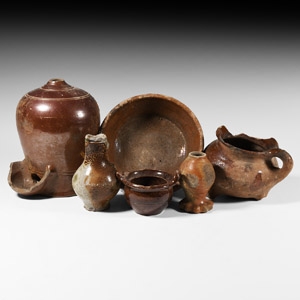
Including a jar with scalloped foot, a piriform juglet, footed pot with handle, small jar with remaining handle, likely bird water feeder and a stamped tripod dish; most glazed; most chipped or cracked. 3.3 kg total, 10-18 cm
Acquired 1990s-early 2000s. East Anglian private collection.
The salt-glazed stoneware jugs, like some of the specimens here presented, had a distinctive pitted ‘orange-skin’ surface. These tall jugs often have grooves around their bodies to support them during the high-temperature firing which was necessary to achieve the hard fabric. First imported into Britain in the early 14th century stone wares became common in the 16th and 17th centuries. Most came from production centres in the Rhineland, notably Cologne, Frechen, Langerwehe, Raeren and Westerwald.
