Loading, please wait...
Details
LOT 1327
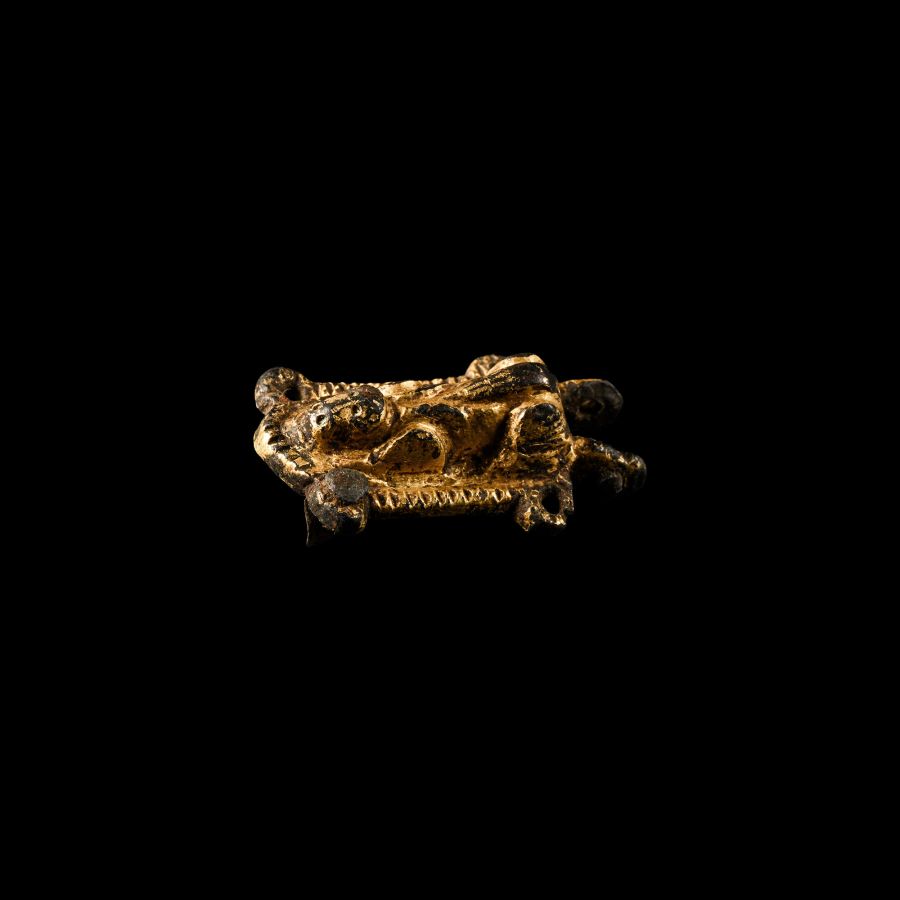
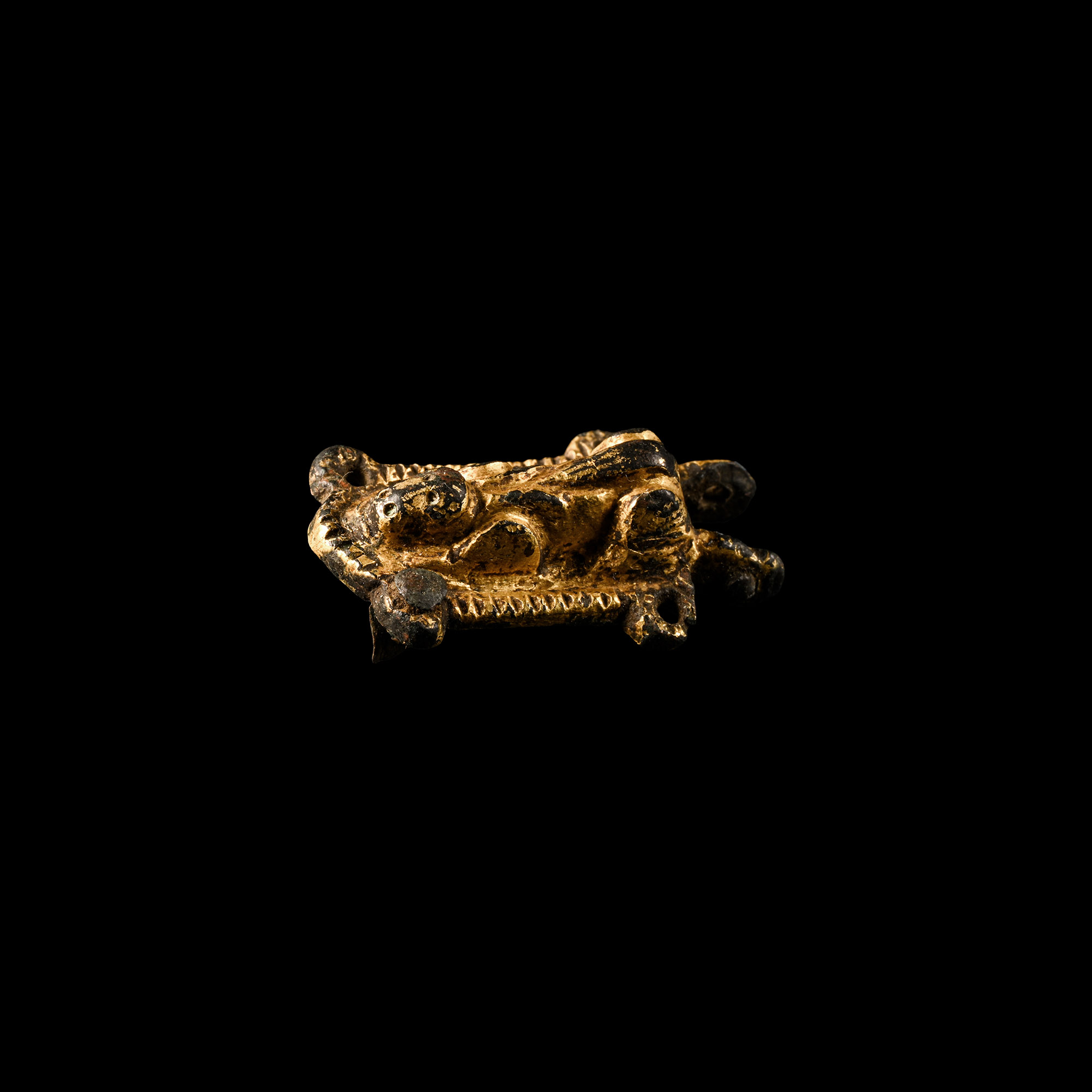
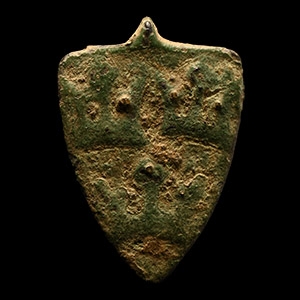
Medieval Gilt Bronze Knight's Horse Harness Hanger with Lion
12TH-14TH CENTURY A.D.
1 1/8 in. (30 grams, 30 mm).
The lion in high-relief, lying along the pendant with its head resting on its front paws, lug to each corner with rivet hole, two pierced lugs to top edge for suspension bar, decoratively notched edges, extensive remains of gilding.
Provenance
Acquired early 1990s.
From an East Anglian private collection.
Literature
Cf. The British Museum's Portable Antiquities Scheme, record id. NMS-4B9603, for a similar dated 12th-13th century A.D.
CONDITIONVETTING:
TimeLine Auctions follows a vetting process to ensure the authenticity and legality of all items, reinforcing our commitment to integrity and responsible trading. Each antiquity, antique, and coin lot undergoes thorough examination by a vetting committee of at least ten external specialists, professional trade association members, scientists, and archaeologists: Our Vetting Process
AUCTIONS:
TimeLine is a leading auction house specialising in antiquities, ancient art, collectables, natural history, coins, medals, and books. Our auctions offer museums, collectors, historians, and enthusiasts the opportunity to acquire unique and historically significant pieces.
LOT 1327
Medieval Gilt Bronze Knight's Horse Harness Hanger with Lion
Estimate £150 - 200€170 - 230 (for guidance only)$200 - 270 (for guidance only)
RELATED LOTS
-
'The Navestock' Medieval Gilt Bronze Lion Figure
12th-13th century A.D.Sold for (Inc. bp): £1,560
Standing four-square on a rectangular base, in the heraldic 'statant' pose; the head raised and mouth open, mane represented by radiating curved scales on the neck and back with nicked edges, long recurved tail with characteristic feathered finial; possibly a gaming piece. 56.9 grams, 49 mm wide
Fine condition.
Found whilst searching with a metal detector near Navestock, Essex, UK, in 2010. This lot has been checked against the Interpol Database of stolen works of art and is accompanied by search certificate no 114450-195656.
Stephen Pollington writes: 'The purpose of the piece must remain the object of speculation but one context suggests itself immediately: the 12th century set of character figures carved in ivory, discovered on the Isle of Lewis in Scotland. Stylistically, the Romanesque lion must be dated a little later than these figures since it displays classic 'heraldic' features associated with the medieval period, but the quality of the gilding and the nature of the bronze are suggestive of the Anglo-Scandinavian style of workmanship. As a gaming piece, it would be tempting to regard the roaring lion as a natural emblem of aggressive kingship. An alternative suggested use is that of a casket fitting. Caskets and coffers with heraldic decaoration are a known feature of wealthy medieval households, such as that of St. Louis now in the Louvre, Paris ('a small coffer, decorated with enamel medallions and heraldic shields, includes the arms of Louis IX of France and his mother Blanche of Castile among twenty-one members of the French nobility from the early thirteenth century' in the words of Audrey L. Jacobs) or the 'Minnekastchen' in Nurnberg's Germanisches Nationalmuseum (inventory HG 216). Such caskets were richly furnished with decorative detailing. A possible parallel was found at Knocking in Shropshire in 2019 and recorded with the PAS (reference WREX-ADF3E6); this lion is also modelled in the round, and its pose is 'statant gardant' with a similar (though less well-defined) double-curved tail. The integrally modelled tail is perhaps delicate for a gaming piece or casket mount and would have been easily damaged in use. Therefore, the piece might be an item of heraldic tomb furniture, perhaps similar to the carved and gilded wooden lion figurine which decorated the cap attached to the helm of the Black Prince in Canterbury cathedral. -
Medieval Bronze Vesica-Shaped Seal Matrix with Falcon
Circa 14th-15th century A.D.Sold for (Inc. bp): £390
With central falcon on the wrist with its jesses hanging down, linear border and legend 'FRANGE LEGE TEGE' (BREAK (the seal), READ (the contents of the letter), CONCEAL (the contents)); strap and loop to the reverse. 8.7 grams, 30 mm
Found Southern England. Acquired on the UK art market in the 1980s. From an East Anglian private collection.
The legend is a functional instruction - commonly found on seals. -
Medieval Bronze Pendant with Magical Symbols
Circa 14th-16th century A.D.Sold for (Inc. bp): £208
The large round plaque with a grid of nine squares, each with enigmatic symbols within; the other side with a large Star of David with a smaller one inside; pierced for suspension. 34.5 grams, 42 mm
Acquired on the UK art market before 2000. Property of a Surrey, UK, collector.