
Loading, please wait...
LOT 0417
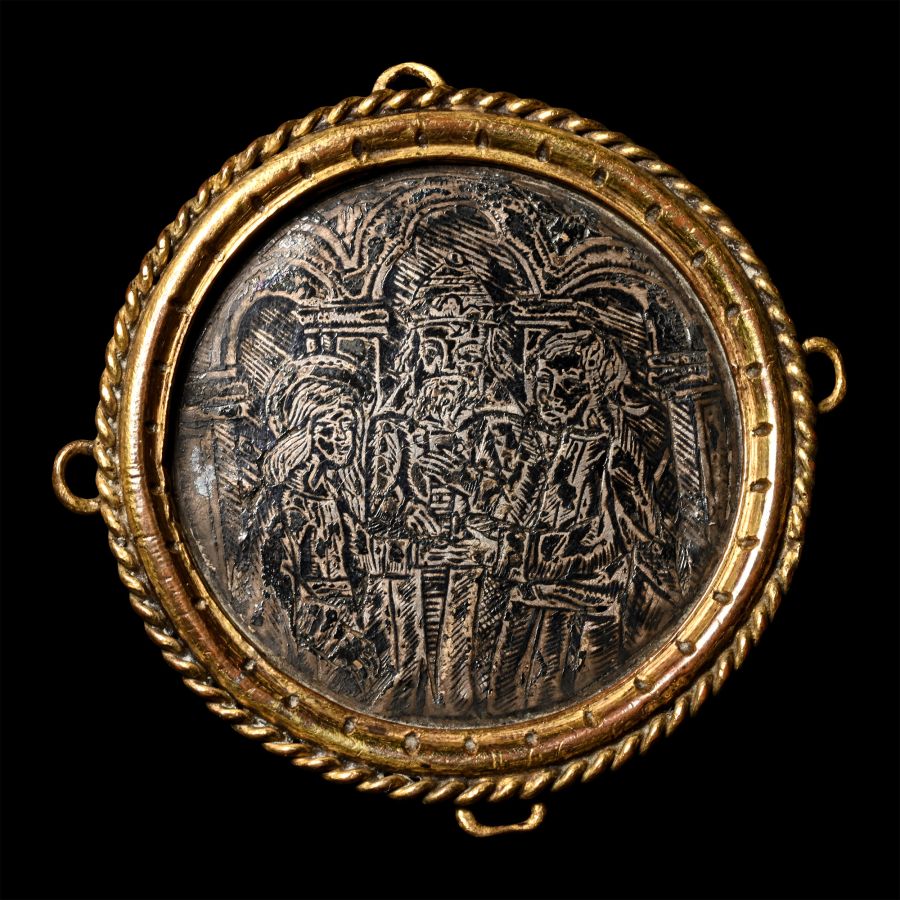
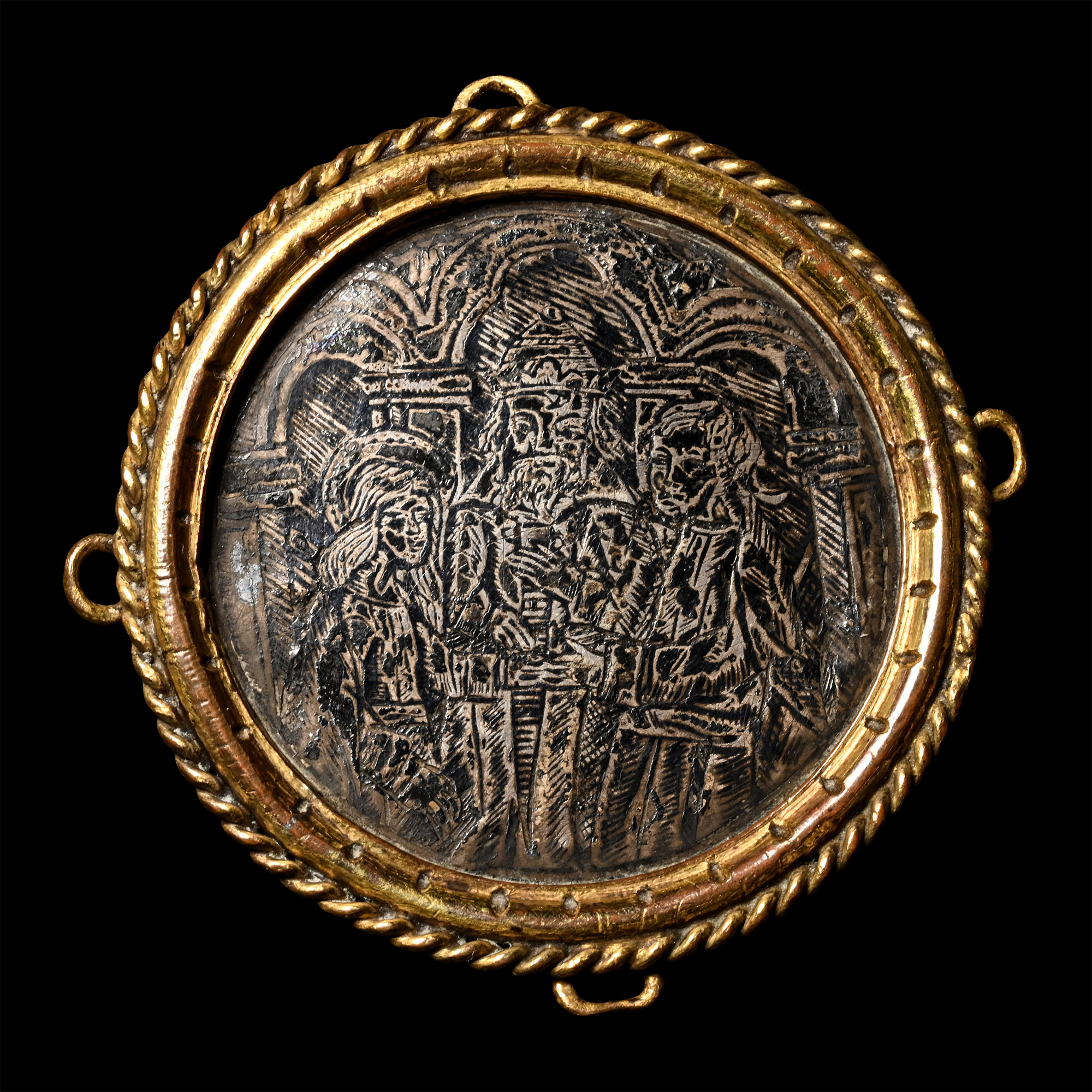
Medieval Gilt and Niello Hat Badge with Marriage of the Virgin
ITALY, CIRCA 1500 A.D.
1 3/4 in. (10.8 grams, 46 mm).
Niello plaque depicting the marriage ceremony between Mary and Joseph, set in a gilt brass mount with a rope twist border, four loops for attachment.
ProvenancePrivate collection, Europe.
Acquired on the Belgian art market.
Niello is a black mixture, usually of sulphur, copper, silver and lead. It is used as an inlay on engraved or etched metal, especially silver. It is added as a powder or paste, then fired until it melts or at least softens and flows or is pushed into the engraved lines in the metal. Men began wearing hat ornaments on their caps from the late fifteenth century, which could be either purely decorative or symbolic. Symbolic examples are traditionally known as enseignes, as they conveyed the wearer’s personal intent or a visible message. These jewels trace their origins to the medieval pilgrim badge, usually mass-produced in base metal. It is believed that this fashion shift to a stylish male accessory began when French king Charles VIII entered Naples in February 1495, wearing a gold circular jewel on his cap, while his men had similar, though not gold, jewels on their caps or sleeves. Italians quickly adopted this trend, which then spread to most European courts. However, this fashion declined in the late sixteenth to early seventeenth century, giving way to the popularity of aigrettes.
CONDITIONTimeLine Auctions follows a vetting process to ensure the authenticity and legality of all items, reinforcing our commitment to integrity and responsible trading. Each antiquity, antique, and coin lot undergoes thorough examination by a vetting committee of at least ten external specialists, professional trade association members, scientists, and archaeologists: Our Vetting Process
AUCTIONS:
TimeLine is a leading auction house specialising in antiquities, ancient art, collectables, natural history, coins, medals, and books. Our auctions offer museums, collectors, historians, and enthusiasts the opportunity to acquire unique and historically significant pieces.
LOT 0417
Medieval Gilt and Niello Hat Badge with Marriage of the Virgin
Sold for (Inc. bp): £1,430
-
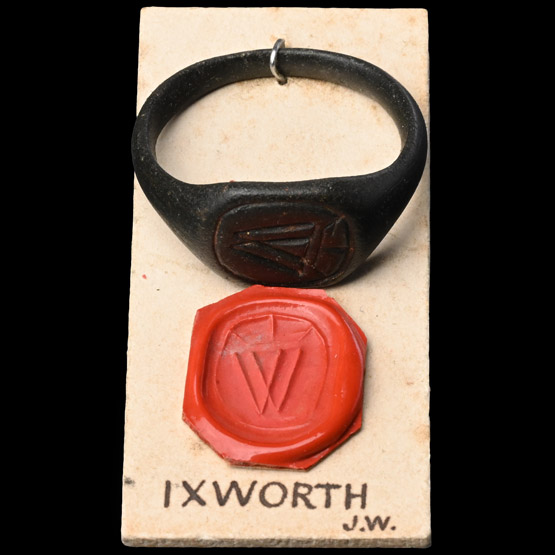
Large Medieval Bronze 'Ixworth' Signet Ring with Crowned W
15th-16th century A.D.Sold for (Inc. bp): £247
D-section hoop and ellipsoid bezel with 'W' formed as two overlapping 'V's; attached to a collector's card with sample seal impression and legend 'Ixworth J.W.'. 9.4 grams total, 25.17 mm overall, 20.84 mm internal diameter (approximate size British W, USA 11, Europe 25, Japan 24)
Found Ixworth, Suffolk, UK, by J.W. From the collection of Dame Joan Evans (1893-1977), thence gifted during her lifetime to a gentleman collector friend from South East England.
Dame Joan Evans, DBE, FSA, FRHistS, enjoyed a long and distinguished career as an author and historian. She was appointed the president of the Society of Antiquaries in 1959, the first woman to hold this position, serving until 1964. From 1948 to 1951, Joan Evans served as President of the Royal Archaeological Institute. She received the Society’s gold medal in 1973. Joan Evans was honoured with a host of honorary degrees and fellowships, as well as fellowships of the Royal Historical Society and the Royal Society of Literature. She was a Chevalier of the Légion d’Honneur and was appointed a Dame of the British Empire in 1976. She served as a trustee of both the London and the British museums, and as a member of the advisory council of the Victoria and Albert Museum. -

Medieval Wooden Bench Finial in the Form of an Elephant and Castle
England, 15th century A.D.Estimate: £3,500 - 4,500 (+bp*)
Opening Bid: £1,750
Carved stylised elephant with elongated ears supporting a palanquin in the form of a caste with a carved cross, foliage motif to the reverse; mounted on a velvet-covered stand. 1.31 kg total, 34.2 cm including stand
Private collection, Europe. Acquired on the English art market. This lot has been checked against the Interpol Database of stolen works of art and is accompanied by search certificate number no.13088-248391.
The image of an elephant carrying warriors in a howdah originated from Alexander the Great's battle against King Porus's war elephants at the Battle of Hydaspes in 326 BC. This motif became widely known in European art through the spread of Bestiaries which were medieval texts combining natural history with moralising Christian stories. One of the most well known was Matthew Paris’s imagined depictions of elephants, most notable in this case is his war elephant illustrated in Chronica maiora II, circa 1240-1255 (Cambridge, Corpus Christi College, MS 016II). Another well known manuscript - The Rochester Bestiary, circa 1230-1240 (British Library, London, Royal MS 12 F.xiii) contains a miniature with a war elephant in the midst of battle, above another image of elephants supposedly in their natural habitat. Since very few live elephants were seen in Europe during the medieval period, their representations were often more imaginative than realistic. Other Medieval bench end carvings of elephants in English churches are known, amongst them are: St Peter and St Paul, Tuttington, Norfolk; St Andrew, South Lopham, Norfolk; St Edmund, South Burlingham, Norfolk; St Andrew, Holme Hale, Norfolk. Elephants can also be found on misericords, some examples can be found at: Cathedral Church of Saint Peter, Exeter; Cathedral Church of St Peter, Gloucester; and St Mary's Church, Beverley. -
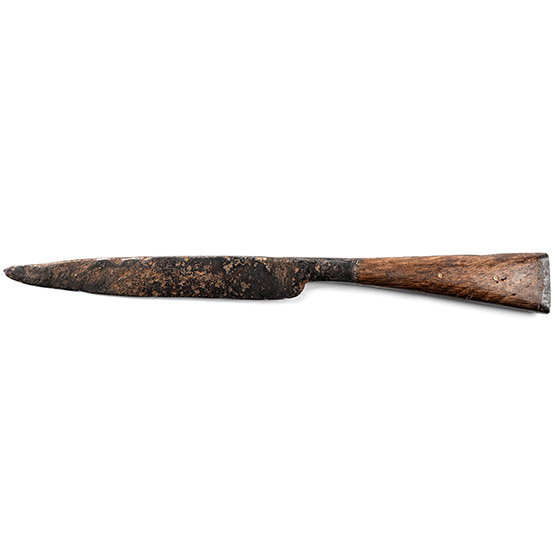
Medieval Iron Knife with Wooden Handle
Circa 1500 A.D.Sold for (Inc. bp): £130
Narrow single-edged blade with integral bolster, flared scale-tang hilt with integral finial; feint punched maker's mark 'ΛΛ' to one face. 49 grams, 21.8 cm
From an old English collection, 1980s.
