
Loading, please wait...
LOT 1743
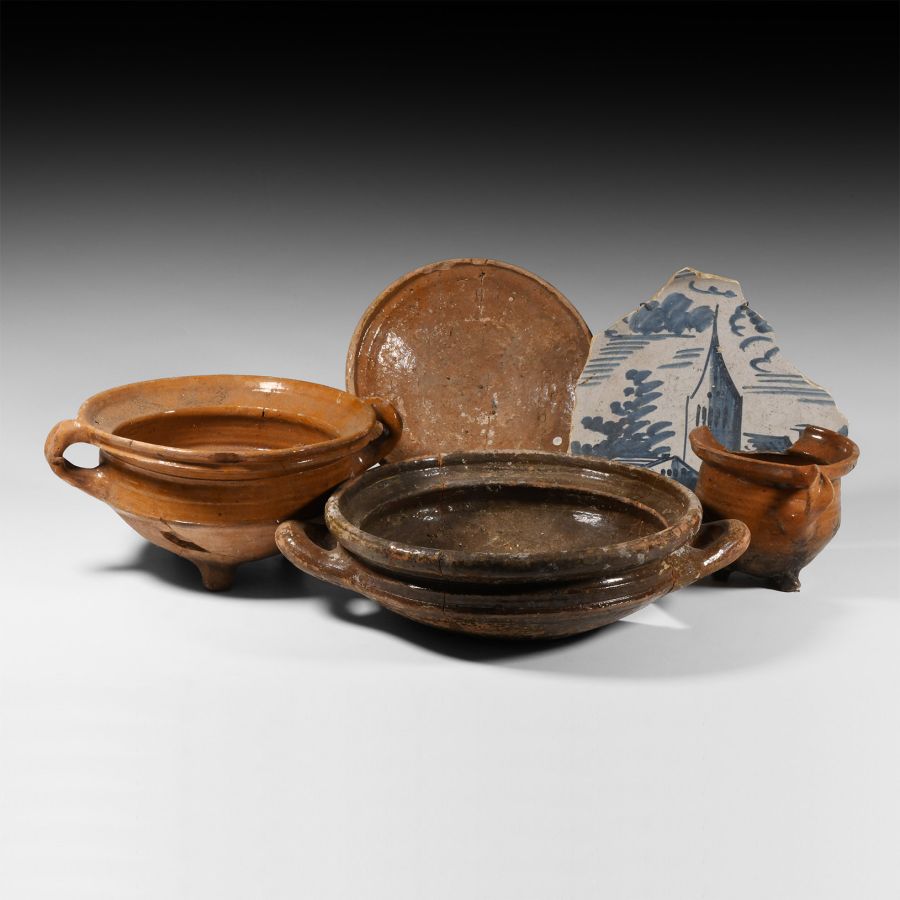
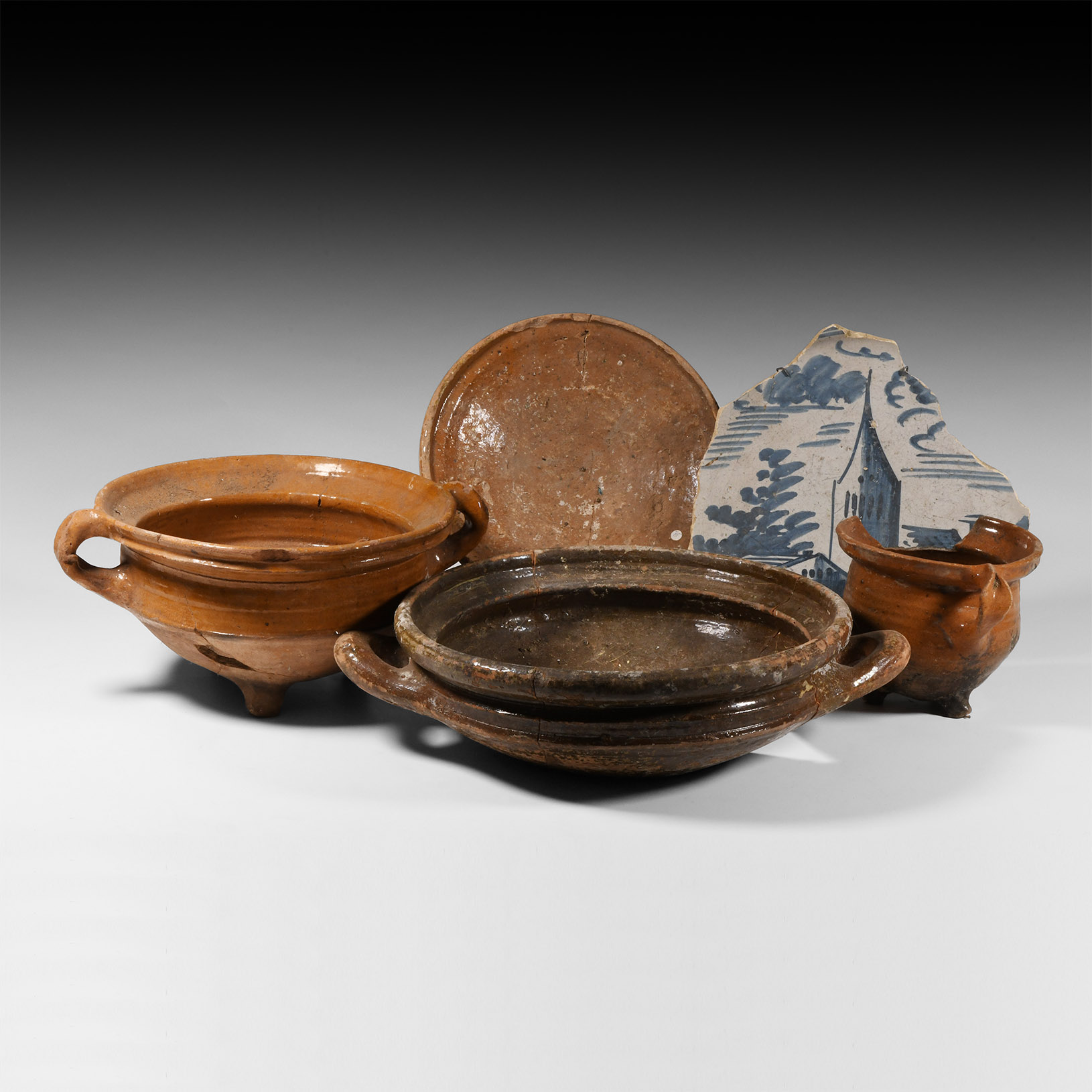
Medieval Ceramic Vessel Group
15TH CENTURY A.D. AND LATER
5 3/4 - 13 1/4 in. (4.15 kg total, 14.5-33.5 cm).
Including glazed vessels of various types: tripod pots, dishes, platters, together with a decorated fragment; chipped and cracked. [5, No Reserve]
ProvenanceAcquired 1990s-early 2000s.
East Anglian private collection.
Cf. for similar examples of redware tripods from Low Countries Brown, D., H., Pottery in Medieval Southampton, c.1066-1510, Southampton, 2002, fig.28.
FootnotesThe majority of ceramics here presented are kitchen wares. Usually cooking pots are the most numerous forms in the majority of medieval contexts. They are mostly related to domestic functions, cooking pots being used to boil food or fry it. They come in different sizes and have globular bodies, everted rims and one or two handles. Ceramics from Dundee, Scotland, and Southampton, confirm that one of the most common vessel types employed among 1490-1510 A.D. was the tripod pipkin, with globular body, rounded base, three legs and a single or double handle, like the specimen here visible. These specimens were very often redware pottery imported from the Low Countries.
CONDITIONTimeLine Auctions follows a vetting process to ensure the authenticity and legality of all items, reinforcing our commitment to integrity and responsible trading. Each antiquity, antique, and coin lot undergoes thorough examination by a vetting committee of at least ten external specialists, professional trade association members, scientists, and archaeologists: Our Vetting Process
AUCTIONS:
TimeLine is a leading auction house specialising in antiquities, ancient art, collectables, natural history, coins, medals, and books. Our auctions offer museums, collectors, historians, and enthusiasts the opportunity to acquire unique and historically significant pieces.
-
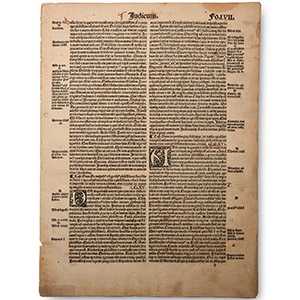
Medieval Judges Bible Page by Johann Gruninger
Printed 1492 A.D.Sold for (Inc. bp): £208
Being a single, double-sided leaf from an early printed paper Latin bible for the Book of Judges, chapters 15-18; the text set in two columns of blackletter type with numerous hand-applied rubrications (embellishments) in red, with foliation and other marks; square woodblock versals; printed by Johann Gruninger of Strasbourg with commentary by Nicholas de Lyra. 11 grams, 33 x 24.5 cm
Ex M Cummings collection, UK, 1990s-2000s. Accompanied by a Vulgate Latin text with English translation.
This portion of the Book of Judges tells of Samson slaying a thousand Philistines with the 'jawbone of an ass' together with the betrayal by Delilah, his loss of strength and capture when his hair was cut and and his eventual death by pulling down the pillars. -
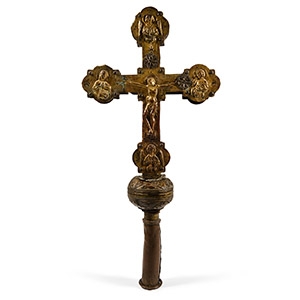
Medieval Gilt Bronze Processional Cross
15th-16th century A.D.Sold for (Inc. bp): £16,900
With wooden core to which the embossed sheets have been attached; the obverse with a central nimbate Corpus Christi, an applied rosette above and to the left arm; an angel to the finial of the upper and lower arm with Mary and St John the Evangelist to the side arms; the reverse with a central figure of Jesus holding the Gospel and making the sign of blessing; each finial of the arm with the symbols of the Evangelists (eagle, angel, lion and ox); the cross resting on a floral sphere with a socket below. 920 grams, 52.5 cm
Some damage and repair.
with Adolphe Goumaz, Pully, Switzerland. Ex private collection. Accompanied by an academic report by Dr Raffaele D’Amato. This lot has been checked against the Interpol Database of stolen works of art and is accompanied by search certificate no.11804-206500.
The metal sheets of the cross seem to be 15th century A.D. North Italian work. The four Evangelists are depicted with a human face at the front of the cross, and in animal forms at the reverse. -
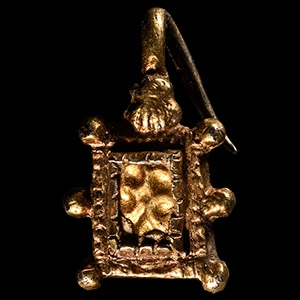
Medieval Silver-Gilt Dress Hook Fastener
14th-15th century A.D.Sold for (Inc. bp): £49
Rectangular bodied with raised central panel and knops to the perimeter, shell to top centre; hook and rectangular loop to reverse. 3.6 grams, 23 mm
Acquired on the UK market, 1990s. Property of a retired academic.
