
Loading, please wait...
LOT 1759
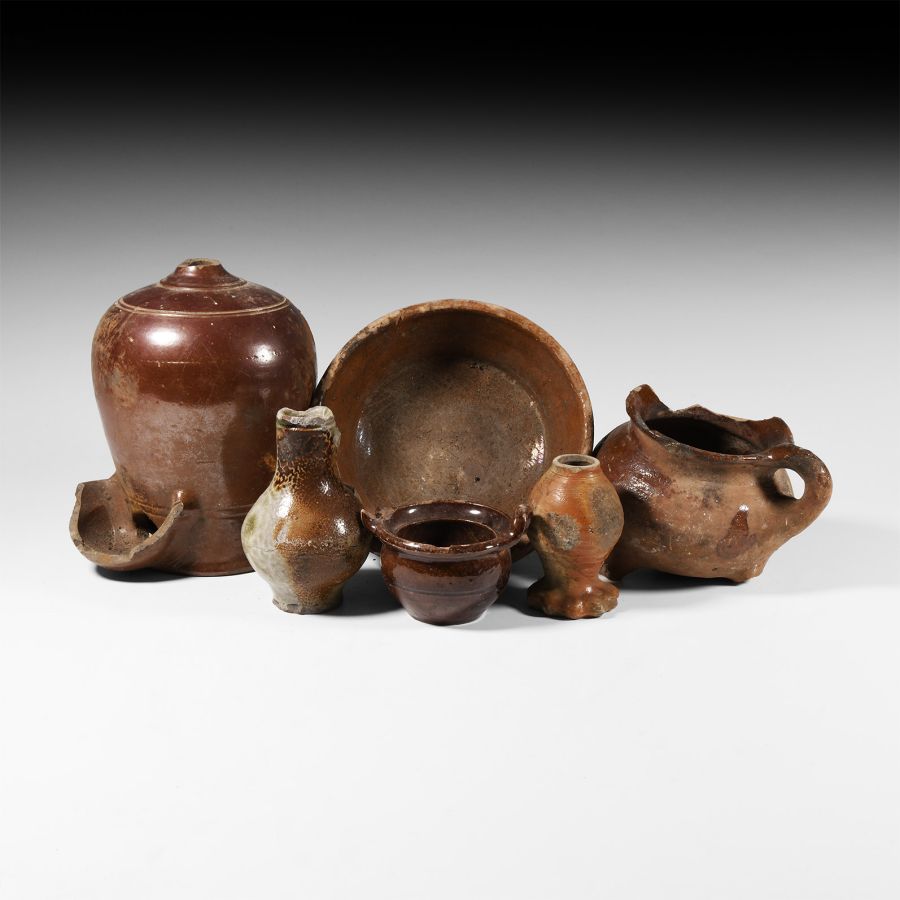
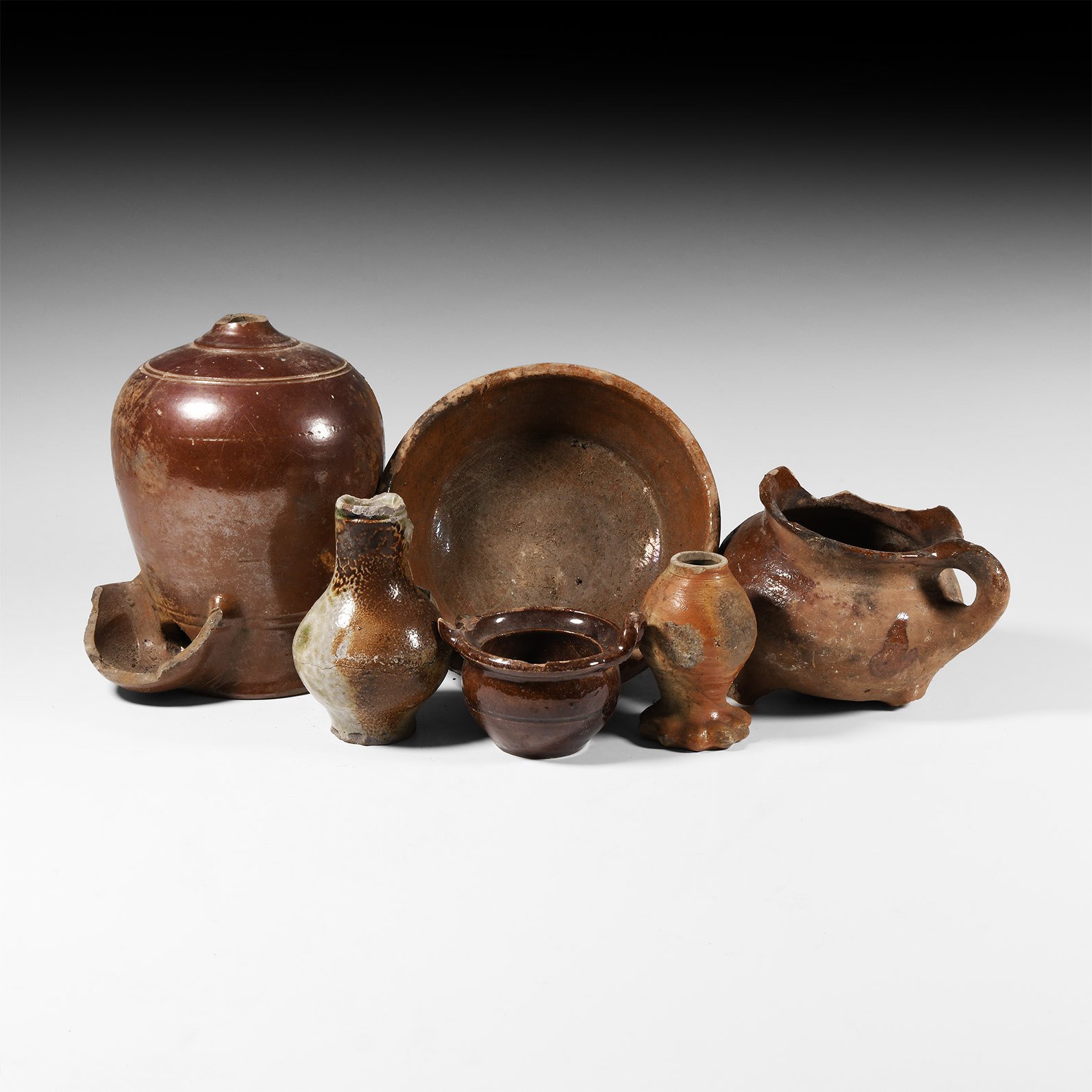
Medieval Ceramic Group
15TH CENTURY A.D. AND LATER
4 - 7 in. (3.3 kg total, 10-18 cm).
Including a jar with scalloped foot, a piriform juglet, footed pot with handle, small jar with remaining handle, likely bird water feeder and a stamped tripod dish; most glazed; most chipped or cracked. [6, No Reserve]
ProvenanceAcquired 1990s-early 2000s.
East Anglian private collection.
See similar jars in Jennings, S., Medieval Pottery in the Yorkshire Museum, York, 1992, fig.44.
FootnotesThe salt-glazed stoneware jugs, like some of the specimens here presented, had a distinctive pitted ‘orange-skin’ surface. These tall jugs often have grooves around their bodies to support them during the high-temperature firing which was necessary to achieve the hard fabric. First imported into Britain in the early 14th century stone wares became common in the 16th and 17th centuries. Most came from production centres in the Rhineland, notably Cologne, Frechen, Langerwehe, Raeren and Westerwald.
CONDITIONTimeLine Auctions follows a vetting process to ensure the authenticity and legality of all items, reinforcing our commitment to integrity and responsible trading. Each antiquity, antique, and coin lot undergoes thorough examination by a vetting committee of at least ten external specialists, professional trade association members, scientists, and archaeologists: Our Vetting Process
AUCTIONS:
TimeLine is a leading auction house specialising in antiquities, ancient art, collectables, natural history, coins, medals, and books. Our auctions offer museums, collectors, historians, and enthusiasts the opportunity to acquire unique and historically significant pieces.
-
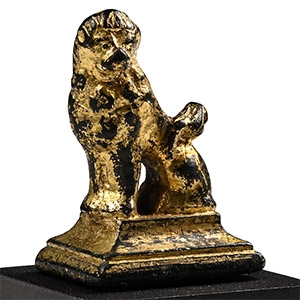
Medieval Gilt Bronze Lion Finial
14th-15th century A.D.Sold for (Inc. bp): £520
Modelled in the half-round standing with head left on a plinth base, rectangular fixing socket to underside. 25.1 grams, 32 mm high
‘The Ancient Menagerie Collection’ formerly the property of a Cambridgeshire lady, collected since the 1990s and acquired from auctions and dealers throughout Europe and the USA, now ex London collection. -
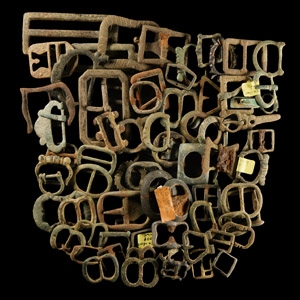
Medieval and Later Bronze Buckle Collection
Circa 12th-20th century A.D.Sold for (Inc. bp): £39
Comprising a variety buckle types and sizes from a broad range of time periods, including examples with trace remains of gilding; decoratively shaped and incised examples; together with a small number retaining their tongues or straps. 306 grams total, 13-61 mm
Found Berkshire, UK. -
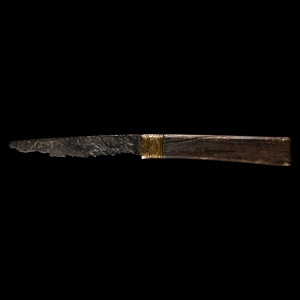
Medieval 'Thames' Iron Knife with Bone Handle
15th-16th century A.D.Sold for (Inc. bp): £91
Blade with single cutting edge and punched motifs to spine near the neck; bolster displaying engraved panels to both faces; shaped handle with sub-triangular cross-section. 24 grams, 17.5 cm
Found Billingsgate spoil from the Thames foreshore, London, UK.
