
Loading, please wait...
_900x900.jpg "Medieval Bronze Vesica-Shaped Seal Matrix")
_200x200.jpg "Medieval Bronze Vesica-Shaped Seal Matrix")
.jpg "Medieval Bronze Vesica-Shaped Seal Matrix")
LOT 1611
Medieval Bronze Vesica-Shaped Seal Matrix
CIRCA 13TH CENTURY A.D.
1 1/8 in. (5.99 grams, 28 mm).
With intaglio robed figure to the centre and surrounding legend: '+ AMIE AEI AVEI.'. [No Reserve]
ProvenanceFound Odiham, Hampshire, UK.
FootnotesThis is an amatory legend, such are not uncommon on personal seals. It seems likely that the intended inscription was that found on a gold finger ring from Essex in the 18 century, i.e. 'AMI AMES AMIE AVES' [Beloved, love! You have a beloved!], also see a brooch on the PAS database under reference no.BUC-B93E93, which reads 'AMIE AMEZ A'.
CONDITIONTimeLine Auctions follows a vetting process to ensure the authenticity and legality of all items, reinforcing our commitment to integrity and responsible trading. Each antiquity, antique, and coin lot undergoes thorough examination by a vetting committee of at least ten external specialists, professional trade association members, scientists, and archaeologists: Our Vetting Process
AUCTIONS:
TimeLine is a leading auction house specialising in antiquities, ancient art, collectables, natural history, coins, medals, and books. Our auctions offer museums, collectors, historians, and enthusiasts the opportunity to acquire unique and historically significant pieces.
-
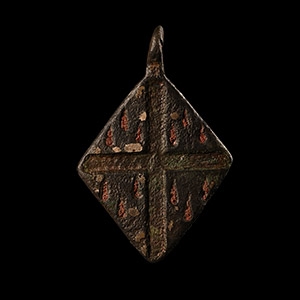
Medieval Knight's Heraldic Horse Harness Pendant
14th-15th century A.D.Estimate: £180 - 240 (+bp*)
Opening Bid: £90
Lozengiform with integral loop, reserved cross on an ermine field. 16 grams, 48 mm
Found Romney Marsh area, 2023. Property of a Kent gentleman. -
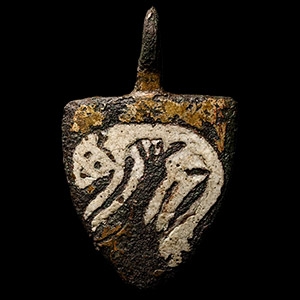
Medieval Gilt Bronze Knight's Heraldic Horse Harness Pendant
13th-14th century A.D.Sold for (Inc. bp): £312
Heater-shield shaped with integral suspension loop, a stylised lion facing left in white enamel against remains of a gilt field. 11.1 grams, 41 mm
Acquired early 1990s. From an East Anglian private collection. -
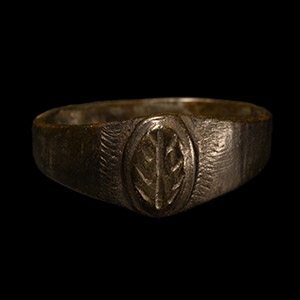
Medieval Bronze Ring with Olive Branch
Circa 15th-16th century A.D.Sold for (Inc. bp): £78
Composed of a roughly flat-section hoop with expanded shoulders and stepped oval bezel engraved with a stylised olive branch, flanking shallow zigzags. 3.86 grams, 24.84 mm overall, 22.88 mm internal diameter (approximate size British W, USA 11, Europe 25, Japan 24)
Private collection formed since the 1940s. UK art market. Property of an Essex gentleman.
