
Loading, please wait...
_900x900.jpg "Medieval Bronze Vesica-Shaped Seal Matrix")
_200x200.jpg "Medieval Bronze Vesica-Shaped Seal Matrix")
.jpg "Medieval Bronze Vesica-Shaped Seal Matrix")
LOT 1767
Medieval Bronze Vesica-Shaped Seal Matrix
13TH-14TH CENTURY A.D.
1 1/8 in. (4.98 grams, 28 mm).
With central intaglio fleur-de-lys motif and legend 'S' SECI.I[..]ITA; strap and loop to the reverse. [No Reserve]
ProvenanceFound Nottinghamshire, UK.
CONDITIONTimeLine Auctions follows a vetting process to ensure the authenticity and legality of all items, reinforcing our commitment to integrity and responsible trading. Each antiquity, antique, and coin lot undergoes thorough examination by a vetting committee of at least ten external specialists, professional trade association members, scientists, and archaeologists: Our Vetting Process
AUCTIONS:
TimeLine is a leading auction house specialising in antiquities, ancient art, collectables, natural history, coins, medals, and books. Our auctions offer museums, collectors, historians, and enthusiasts the opportunity to acquire unique and historically significant pieces.
-
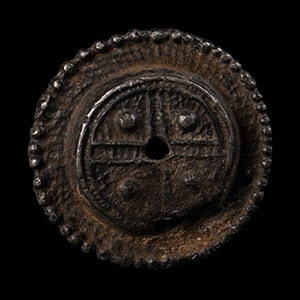
Medieval Pewter Pilgrim's Badge with Voided Cross and Pellets
14th-15th century A.D.Sold for (Inc. bp): £65
Hatched flange rim with border of pellets, raised body pierced at centre and close to rim. 7.31 grams, 31 mm
From the collection of a North American gentleman, formed in the 1990s.
The medallic form of badge appears to develop during the 15th century. The symbols of the straight cross and annulets are already visible in tokens from London. During the medieval period, pewter and leaden tokens probably served a common purpose throughout England, France and the Low Countries. -
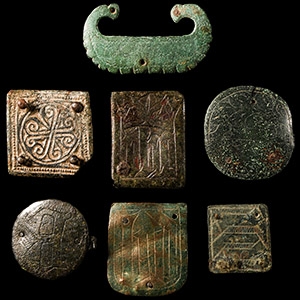
Medieval Belt and Other Mounts Group
13th-15th century A.D.Sold for (Inc. bp): £46
The majority bearing initials, including a crowned IHC monogram; blackletter 'B'; a possible cross cercelee within a double roundel and pellet border; together with other motifs and initials. 59 grams total, 27-52 mm
Acquired on the UK market, 1990s. Property of a retired academic. -
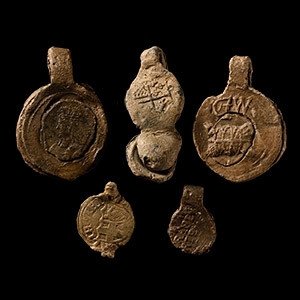
Medieval Lead Bag and Tax Seal Group
14th century A.D. and laterSold for (Inc. bp): £26
One bearing the bust of a crowned monarch; one with GW over a madder-bag, showing that he was a dyer; one with partial legend within beaded border to one face and coat of arms to the other; one with partial legend 'THE [COMMON WEA]LTH' and arms of the Commonwealth (1649- 1660); one bearing a cloth-worker's privy mark. 35.5 grams total, 18-32 mm
Acquired on the UK market, 1990s. Property of a retired academic.
Elton explains (p.269) that though similar in shape to a wool-sack, the madder-bag 'has a series of criss-crossing lines representing the cordage holding its contents in place during the vigorous dyeing process'.
