
Loading, please wait...
_900x900.jpg "Medieval Bronze Vesica-Shaped Seal Matrix with Virgin and Child")
_200x200.jpg "Medieval Bronze Vesica-Shaped Seal Matrix with Virgin and Child")
.jpg "Medieval Bronze Vesica-Shaped Seal Matrix with Virgin and Child")
LOT 0399
Medieval Bronze Vesica-Shaped Seal Matrix with Virgin and Child
CIRCA 13TH-15TH CENTURY A.D.
1 1/8 in. (6.82 grams, 30 mm).
With central 'Virgin and Child' motif and head of supplicant beneath, pelletted border and legend '* AVE MARIA GRACIA PL' (Hail Mary [full of] grace); strap and loop to the reverse.
ProvenanceFound Southern England.
Acquired on the UK art market in the 1980s.
From an East Anglian private collection.
TimeLine Auctions follows a vetting process to ensure the authenticity and legality of all items, reinforcing our commitment to integrity and responsible trading. Each antiquity, antique, and coin lot undergoes thorough examination by a vetting committee of at least ten external specialists, professional trade association members, scientists, and archaeologists: Our Vetting Process
AUCTIONS:
TimeLine is a leading auction house specialising in antiquities, ancient art, collectables, natural history, coins, medals, and books. Our auctions offer museums, collectors, historians, and enthusiasts the opportunity to acquire unique and historically significant pieces.
LOT 0399
Medieval Bronze Vesica-Shaped Seal Matrix with Virgin and Child
Sold for (Inc. bp): £234
-
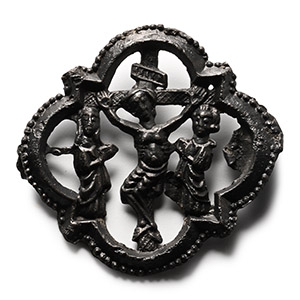
Published Medieval 'Thames' Pewter Rood Group Pilgrim's Badge with Crucifixion Scene
Circa 14th-15th century A.D.Sold for (Inc. bp): £442
Openwork badge comprising a quatrefoil frame with interstitial barbs, beaded rim; central crucifixion scene; remains of pin-lug to the reverse. 6.46 grams, 39 mm
Found Billingsgate spoil from the Thames foreshore, London, UK, circa 1984. Property of an Essex collector.
A group of figures of this type is called the 'rood group' and was traditionally displayed, before the Reformation, in church on the 'rood screen', from Old English rod 'sign, emblem, display' referring to the visual depiction of the Crucifixion. -
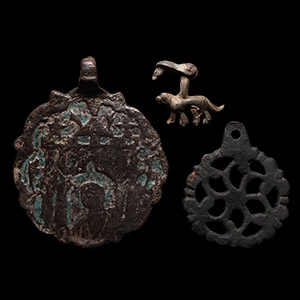
Medieval Bronze Knight's Heraldic Horse Harness Pendant Group
13th-15th century A.D.Sold for (Inc. bp): £156
Comprising: a talbot on a hinged attachment stud; an openwork rosette; an enamelled plaque with scene of a figure beneath an arch. 50.4 grams total, 34-66 mm
Found UK. Acquired on the UK art market after 2000. Ex Stratford collection, Suffolk, UK. -
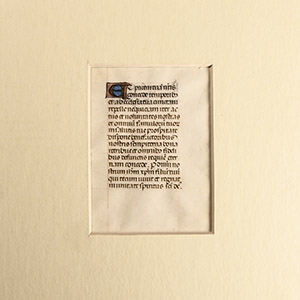
Medieval Illuminated Book of Hours Vellum Manuscript Page
Rome, 1460-1470 A.D.Sold for (Inc. bp): £85
With fifteen lines of Latin text in blackletter script; burnished gold capital on red and blue; in a cardboard mount with reveal. 96 grams, 25.5 x 20.5 cm
Acquired on the UK art market in 2016. Property of a Nottinghamshire gentleman.
