
Loading, please wait...
_900x900.jpg "Medieval Bronze Vesica-Shaped Seal Matrix with Falcon")
_200x200.jpg "Medieval Bronze Vesica-Shaped Seal Matrix with Falcon")
.jpg "Medieval Bronze Vesica-Shaped Seal Matrix with Falcon")
LOT 0404
Medieval Bronze Vesica-Shaped Seal Matrix with Falcon
CIRCA 14TH-15TH CENTURY A.D.
1 1/8 in. (8.7 grams, 30 mm).
With central falcon on the wrist with its jesses hanging down, linear border and legend 'FRANGE LEGE TEGE' (BREAK (the seal), READ (the contents of the letter), CONCEAL (the contents)); strap and loop to the reverse.
ProvenanceFound Southern England.
Acquired on the UK art market in the 1980s.
From an East Anglian private collection.
The legend is a functional instruction - commonly found on seals.
CONDITIONTimeLine Auctions follows a vetting process to ensure the authenticity and legality of all items, reinforcing our commitment to integrity and responsible trading. Each antiquity, antique, and coin lot undergoes thorough examination by a vetting committee of at least ten external specialists, professional trade association members, scientists, and archaeologists: Our Vetting Process
AUCTIONS:
TimeLine is a leading auction house specialising in antiquities, ancient art, collectables, natural history, coins, medals, and books. Our auctions offer museums, collectors, historians, and enthusiasts the opportunity to acquire unique and historically significant pieces.
-
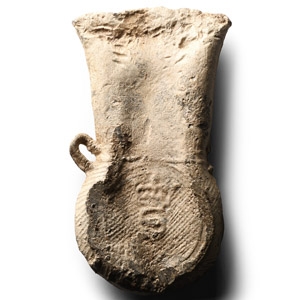
Medieval Lead Pilgrim's Holy Water Ampulla
Circa 14th-15th century A.D.Sold for (Inc. bp): £117
With scallop detailing to one face of the bulb, hatched panel to the reverse with crowned 'S'. 46.7 grams, 57 mm
Found Norfolk, Southern England. Acquired on the UK art market in the 1980s. From an East Anglian private collection. Accompanied by an old Norfolk Castle Museum record slip. -
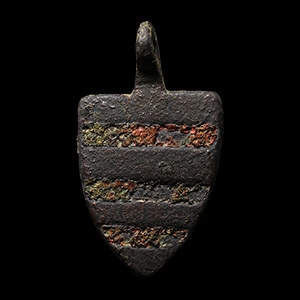
Medieval Knight's Enamelled Bronze 'Rochefort Family' Heraldic Horse Harness Pendant
14th-15th century A.D.Sold for (Inc. bp): £143
On a heater-shaped shield with pierced loop at the apex, three horizontal bars with the remains of red enamel; possibly descended from Rochefort de Chars of Gasc. 10.05 grams, 39.64 mm
Found Norfolk, UK, circa 1990s. -
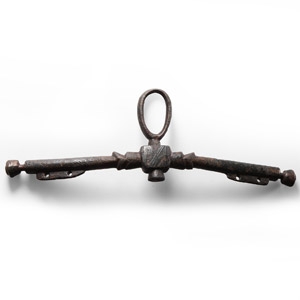
Medieval Niello Inlaid Bronze Purse Bar
15th-16th century A.D.Estimate: £100 - 140 (+bp*)
Opening Bid: £50
Classified as a Williams Class A1 with rectangular central section, two expanding round-section arms with devolved gripping animal heads projecting from the central section; pierced attachment lobes below the arms; articulate central swivel; niello-inlaid double crisscross motif to arms and central section of both faces. 95.9 grams, 17 cm
Ex property of a Kent gentleman; found Romney Marsh area, Kent, UK, 1990-2015. Property of a Buckinghamshire, UK, gentleman.
