
Loading, please wait...
LOT 0348
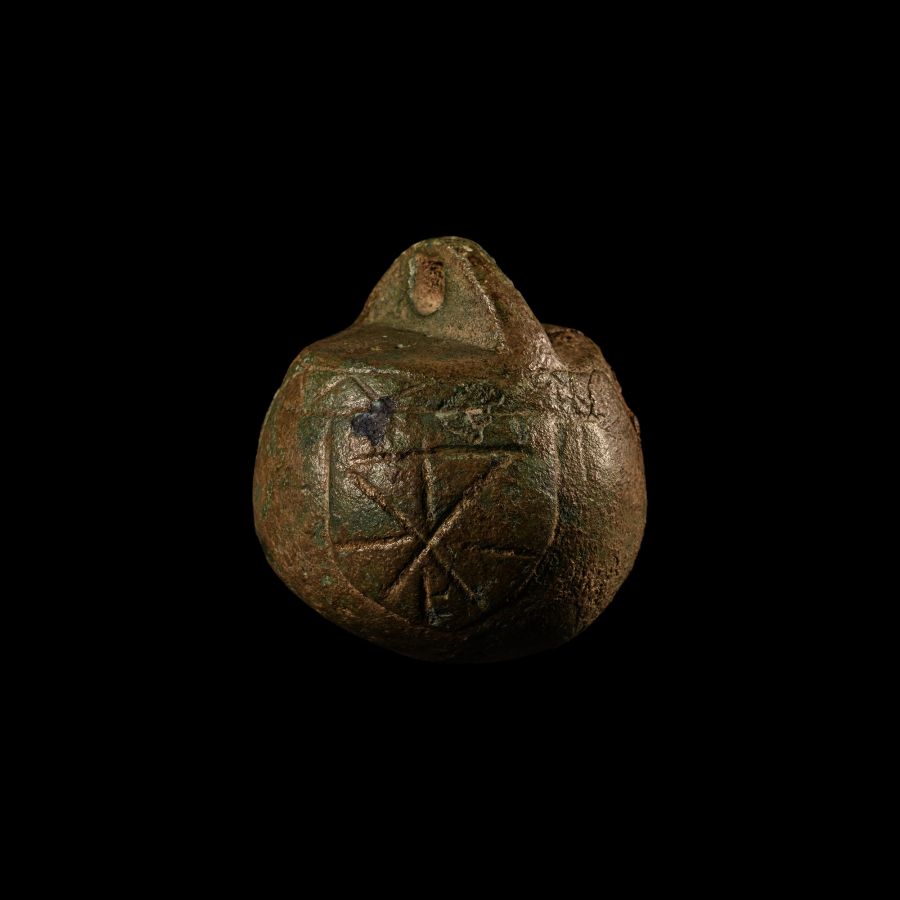
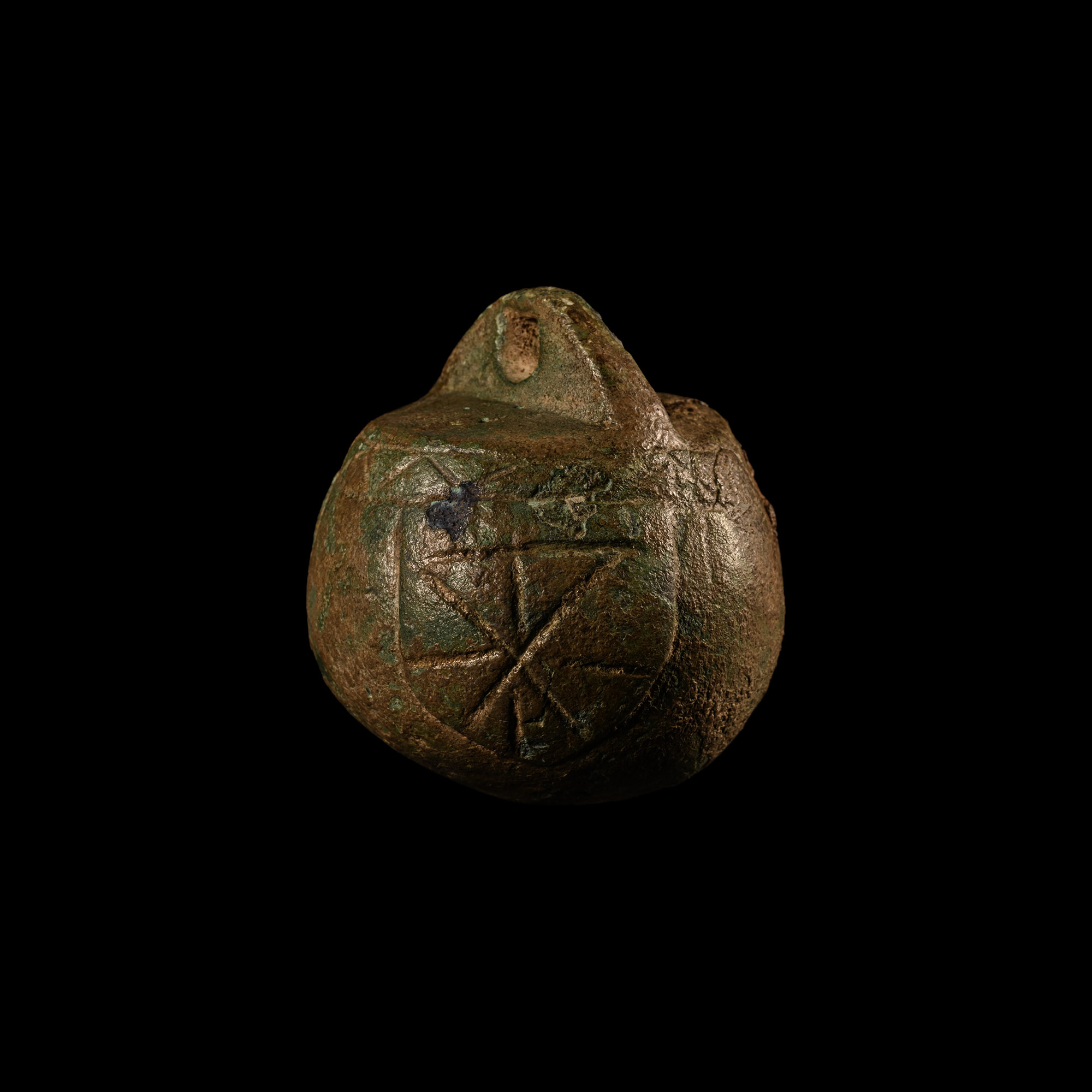
Medieval Bronze Steelyard Weight with Heraldic Shields
CIRCA 1260-1300 A.D.
2 1/4 in. (615 grams, 56 mm).
Heavy with a lead core, spherical in form with pierced flange for suspension above and hatched band to the shoulder; an unusal unofficial copy with three heater shields with raised heraldic arms spaced equally around the body, etched geometric band of chevrons above. [No Reserve]
ProvenanceEx Simmons Gallery, London E11, UK, in the 1990s.
From a North London collection.
For official examples see: Saunders, Peter and Eleanor, Salisbury & South Wiltshire Museum Medieval Catalogue, Part 1, SSWM, 1991, p.48, item 1, for an example displaying the same heraldry; cf. Ward Perkins, J. B., Medieval Catalogue, London Museum Catalogues 7, 1940, p.173, item A2487, pl.XXXVIII, 2, for another example.
FootnotesThese heraldic steelyard weights were originally made under the official sanction of Richard (brother of King Henry III) or Edmund, Duke of Cornwall on behalf of the King; Edmund died in 1300 A.D. and such weights were banned in 1350. This example would most likely have been made unofficially towards the end of the period 1260-1300 A.D. The Hanseatic League was created in Germany to protect the interests and privileges of merchants in the medieval period, starting in Europe and with influence spreading to England from the 13th century.
CONDITIONTimeLine Auctions follows a vetting process to ensure the authenticity and legality of all items, reinforcing our commitment to integrity and responsible trading. Each antiquity, antique, and coin lot undergoes thorough examination by a vetting committee of at least ten external specialists, professional trade association members, scientists, and archaeologists: Our Vetting Process
AUCTIONS:
TimeLine is a leading auction house specialising in antiquities, ancient art, collectables, natural history, coins, medals, and books. Our auctions offer museums, collectors, historians, and enthusiasts the opportunity to acquire unique and historically significant pieces.
-
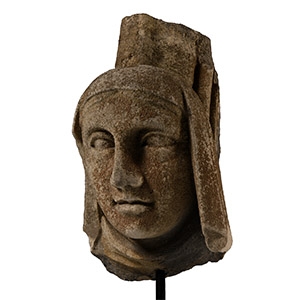
Medieval Limestone Corbel Head
Circa 14th century A.D.Sold for (Inc. bp): £2,210
The figure carved wearing a hooded cowl, face face with furrowed brow, hooded eyes, sunken cheeks and down-turned mouth; remains of moulded springer to the top and rear of the head; chipped; mounted on a custom-made display stand. 3.8 kg, 28 cm including stand
Ex Simmons Gallery, London E11, UK. Ex London collection, 1980s-1990s. -
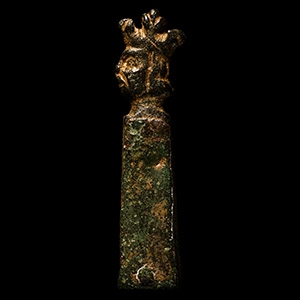
Medieval Bronze Strap End with Crowned Head of a King
14th-15th century A.D.Sold for (Inc. bp): £91
The tapering rectangular body retaining two rivets, terminal formed as a crowned king's head with bifacial detailing. 5.6 grams, 40 mm
Found Cambridgeshire, UK. Acquired on the UK market, 1990s. Property of a retired academic. -
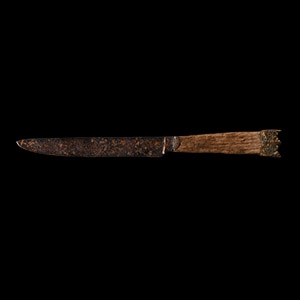
Medieval Iron Knife with Bronze Pommel
Late 14th century A.D.Sold for (Inc. bp): £187
Comprising a single cutting edge; scale tang with pommel formed as a bifacial crown with incised detailing; Netherlands. 31 grams, 18.3 cm
Acquired 1960s-1990s. Late Alison Barker collection, a retired London barrister.
Knife handles can be classified according to their method of attachment into whittle and scale-tang handles. Whittle-tang handles were the most common type used in the early medieval period. Whittle tang handles (like here) were more common later and fixed by pushing the pointed end of the knife tang into the handle.
