
Loading, please wait...
LOT 1937
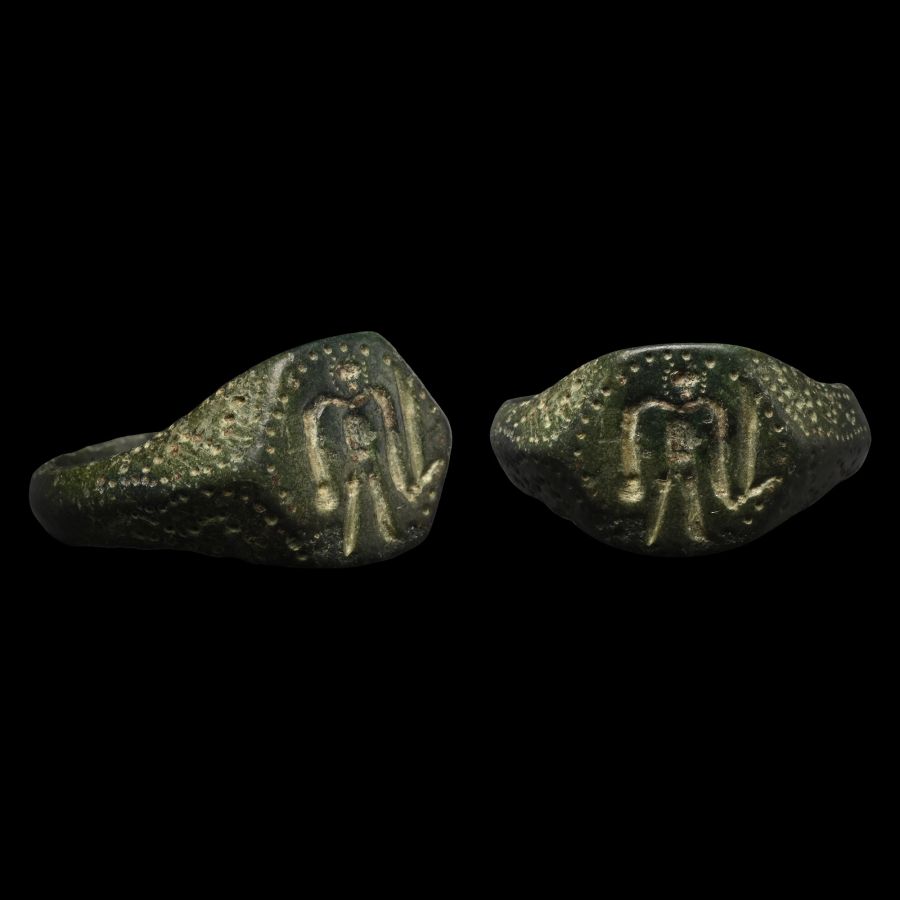
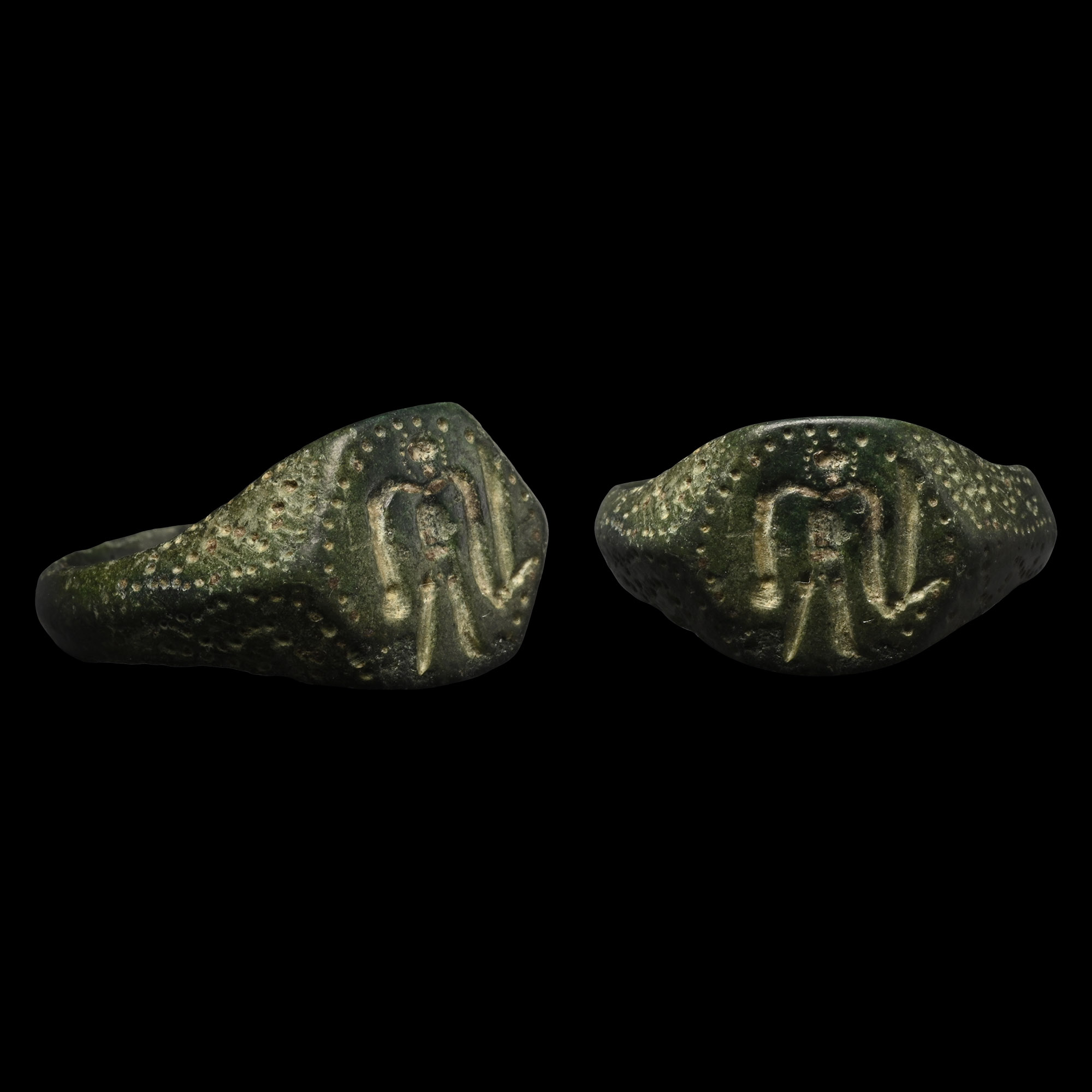
Medieval Bronze Ring with Warrior
16TH CENTURY A.D.
1 in. (7.78 grams, 24.23 mm overall, 19.54 mm internal diameter (approximate size British R 1/2, USA 9 3/4, Europe 19.38, Japan 18)).
The hoop with keeled shoulders with lines of pointillé decoration, a hexagonal bezel with an incuse stylised figure. [No Reserve]
ProvenanceAcquired on the UK and EU art market before 2000.
From the private collection of a Surrey, UK, gentleman.
Cf. for the type Bailey, G., Detector finds 6, Witham, 2005, p.30, fig.C8.17 (hexagonal signet ring).
FootnotesThe finger rings worn by merchants and tradesmen were made of different metals. The commonest were in brass or bronze. The merchants and tradesmen ordered various devices to be engraved on the bezels of their rings, and sometimes they gave the appearance of heraldic blazons.
CONDITIONTimeLine Auctions follows a vetting process to ensure the authenticity and legality of all items, reinforcing our commitment to integrity and responsible trading. Each antiquity, antique, and coin lot undergoes thorough examination by a vetting committee of at least ten external specialists, professional trade association members, scientists, and archaeologists: Our Vetting Process
AUCTIONS:
TimeLine is a leading auction house specialising in antiquities, ancient art, collectables, natural history, coins, medals, and books. Our auctions offer museums, collectors, historians, and enthusiasts the opportunity to acquire unique and historically significant pieces.
-
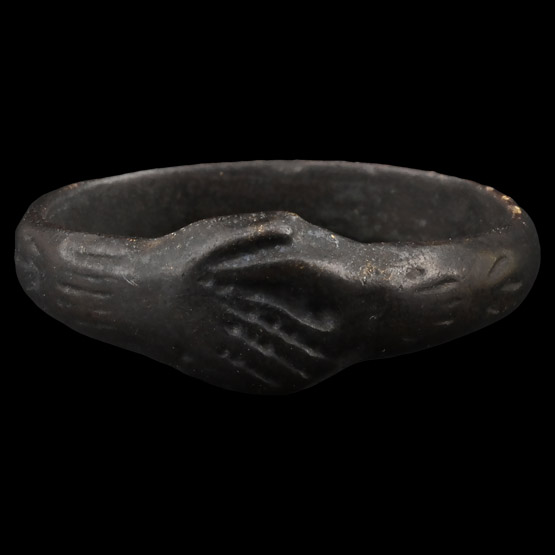
Medieval Bronze Clasped Hands Wedding Ring
15th-16th century A.D.Sold for (Inc. bp): £117
Bezel formed as two hands clasped in mane in fede motif. 3.17 grams, 23.17 mm overall, 19.19 mm internal diameter (approximate size British R 1/2, USA 8 3/4, Europe 19.38, Japan 18)
Ex German art market, 2000s. Acquired from an EU collector living in London. From the collection of a Surrey, UK, gentleman. -
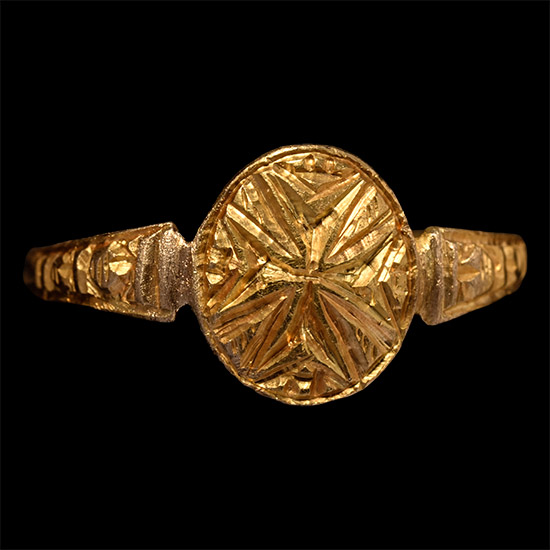
'The Dummer' Medieval Knight's Hospitaller Gold Ring
England, circa 1500-1540 A.D.Sold for (Inc. bp): £4,680
Featuring a sub-circular integral bezel decorated with an eight-armed Maltese cross with some incised decoration in its foils and a sub-circular border with traces of enamel in the field; the moulded shoulders bordered by a long triangle terminating with a long sub-oval indentation, slightly raised and decorated with two parallel lines and two circles with lines through the middle, possibly a stylised letter 'G', the shoulders tapering slightly to the narrowest section of the now straightened narrow and undecorated band. 1.21 grams, 18.40 mm overall, 16.62 mm internal diameter (approximate size British L 1/2, USA 6, Europe 11.87, Japan 11)
Found Dummer, Basingstoke and Deane, Hampshire, UK; declared as Treasure under the Treasure Act and disclaimed. Accompanied by a copy of a letter explaining that the Crown’s interest in this find has been disclaimed. Accompanied by a copy of the Report on find of Potential Treasure for H M Coroner no.2023 T292. Accompanied by a copy of the British Museum's Portable Antiquities Scheme (PAS) report no.HAMP-463CD7.
This motif is symbolic of membership in an Order of Knights Hospitaller, such as the Order of St John. In England, these Knights ceased to hold property after 1540 and the English Reformation. This suggests that the ring is from the earlier part of the sixteenth century. However, the letter 'G' is a prominent symbol of Freemasonry, where it typically stands for Geometry and/or God, the 'Grand Architect of the Universe'. -
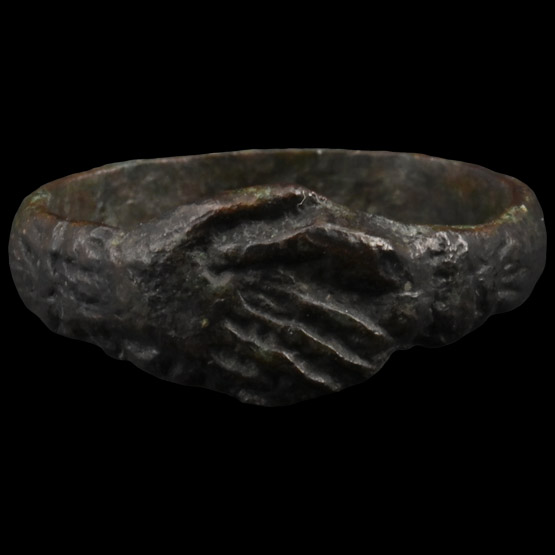
Medieval Bronze Clasped Hands Wedding Ring
15th-16th century A.D.Sold for (Inc. bp): £78
D-section hoop with bezel formed as two clasped hands in 'mane in fede' motif. 2.38 grams, 19.49 mm overall, 16.13 mm internal diameter (approximate size British K, USA 5 1/4, Europe 9.95, Japan 9)
Ex German art market, 2000s. Acquired from an EU collector living in London. From the collection of a Surrey, UK, gentleman.
