
Loading, please wait...
_900x900.jpg "Medieval Bronze Ring with Sun Motif")
_200x200.jpg "Medieval Bronze Ring with Sun Motif")
.jpg "Medieval Bronze Ring with Sun Motif")
LOT 1925
Medieval Bronze Ring with Sun Motif
14TH-16TH CENTURY A.D.
1 in. (11.49 grams, 26.04 mm overall, 19.37 mm internal diameter (approximate size British R, USA 8 1/2, Europe 18 3/4, Japan 18)).
Comprising a D-section shank with stud to the underside, drum-shaped bezel with impressed central starburst. [No Reserve]
ProvenanceEx German art market, 2000s.
Acquired from an EU collector living in London.
From the collection of a Surrey, UK, gentleman.
Cf. for the type of ring one of the rings found in the Hoard of Fishpool, in Leahy, K., Lewis, M., Finds Identified II, Dress fittings & ornaments, Witham, 2020, p.268.
CONDITIONTimeLine Auctions follows a vetting process to ensure the authenticity and legality of all items, reinforcing our commitment to integrity and responsible trading. Each antiquity, antique, and coin lot undergoes thorough examination by a vetting committee of at least ten external specialists, professional trade association members, scientists, and archaeologists: Our Vetting Process
AUCTIONS:
TimeLine is a leading auction house specialising in antiquities, ancient art, collectables, natural history, coins, medals, and books. Our auctions offer museums, collectors, historians, and enthusiasts the opportunity to acquire unique and historically significant pieces.
-
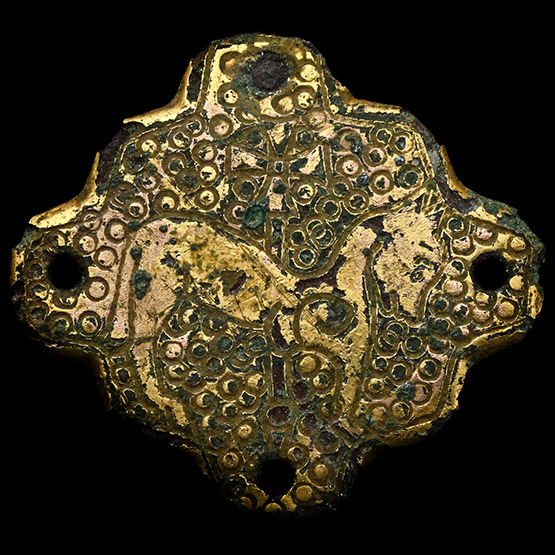
Medieval Knight's Gilt Bronze Agnus Dei Horse Harness Mount
Circa 1100 A.D.Sold for (Inc. bp): £286
Octofoil mount with four attachment holes, agnus dei motif in profile reserved against a pounced field. 11.3 grams, 41 mm
Found Shottesbrooke, Windsor and Maidenhead, UK. Accompanied by a copy of the British Museum's Portable Antiquities Scheme (PAS) report no.SUR-D59AA0.
The image represents the Agnus Dei, a visual representation of Jesus as a lamb, which is more normally shown with a flag. The intensive use of punched annulets is often found on harness pendants of 12th-century date. -
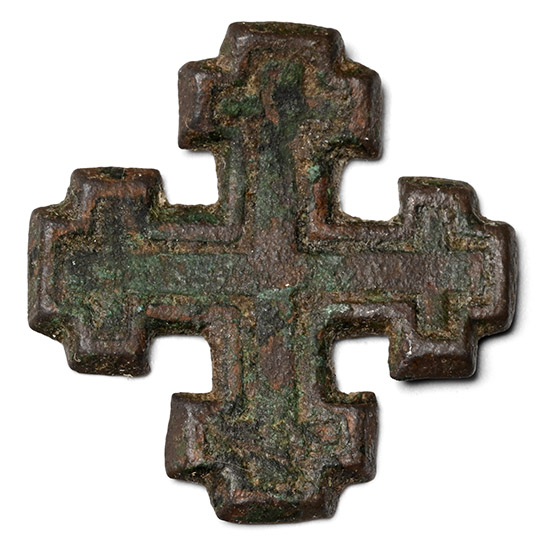
Medieval Bronze Knight's Holy Sepulchre Badge
Circa 13th-14th century A.D.Sold for (Inc. bp): £59
Formed as a cross-crosslet, the symbol of the Knights of the Holy Sepulchre, with a punched-point border. 1.5 grams, 23 mm
Found Suffolk, UK.
The 'Equestrian Order of the Holy Sepulchre of Jerusalem' was an order of knighthood under the protection of the Pope, formed around 1099 AD by Duke Godfrey of Bouillon, the leader of the First Crusade. It was established for the protection of pilgrims travelling to the Holy Land and was recognised by a Papal Bull in about 1113 AD. -
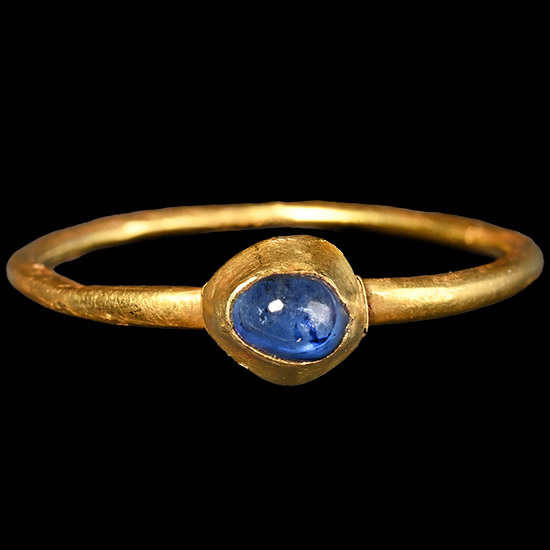
Medieval Gold Ring with Cabochon Sapphire
13th-14th century A.D.Sold for (Inc. bp): £4,160
Featuring a large round-section hoop and raised cell set with a polished sapphire cabochon. 2.03 grams, 26.68 mm overall, 19.10 x 19.45 mm internal diameter (approximate size British R 1/2, USA 8 3/4, Europe 19.38, Japan 18)
Acquired on the European art market. This lot has been checked against the Interpol Database of stolen works of art and is accompanied by search certificate number no.13388-258005.
During the Middle Ages, gemstones were often associated with magical and protective properties they were believed to possess. Gemstones could protect against evil or poisons, as well as heightening the individual’s characteristics and strengths. Sapphires were frequently worn by Bishops and other clergy, due to their ability to promote their bearer’s chastity and piety. Sapphires were believed to be able to change colour if the wearer acted sinfully or lacked faith; it was because of this belief that jewels set with sapphires were worn as symbols of honesty and devout faith.
