
Loading, please wait...
LOT 1949
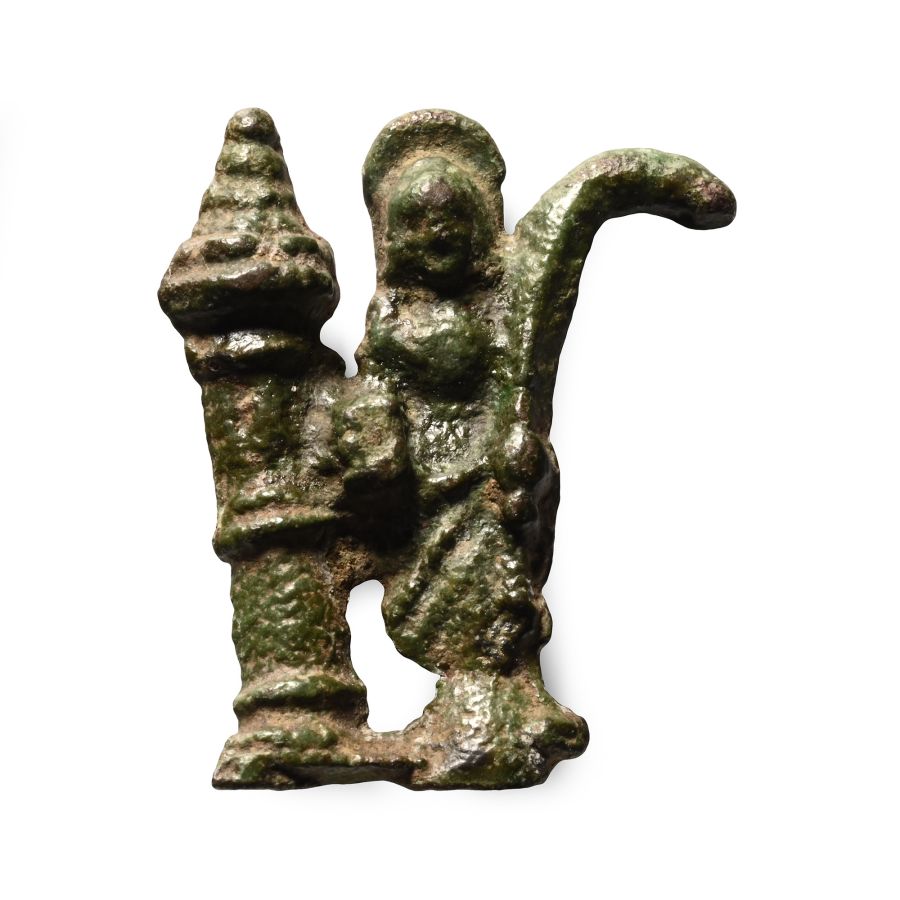
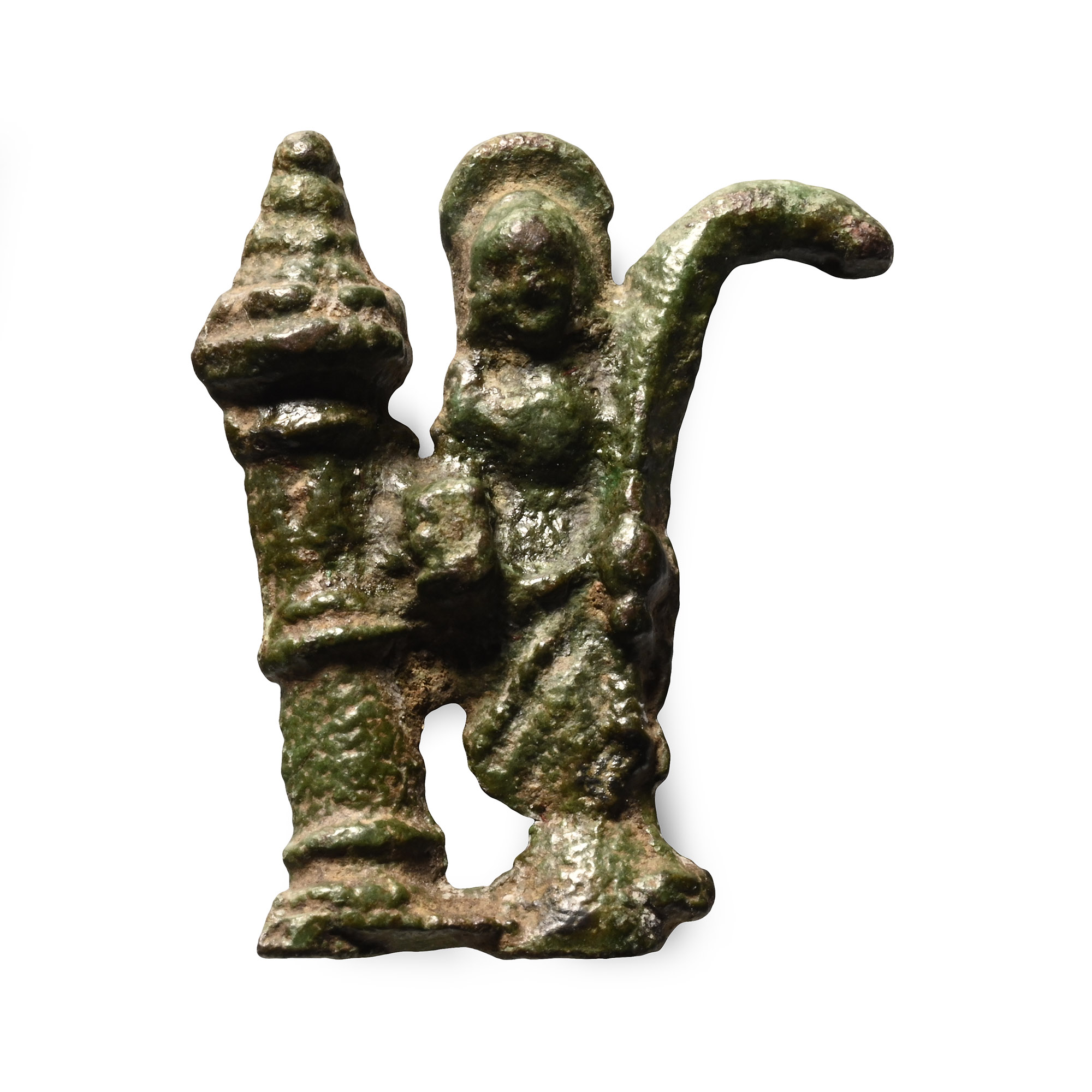
Medieval Bronze Pilgrim's Badge of Saint Barbara
14TH-15TH CENTURY A.D.
1 in. (3.05 grams, 24 mm).
Nimbate Saint Barbara standing next to a tower with three windows and holding a palm frond, modelled in the half-round; remains of stud to the reverse. [No Reserve]
ProvenanceAcquired on the UK art market in the 1980s.
From the private collection of an Essex gentleman.
See Spencer, B., Pilgrim Souvenirs and Secular Badges, Woodbridge, 2010, p.178.
FootnotesAccording to the legendary accounts of her life that circulated from the seventh century, Barbara was the daughter of a rich pagan named Dioscorus. She was carefully guarded by her father who kept her locked up in a tower in order to preserve her from the outside world. Having secretly become a Christian, she rejected an offer of marriage that she received through him. Before going on a journey, her father commanded that a private bath-house be erected for her use near her dwelling, and during his absence Barbara had three windows put in it, as a symbol of the Holy Trinity, instead of the two originally intended. When her father returned, she acknowledged herself to be a Christian; upon this she was ill-treated by him and dragged before the prefect of the province, Martinianus, who had her cruelly tortured and finally condemned her to death by beheading. The father himself carried out the death-sentence, but in punishment for this he was struck by lightning on the way home and his body consumed. This summary omits picturesque details found in some versions. These recount that, when her father discovered that she was a Christian, he wanted to kill her, but her prayers created an opening in the tower wall and she escaped. Pursued by her father and guards, she hid in a gorge in the mountains. She stayed hidden here until a shepherd betrayed her. As legend has it, the shepherd was transformed into a marble statue and his herd into grasshoppers. When tortured, Barbara held true to her faith. During the night, the dark prison was bathed in light and new miracles occurred. Every morning her wounds were healed. Torches that were to be used to burn her went out as soon as they came near her. According to one version, she died on 4 December 306 in her native Nicomedia, Bithynia, Asia Minor. Saint Barbara is one of the Fourteen Holy Helpers (also known as Helpers in Need). Her association with the lightning that killed her father has caused her to be invoked against lightning and fire; by association with explosions, she is also the patron of artillery and mining. Her feast on 4 December was included in the Tridentine Calendar, having been introduced in Rome in the twelfth century. In 1729 that date was assigned to the celebration of Saint Peter Chrysologus, reducing that of Saint Barbara to a commemoration in his Mass. In 1969, because the accounts of her life and martyrdom were judged to be entirely fabulous, lacking clarity even about the place of her martyrdom, it was removed from that calendar. But she is still mentioned in the Roman Martyrology, which, in addition, lists another ten martyr saints named Barbara. Orthodox Christians have never ceased to venerate Saint Barbara, who is very popular among them. For them too her feast day is 4 December. In the 12th century, the relics of Saint Barbara were brought from Constantinople to the St. Michael's Golden-Domed Monastery in Kiev, where they were kept until the 1930s, when they were transferred to St. Vladimir's Cathedral in the same city.
CONDITIONTimeLine Auctions follows a vetting process to ensure the authenticity and legality of all items, reinforcing our commitment to integrity and responsible trading. Each antiquity, antique, and coin lot undergoes thorough examination by a vetting committee of at least ten external specialists, professional trade association members, scientists, and archaeologists: Our Vetting Process
AUCTIONS:
TimeLine is a leading auction house specialising in antiquities, ancient art, collectables, natural history, coins, medals, and books. Our auctions offer museums, collectors, historians, and enthusiasts the opportunity to acquire unique and historically significant pieces.
-
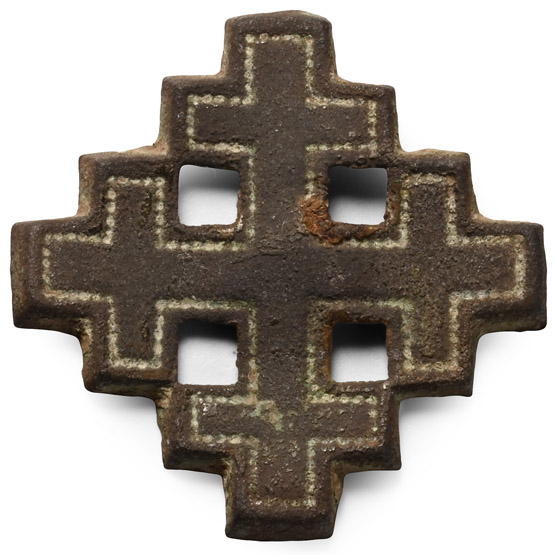
Medieval Bronze Knight's Holy Sepulchre Badge
Circa 13th-14th century A.D.Sold for (Inc. bp): £85
Formed as a cross-crosslet, the symbol of the Knights of the Holy Sepulchre, with punched-point border. 0.81 grams, 24 mm
Found Suffolk, UK. Property of a Suffolk, UK, gentleman.
The 'Equestrian Order of the Holy Sepulchre of Jerusalem' was an order of knighthood under the protection of the Pope, formed around 1099 AD by Duke Godfrey of Bouillon, the leader of the First Crusade. It was established for the protection of pilgrims travelling to the Holy Land and was recognised by a Papal Bull in about 1113 AD. -
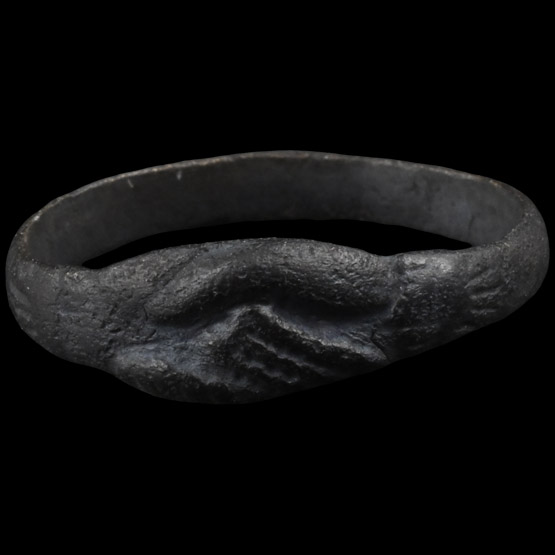
Medieval Bronze Clasped Hands Ring
15th-17th century A.D.Sold for (Inc. bp): £85
With D-section hoop, bezel formed as two clasped hands in 'mane in fede' pattern. 1.99 grams, 22.70 mm overall, 19.83 mm internal diameter (approximate size British T 1/2, USA 9 3/4, Europe 21.89, Japan 21)
Ex German art market, 2000s. Acquired from an EU collector living in London. From the collection of a Surrey, UK, gentleman. -
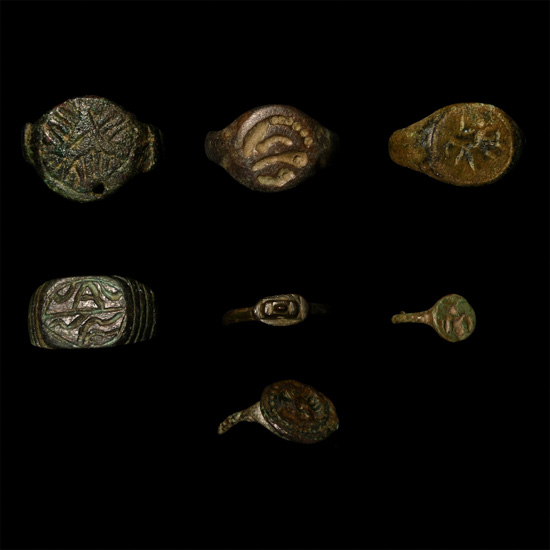
Celtic to Medieval Bronze Ring Collection
1st century B.C.-16th century A.D.Sold for (Inc. bp): £117
Comprising seven rings with decorative bezels, one with a broken hoop. 26.3 grams total, 14-23 mm
Acquired on the UK and EU art market before 2000. From the private collection of a Surrey, UK, gentleman.
Similar cast bronze rings with images of stylised animals and chevrons or other geometric patterns were found in the Necropolis of Zabran, Zemun, and dated 10th-15th century A.D. These rings were often decorated with stylised images of animals and geometric patterns.
