Loading, please wait...

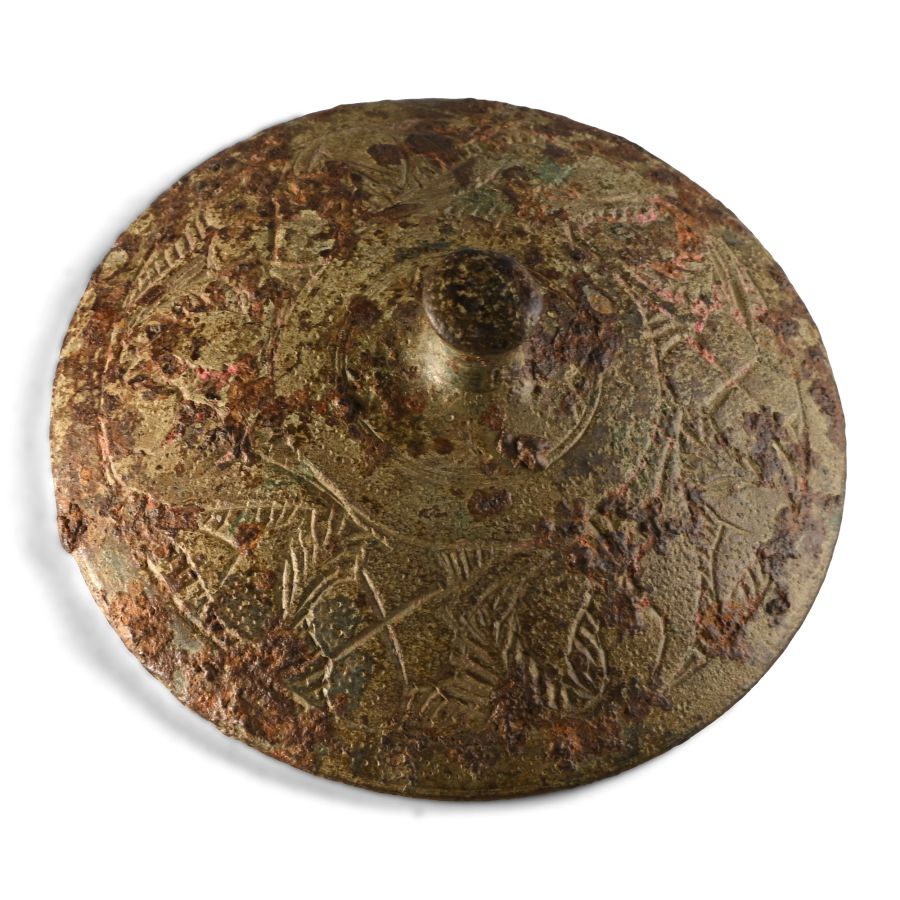
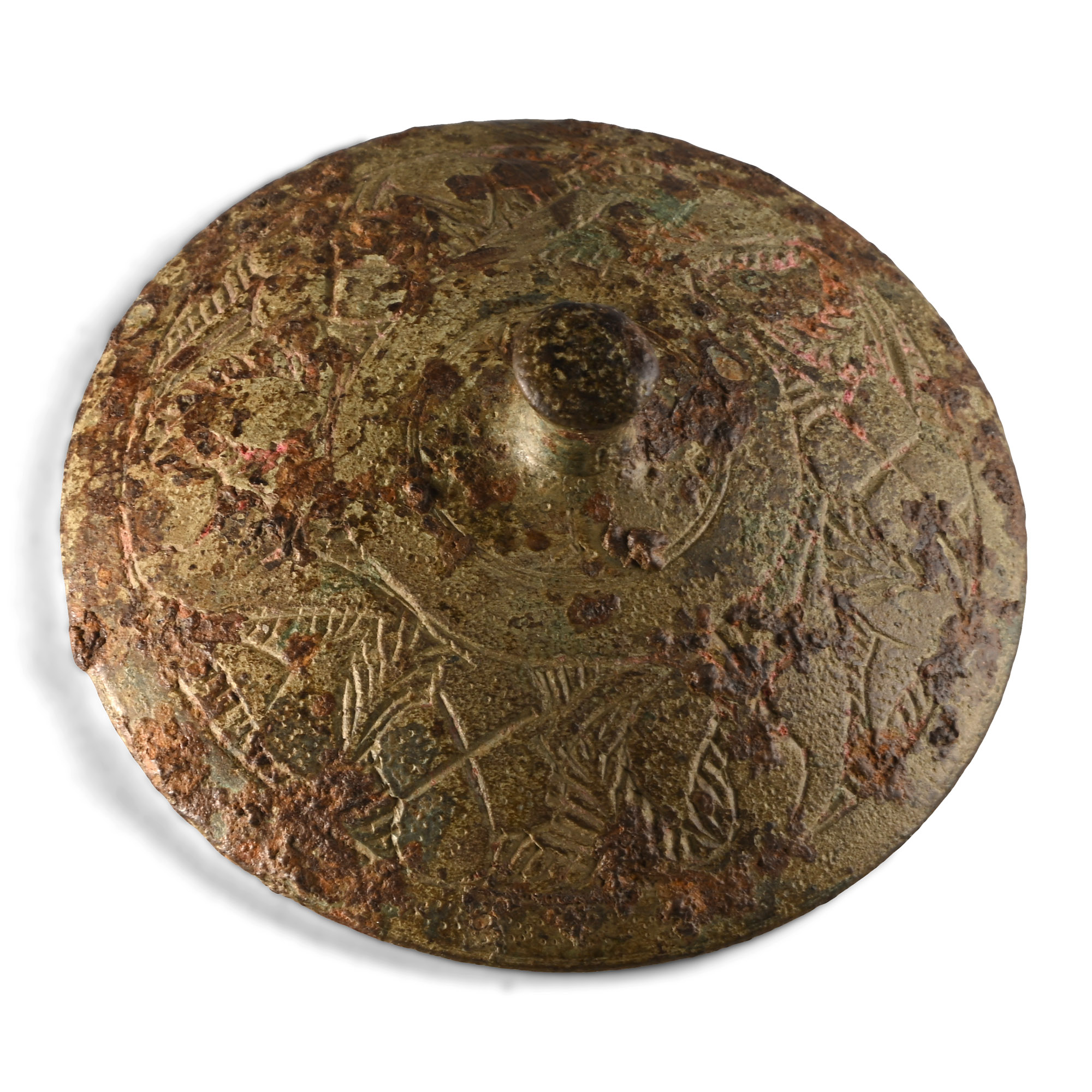
Medieval Bronze Lid with Engraved Floral Design Medieval Bronze Lid with Engraved Floral Design Medieval Bronze Lid with Engraved Floral Design
Use mousewheel to zoom in and out, click to enlarge
Details

LOT 1901

Medieval Bronze Lid with Engraved Floral Design

CIRCA 15TH-16TH CENTURY A.D.

2 3/4 in. (74.3 grams, 71 mm).

Gently domed in profile with knop handle; concentric incised bands with reserved foliage and flowers on a hatched field; lip to underside. [No Reserve]

Provenance

Found near Grimsby, North East Lincolnshire, UK.
Property of an Essex, UK, gentleman.

CONDITION
VETTING:

TimeLine Auctions follows a vetting process to ensure the authenticity and legality of all items, reinforcing our commitment to integrity and responsible trading. Each antiquity, antique, and coin lot undergoes thorough examination by a vetting committee of at least ten external specialists, professional trade association members, scientists, and archaeologists: Our Vetting Process


AUCTIONS:

TimeLine is a leading auction house specialising in antiquities, ancient art, collectables, natural history, coins, medals, and books. Our auctions offer museums, collectors, historians, and enthusiasts the opportunity to acquire unique and historically significant pieces.

LOT 1901

Medieval Bronze Lid with Engraved Floral Design

Estimate £40 - 60€46 - 70 (for guidance only)$54 - 81 (for guidance only)

Opening Bid
£5 (EUR 6; USD 7) +BP*

Sign in to Bid

Please enter a e-mail
Please enter a password
Or Create Account here.
Please confirm to accept TC and Privacy policy

Bids: 0
RELATED LOTS
  • Medieval Bronze Jetton Brooch
    Medieval Bronze Jetton Brooch
    Circa 14th-15th century A.D.

    Estimate: £30 - 40 (+bp*)

    Opening Bid: £5

    Discoid brooch with a faux-ropework border, band of ring-and-dot motifs around the circumference enclosing a central inscription 'INC' with Greek letter omega above. 3.15 grams, 26 mm


    Ex London, UK, collection. Ex Simmons Gallery, 1990s.

    Lot Details

  • Large Medieval Carved Limestone of St Martin on Horseback with Cloak and Beggar
    Large Medieval Carved Limestone of St Martin on Horseback with Cloak and Beggar
    Flemish, 15th century A.D.

    Estimate: £20,000 - 30,000 (+bp*)

    Bids: 1   |   Current Bid: £10,000

    Carved in high relief, limestone scene depicting Saint Martin of Tours on horseback with his sword raised to cut off a portion of his military cloak to share it with a beggar; the saint wearing articulated armour buckled at his forearms and on his lower leg, with a billowing cloak draped across his shoulders; the horse shown in a contrapposto stance with one foreleg raised, with ornamental caparison and harness pendants; the beggar depicted with emaciated form wearing only underclothes, hands pressed together in supplication; to the reverse, traces of original fixing to a wall or architectural setting; restored. 108 kg, 78.5 cm high


    Ex Richard Chester Master, Cirencester, UK. Kate Thurlow & Robin Thompson Collection, 21 October 1998. This lot has been checked against the Interpol Database of stolen works of art and is accompanied by search certificate number no.13384-259005.

    The subject derives from the episode recorded by Sulpicius Severus in his Vita Sancti Martini (c. 397 A.D.), in which the young Roman soldier Martin, stationed at Amiens, divided his cloak to share it with a freezing beggar; that same night, he dreamt that Christ appeared to him wearing the half of the garment which he had given away. Martin subsequently converted to Christianity and eventually became Bishop of Tours, where he was venerated as one of the most important saints of early medieval Western Europe; his feast day is celebrated on 11th November. The present relief belongs to a tradition of Flemish devotional sculpture that flourished in the 15th century, when the prosperous towns of the Low Countries — Bruges, Ghent, Brussels, and Mechelen — became pre-eminent centres of religious carving exported across Northern Europe. Comparable examples to this piece are held in the collections of the Musée de Cluny, Paris, and the Rijksmuseum, Amsterdam.

    Lot Details

  • Romanesque Limestone Capital with Reef Knot
    Romanesque Limestone Capital with Reef Knot
    Visigothic Style, 12th century A.D.

    Estimate: £6,000 - 8,000 (+bp*)

    Opening Bid: £3,000

    Pillar capital for an architectural column or pier decorated with dense vegetation motifs, tapering swags or garlands; reef-knot motif and leaves above; unworked to the reverse. 74 kg total, 51.5 cm high including stand


    Ex French collection. Holz Artles, 25 April 2015, no.83. Private collection, Kensington, London. Private collection, UK. This lot has been checked against the Interpol Database of stolen works of art and is accompanied by search certificate number no.13383-259007.

    This finely carved capital belongs to a group of Romanesque capitals known as knotwork capitals, widespread in the South of France and North of Spain, where the influence of the architecture of the old Visigothic Kingdom was still strong. These capitals probably originate in one of the most famous sculpture workshops of Romanesque France. The base of the capital is topped by a row of abstractly sculpted acanthus leaves. The dominant section of the capital is decorated with stylised knotwork, composed of ornament that entwine and end in folded acanthus leaves. In between the entwined branches, there is more foliage forming the ‘head of a monster’ which playfully animates the sculpture.

    Lot Details