
Loading, please wait...


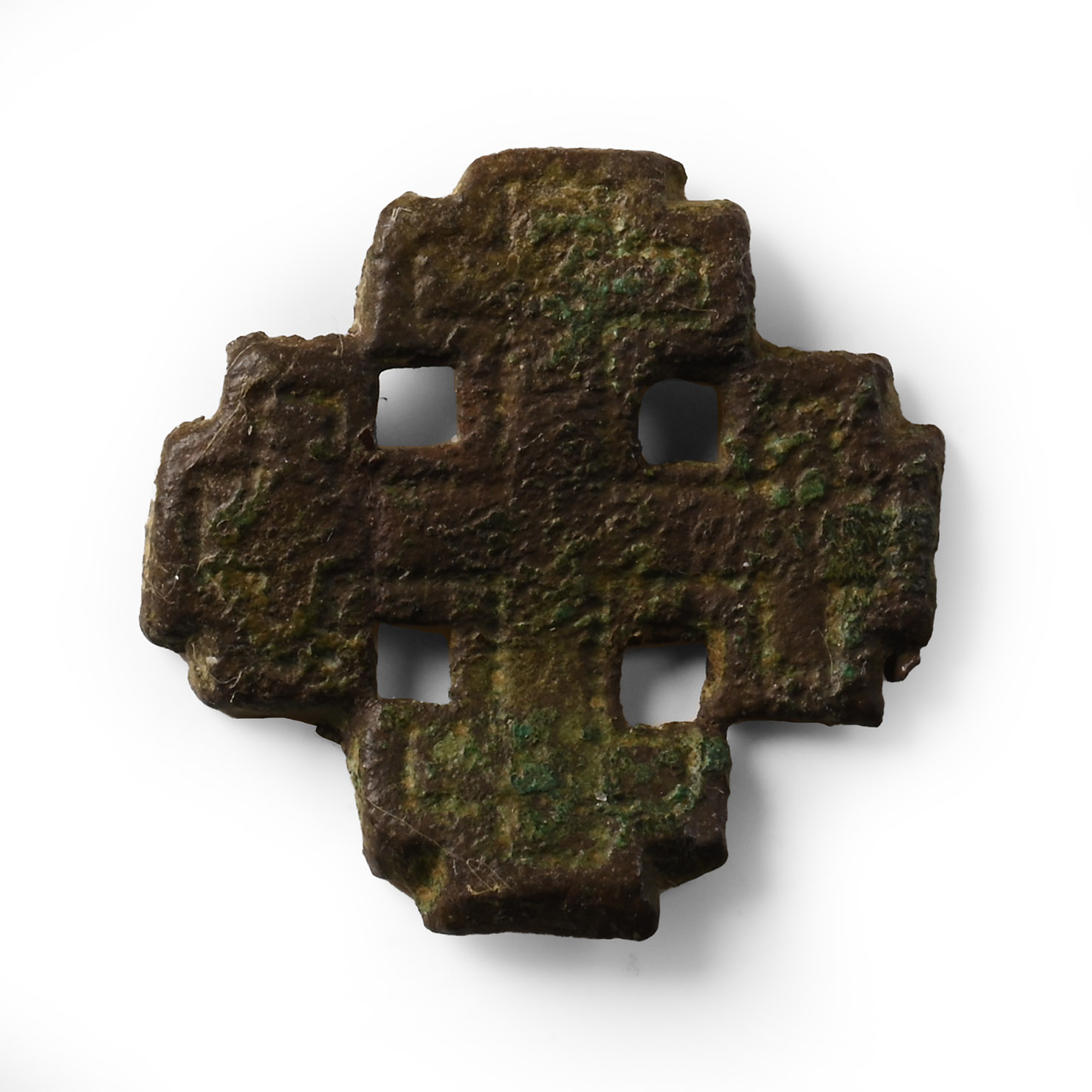
LOT 1846
Medieval Bronze Knight's Holy Sepulchre Badge
13TH-14TH CENTURY A.D.
3/4 in. (1.28 grams, 21 mm).
Formed as a cross-crosslet, the symbol of the Knights of the Holy Sepulchre, with punched-point border. [No Reserve]
ProvenanceAcquired on the European art market since the early 2000s.
From the private Northern Ireland collection of R.M.
Cf. Mitchiner, M., Medieval Pilgrim & Secular Badges, London, 1986, items 939-41.
FootnotesThe 'Equestrian Order of the Holy Sepulchre of Jerusalem' was an order of knighthood under the protection of the Pope, formed around 1099 AD by Duke Godfrey of Bouillon, the leader of the First Crusade. It was established for the protection of pilgrims travelling to the Holy Land and was recognised by a Papal Bull in about 1113 AD.
CONDITIONTimeLine Auctions follows a vetting process to ensure the authenticity and legality of all items, reinforcing our commitment to integrity and responsible trading. Each antiquity, antique, and coin lot undergoes thorough examination by a vetting committee of at least ten external specialists, professional trade association members, scientists, and archaeologists: Our Vetting Process
AUCTIONS:
TimeLine is a leading auction house specialising in antiquities, ancient art, collectables, natural history, coins, medals, and books. Our auctions offer museums, collectors, historians, and enthusiasts the opportunity to acquire unique and historically significant pieces.
-
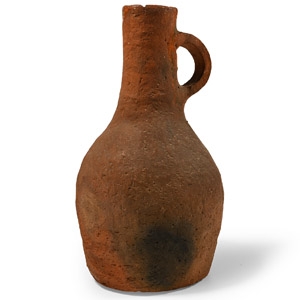
Medieval Red Ware Flagon
15th-16th century A.D.Sold for (Inc. bp): £39
With broad base and squat profile, sloping shoulder and tall tubular neck, rounded rim, single lateral loop handle below; signs of green glaze remaining around the lip. 569 grams, 20.5 cm
From a family collection mostly formed in the 1940s-1950s, thence by descent. -
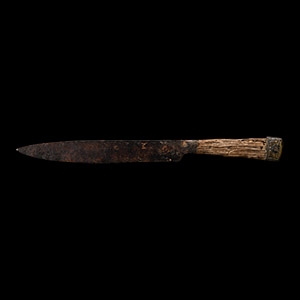
Medieval Iron Knife with Bronze Pommel
Early to mid-15th century A.D.Sold for (Inc. bp): £182
Comprising a single cutting edge and scale tang; bifacial pommel engraved with a foliate motif within a border. 46 grams, 20.5 cm
Acquired 1960s-1990s. Late Alison Barker collection, a retired London barrister.
Knife handles were made of wood, horn, bone or metal. Wood, a cheap, readily available and easily worked material, was by far the most common and most of the species used are both hard and flexible. -
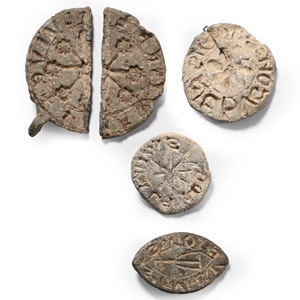
Medieval Lead Seal Matrix Group
12th-14th century A.D.Sold for (Inc. bp): £39
Including disc and vesica types with impressed legends and symbols, the bottom matrix reading 'S’ GVNN’ F’ IOhIS' (seal of Gunnar son of John), possibly of Scandinavian origin based on the first name. 47 grams total, 22-37 mm
Ex Stocker collection, Kent, UK, 1955-early 2000s.
