
Loading, please wait...
_900x900.jpg "Medieval Bronze Handled Iron Dagger with Raven")
_200x200.jpg "Medieval Bronze Handled Iron Dagger with Raven")
.jpg "Medieval Bronze Handled Iron Dagger with Raven")
LOT 0273
Medieval Bronze Handled Iron Dagger with Raven
11TH-14TH CENTURY A.D.
11 3/4 in. (157 grams, 30 cm).
Comprising a long single-edged blade with swept tip, lentoid-section hilt with long shoulder, ribbed and pelletted detailing to upper grip and openwork pommel formed as a perching raven. [No Reserve]
ProvenanceFrom the private collection of a London gentleman, from his grandfather's collection formed before the early 1970s.
This lot is accompanied by an illustrated lot declaration signed by the Head of the Antiquities Department, Dr Raffaele D’Amato.
TimeLine Auctions follows a vetting process to ensure the authenticity and legality of all items, reinforcing our commitment to integrity and responsible trading. Each antiquity, antique, and coin lot undergoes thorough examination by a vetting committee of at least ten external specialists, professional trade association members, scientists, and archaeologists: Our Vetting Process
AUCTIONS:
TimeLine is a leading auction house specialising in antiquities, ancient art, collectables, natural history, coins, medals, and books. Our auctions offer museums, collectors, historians, and enthusiasts the opportunity to acquire unique and historically significant pieces.
-
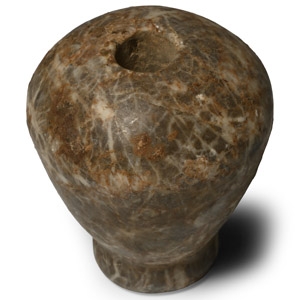
Western Asiatic Stone Macehead
3rd-2nd millennium B.C.Sold for (Inc. bp): £117
Tubular in form with tapering profile and balustered socket. 342 grams, 75 mm
From the collection of a London, UK, gentleman, 1990s. This lot is accompanied by an illustrated lot declaration signed by the Head of the Antiquities Department, Dr Raffaele D’Amato. -
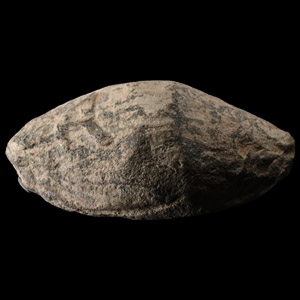
Roman Julius Caesar 'Battle of Munda' Lead Slingshot
45 B.C.Sold for (Inc. bp): £338
A biconical facetted lentoid-section lead sling shot (glans), inscription monogram a combination of letters 'C', 'A' and 'E', for 'C A E S' referring to Julius Caesar. 45.7 grams, 37 mm
Acquired on the UK art market. Property of a gentleman collector. Accompanied by an academic paper by military specialist Dr Raffaele D'Amato, dated 4th May 2022 and titled 'Roman Res Publica - Lead Slingshots (glandes) of Caesarian Age - 45 B.C circa'. This lot is accompanied by an illustrated lot declaration signed by the Head of the Antiquities Department, Dr Raffaele D’Amato.
The shot (type IIb of the Völling classification) is marked with the abbreviated name of Julius Caesar; it was used in quantity at the Battle of Monda (or Munda) against the last fellows of Pompey, the leaders of the Optimates, on the 17th March 45 BC. Similar shots were used in the Caesar's wars; slingers of Caesar's age were part of the light infantry. Caesar speaks of his Balearic slingers during the conquest of Gaul. They wore a short tunic, with leather or rope sandals to the feet, and a warm overcoat which could also have been used to store projectiles. They also used a satchel to carry very deadly lead-like stones or bullets. -
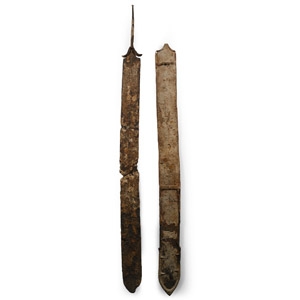
Iron Age Celtic Iron La Tene Sword with Scabbard
250-120 B.C.Estimate: £1,200 - 1,700 (+bp*)
Opening Bid: £600
Comprising a double-edged sword, the blade terminating in a round point, a shallow groove running along both sides of the blade, lozenge-section grip with four edges; supplied with a curved guard and a small cylindrical pommel; the scabbard with edged borders and the slide scabbard for the fastening of the suspension chain. 1.06 kg total, 64-76 cm
Ex German art market, 2000s. Acquired from an EU collector living in London. From the collection of Surrey, UK, gentleman. This lot is accompanied by an illustrated lot declaration signed by the Head of the Antiquities Department, Dr Raffaele D’Amato.
The sword belongs to the period of the last Celtic deeds in Europe, when their warriors succeededin sacking the Holy Sanctuary of Delphi in Greece. Livy, based upon the text of Polybius generically speaks of 'Gallica arma' and 'ferrum', the latter synonymous of a sword (Livy, XXI, 42, 1-4). Diodorus tells us that the swords were worn by the Celts on the right side, hanging from a belt tied around his waist and were not carried hanging from a baldric over the shoulder like the Greeks or the Etruscans (V, 30, 3). He describes (V, 29 and 30) the fighting techniques of the Celts (combat chariot) and a list of all the weapons used: shields as tall as a man which exhibit embossed figures of animals in rolled brass with both decorative and protective function; the brass helmets with high crests, horns, or with figures of birds and quadrupeds to the top; a chainmail armour in iron; long swords hanging from the right side by means of iron and bronze chain; spears; javelins; war trumpets with hoarse sounds; and gold or silver plated belts.
