
Loading, please wait...
_900x900.jpg "Medieval Bronze Double Seal Matrix")
_200x200.jpg "Medieval Bronze Double Seal Matrix")
.jpg "Medieval Bronze Double Seal Matrix")
LOT 0387
Medieval Bronze Double Seal Matrix
CIRCA 1250-1450 A.D.
1 in. (14.34 grams, 26 mm).
Circular die with central W motif and S’ CVNRADI GVFMAN for 'Seal of Conrad Gufman' legend, a tapering ovate sectioned handle with quatrefoil loop terminating to a second, smaller circular die also bearing a central W motif. [No Reserve]
ProvenanceFound whilst searching with a metal detector near Langtoft, East Riding of Yorkshire, UK, circa 2018.
Accompanied by a copy of the British Museum's Portable Antiquities Scheme (PAS) report no.YORYM-2D982E.
TimeLine Auctions follows a vetting process to ensure the authenticity and legality of all items, reinforcing our commitment to integrity and responsible trading. Each antiquity, antique, and coin lot undergoes thorough examination by a vetting committee of at least ten external specialists, professional trade association members, scientists, and archaeologists: Our Vetting Process
AUCTIONS:
TimeLine is a leading auction house specialising in antiquities, ancient art, collectables, natural history, coins, medals, and books. Our auctions offer museums, collectors, historians, and enthusiasts the opportunity to acquire unique and historically significant pieces.
-
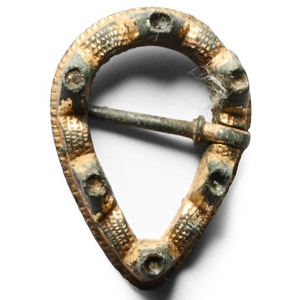
Medieval Gilt Bronze Teardrop Ring Brooch with Turrets
Circa 14th-15th century A.D.Sold for (Inc. bp): £33
Drop-shaped frame with six raised turrets and pointillé detailing between; each turret with a cell at the top; sword-shaped pin. 5.42 grams, 27.97 mm
Found Southern England. Acquired on the UK art market in the 1980s. From an East Anglian private collection. -
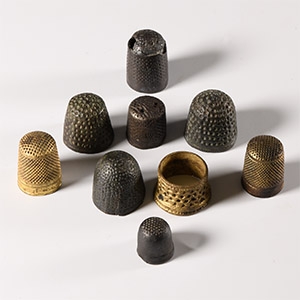
Medieval 'Thames' and Other Bronze Thimble Collection
Circa 15th-19th century A.D.Sold for (Inc. bp): £59
Mixed group including beehive and tailor's ring types. 42.9 grams total, 16-22 mm
Found Billingsgate spoil from the Thames foreshore, London, UK, and Essex, circa 1980s. Property of an Essex collector. -
.jpg)
Medieval Bronze Vesica-Shaped Seal Matrix for Henry of Thorp
Circa 13th-15th century A.D.Sold for (Inc. bp): £286
With central St. Michael slaying the dragon with cross-topped lance motif motif, pelletted border and legend '+ S' HENRICI DE THOR[P]' (seal of Henry of Thorp); strap and loop to the reverse. 12.4 grams, 32 mm
Found Southern England. Acquired on the UK art market in the 1980s. From an East Anglian private collection.
The placename may be Thorpe Market, Norfolk.
