
Loading, please wait...
LOT 2171
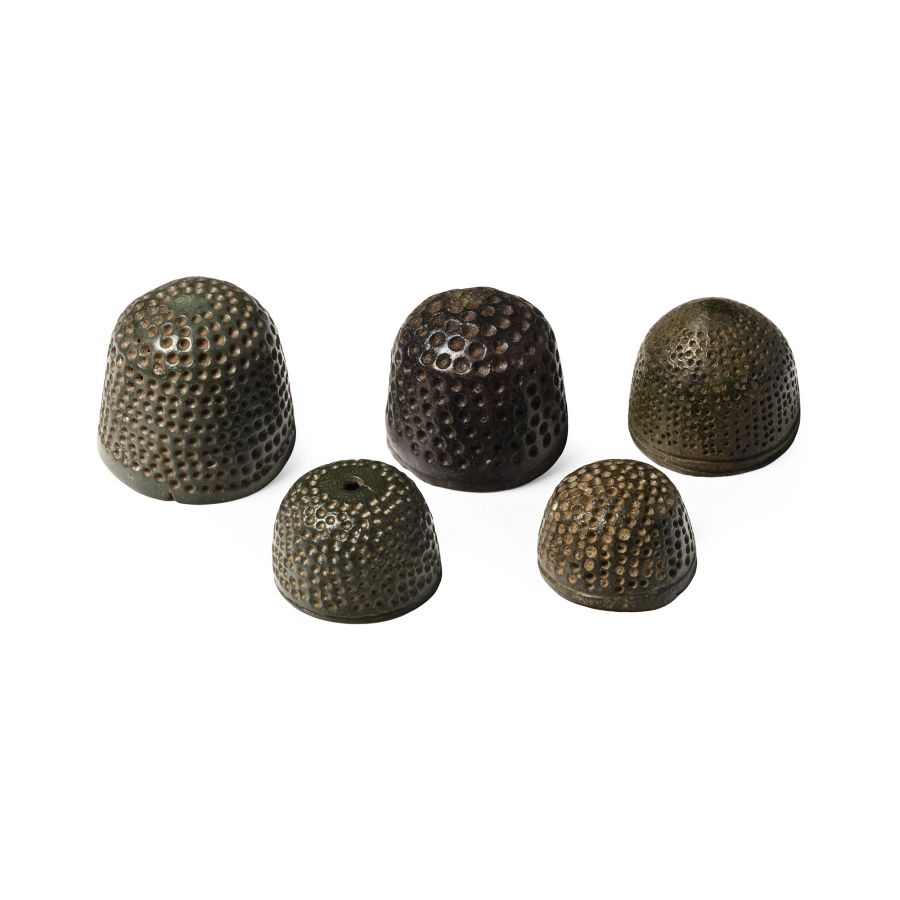
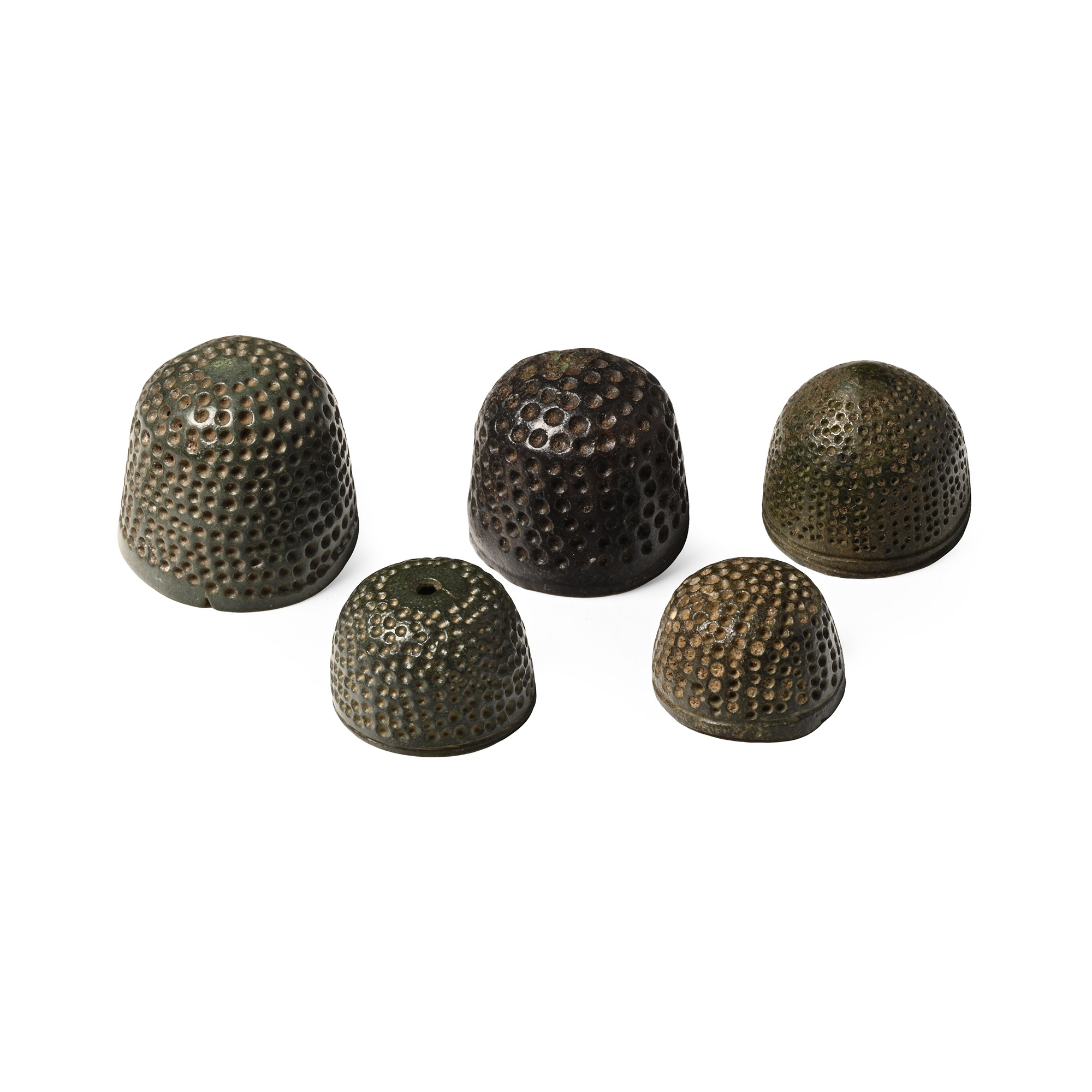
Medieval Bronze Beehive Thimble Collection
CIRCA 14TH-16TH CENTURY A.D.
5/8 - 3/4 in. (27.6 grams total, 15-20 mm).
Comprising five domed thimbles with pellet decoration. [5]
ProvenanceAcquired on the UK art market in the 1980s.
From an East Anglian private collection.
TimeLine Auctions follows a vetting process to ensure the authenticity and legality of all items, reinforcing our commitment to integrity and responsible trading. Each antiquity, antique, and coin lot undergoes thorough examination by a vetting committee of at least ten external specialists, professional trade association members, scientists, and archaeologists: Our Vetting Process
AUCTIONS:
TimeLine is a leading auction house specialising in antiquities, ancient art, collectables, natural history, coins, medals, and books. Our auctions offer museums, collectors, historians, and enthusiasts the opportunity to acquire unique and historically significant pieces.
LOT 2171
Medieval Bronze Beehive Thimble Collection
Estimate £100 - 140€120 - 160 (for guidance only)$140 - 190 (for guidance only)
Opening Bid
£50 (EUR 58; USD 68) +BP*
-
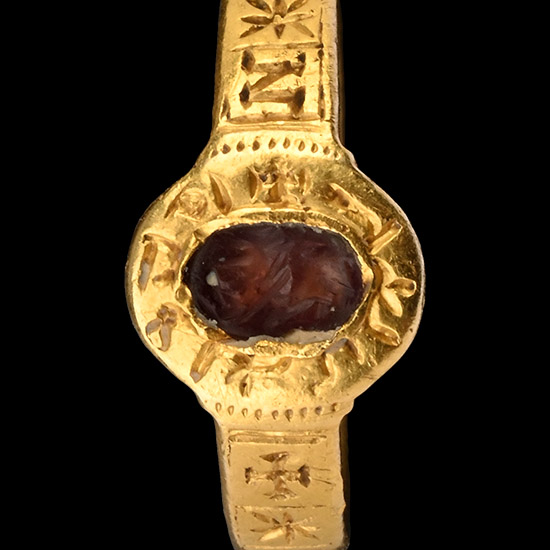
Medieval Gold Ring with Legend and Amethyst Intaglio
Circa 13th-14th century A.D.Estimate: £3,000 - 4,000 (‡+bp*)
Opening Bid: £1,500
Flat hoop and discoid bezel with central cell and inset intaglio lion couchant; flange rim with impressed detailing and cross potent; hoop with enigmatic retrograde legend in serifed Greek and Latin capitals '+*Π*O*N*O*Y*O*I*E*N'. 4.04 grams, 19.36 mm overall, 16.48 x 15.80 mm internal diameter (approximate size British L 1/2, USA 6, Europe 11.87, Japan 11)
Private collection of Kal Noselson, New York, acquired between 1976 and the late 1990s; thence by descent. This lot has been checked against the Interpol Database of stolen works of art and is accompanied by search certificate no.13452-259841.
These aristocratic rings were set with red or blue paste, engraved in intaglio with the heraldic symbol of the family. The round borders were often engraved with indeterminate inscriptions, using Latin and Greek letters. -
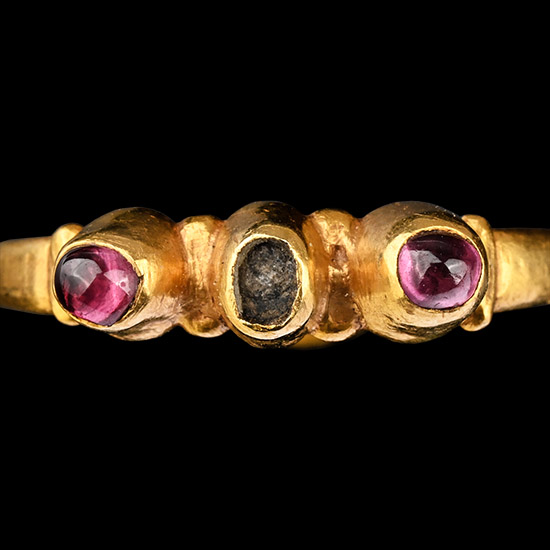
Medieval Gold Fede Ring with Amethysts
Circa 14th century A.D.Estimate: £1,800 - 2,400 (‡+bp*)
Opening Bid: £900
Comprising a D-section hoop with clasped-hands motif to the underside; three radiating cells to the bezel, the outer two each with an amethyst cabochon, the central one absent. 2.14 grams, 20.76 mm overall, 17.48 x 16.74 mm internal diameter (approximate size British M 1/2, USA 6 1/4, Europe 13.09, Japan 12)
Acquired from Derek Content, 23 January 1995. Private collection of Kal Noselson, New York, acquired between 1976 and the late 1990s; thence by descent. Accompanied by an original invoice from Derek Content, 23 January 1995. This lot has been checked against the Interpol Database of stolen works of art and is accompanied by search certificate no.13453-259908.
The ring belongs to the category of fede rings, characterised by clasped hands on the back and ruby sets, conical bezels with oval settings. Sometimes, three knobs were used in place of the set of stones. -
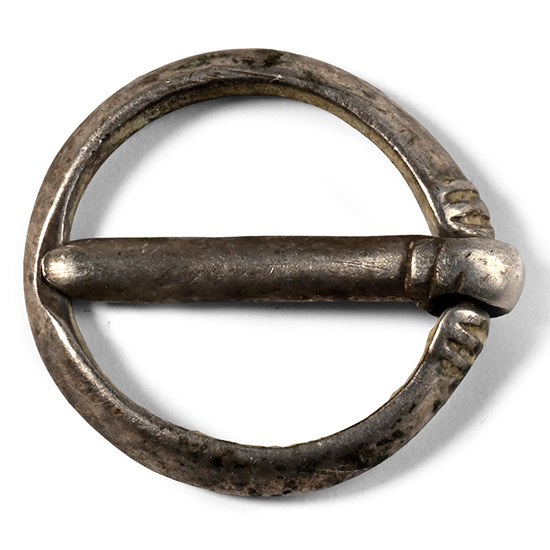
Medieval Silver Annular Brooch with Pin
1200-1700 A.D.Estimate: £40 - 60 (+bp*)
Opening Bid: £5
The frame circular in plan with a sub-triangular cross-section and convex outer edge, flat reverse; a pair of decorative transverse grooves flanking the pin constriction, recess for the pin-rest; pin coiled around the shank, D-shaped in section and with a rounded point, decorated with three transverse grooves to the obverse. 2.72 grams, 21 mm
Found near Lewes, East Sussex, UK; declared as potential Treasure under the Treasure Act with Treasure reference no.2025T785, subsiquently disclaimed and returned to the finder. Accompanied by a copy of the British Museum's Portable Antiquities Scheme (PAS) report no.SUSS-2465B3.
Annular brooches were used to fasten garments, growing in popularity during the 13th and 14th centuries and continuing into the Post Medieval period. See Egan and Pritchard (2002, pg. 248-255) for examples recovered from Medieval contexts in London. A broadly similar medieval example that has been submitted through the treasure process includes: 2007T343 (SUSS-BC4C47). However, the form is decoratively similar to some early Post Medieval examples such as DOR-3A57FD (2022T442) and GLO-3C6A1A (2022T439), of 16th century date, but on these examples the reverse of the frame is bevelled not flat. Based on the above examples a broad 13th to 17th century date is suggested.
