
Loading, please wait...
LOT 1912
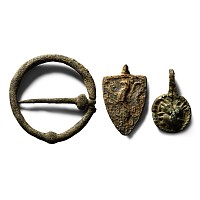
Medieval Bronze Artefact Group
13TH-15TH CENTURY A.D.
7/8 - 1 1/4 in. (12.9 grams total, 23-32 mm).
Comprising a ring brooch, shield-shaped harness pendant with rampant lion, and a discoid pendant. [3, No Reserve]
ProvenanceFound Essex, UK.
CONDITIONTimeLine Auctions follows a vetting process to ensure the authenticity and legality of all items, reinforcing our commitment to integrity and responsible trading. Each antiquity, antique, and coin lot undergoes thorough examination by a vetting committee of at least ten external specialists, professional trade association members, scientists, and archaeologists: Our Vetting Process
AUCTIONS:
TimeLine is a leading auction house specialising in antiquities, ancient art, collectables, natural history, coins, medals, and books. Our auctions offer museums, collectors, historians, and enthusiasts the opportunity to acquire unique and historically significant pieces.
-
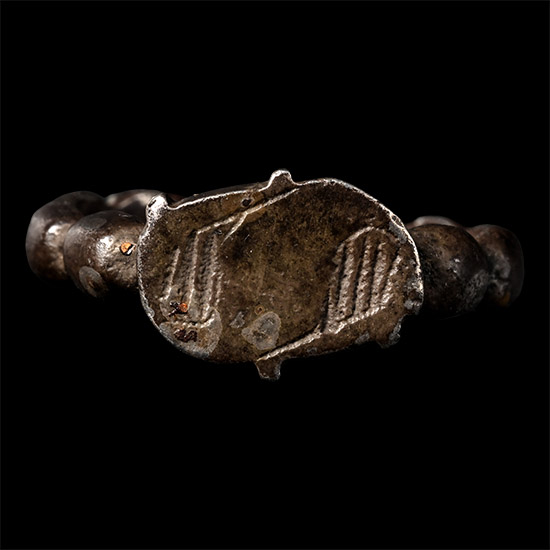
Medieval Silver Ring with 'S' Bezel
England or Germany, 15th century A.D.Estimate: £600 - 800 (+bp*)
Opening Bid: £300
The hoop formed of ten raised bosses and the bezel in the form of a Lombardic letter ’S’. 4.35 grams, 21.25 mm overall, 17.64 mm internal diameter (approximate size British M 1/2, USA 6 1/4, Europe 13.09, Japan 12)
Acquired on the European art market.
Decade or rosary rings were used in personal Catholic prayer, similar to rosaries, with each projection representing a Hail Mary, and the bezel (often formed as a cross) for the Our Father prayer. -
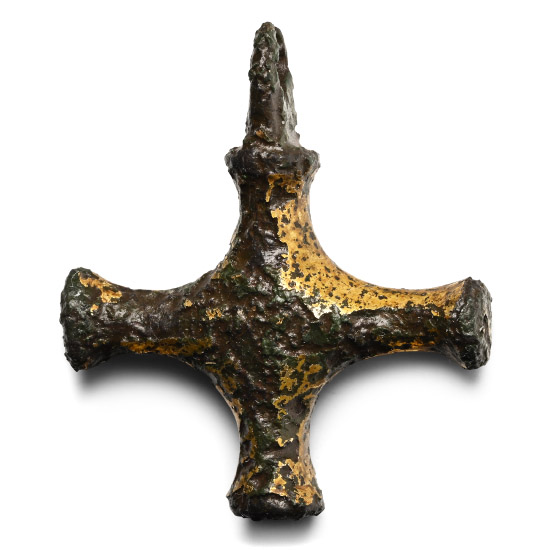
Medieval Gilt Bronze Cross Pendant
England, 1100-1300 A.D.Sold for (Inc. bp): £33
Formed as four radiating round-section arms with disc finials; integral loop above. 8.19 grams, 30 mm
Found Wilden, Bedfordshire, UK. Recorded with UKDFD no.54759. -
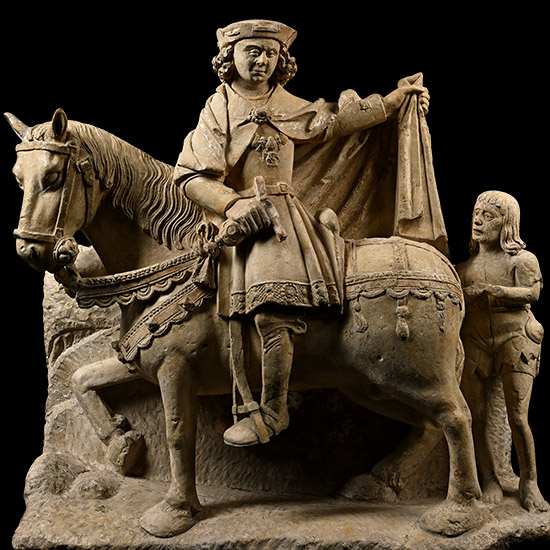
Large Medieval Carved Limestone of St Martin on Horseback with Cloak and Beggar
Flemish, 15th century A.D.Sold for (Inc. bp): £31,200
Carved in high relief, limestone scene depicting Saint Martin of Tours on horseback with his sword raised to cut off a portion of his military cloak to share it with a beggar; the saint wearing articulated armour buckled at his forearms and on his lower leg, with a billowing cloak draped across his shoulders; the horse shown in a contrapposto stance with one foreleg raised, with ornamental caparison and harness pendants; the beggar depicted with emaciated form wearing only underclothes, hands pressed together in supplication; to the reverse, traces of original fixing to a wall or architectural setting; restored. 108 kg, 78.5 cm high
Ex Richard Chester Master, Cirencester, UK. Kate Thurlow & Robin Thompson Collection, 21 October 1998. This lot has been checked against the Interpol Database of stolen works of art and is accompanied by search certificate number no.13384-259005.
The subject derives from the episode recorded by Sulpicius Severus in his Vita Sancti Martini (c. 397 A.D.), in which the young Roman soldier Martin, stationed at Amiens, divided his cloak to share it with a freezing beggar; that same night, he dreamt that Christ appeared to him wearing the half of the garment which he had given away. Martin subsequently converted to Christianity and eventually became Bishop of Tours, where he was venerated as one of the most important saints of early medieval Western Europe; his feast day is celebrated on 11th November. The present relief belongs to a tradition of Flemish devotional sculpture that flourished in the 15th century, when the prosperous towns of the Low Countries — Bruges, Ghent, Brussels, and Mechelen — became pre-eminent centres of religious carving exported across Northern Europe. Comparable examples to this piece are held in the collections of the Musée de Cluny, Paris, and the Rijksmuseum, Amsterdam.
