
Loading, please wait...
LOT 1155
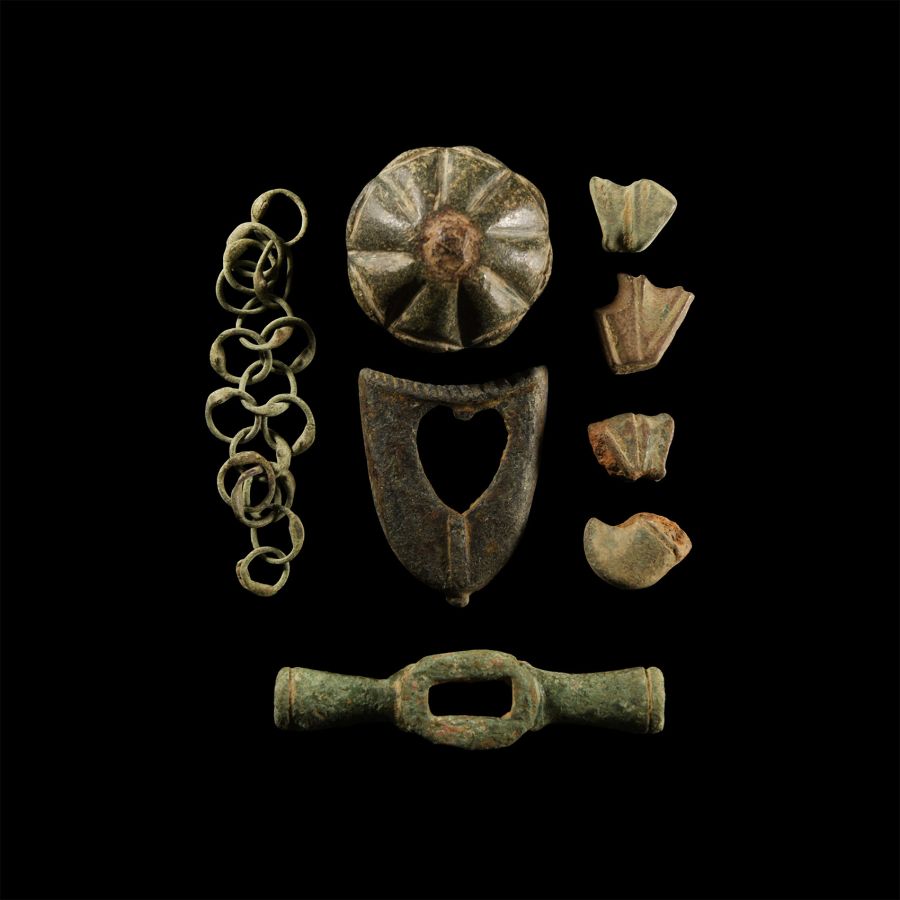
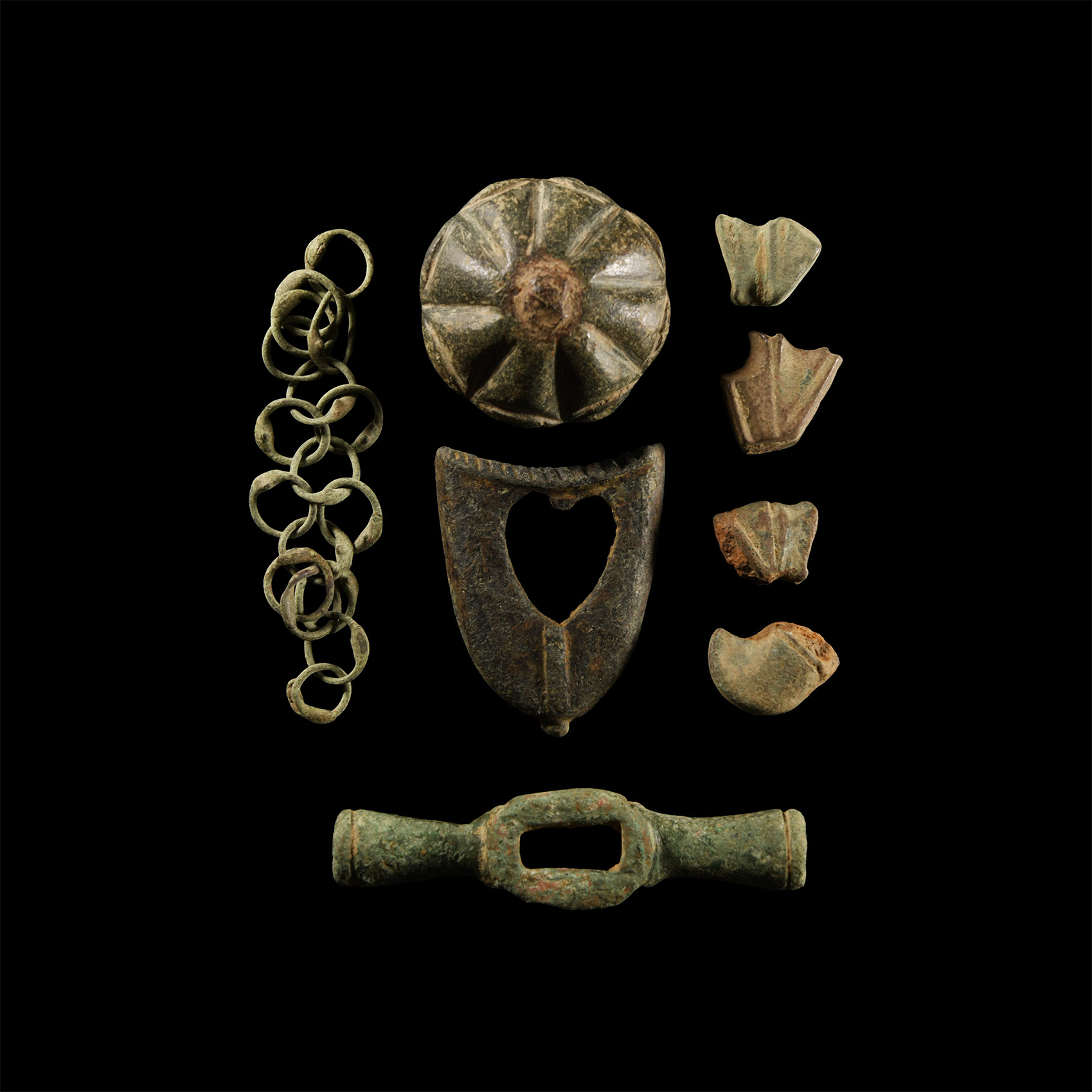
Medieval Bronze Artefact Group
14TH-16TH CENTURY A.D.
1/2 in. (135 grams total, 12-60 mm).
Comprising: a dagger quillon guard dated 15th-16th century A.D. with X-motifs and accompanied by a Portable Antiquities Scheme record; a partial chape with openwork heart motif; lobed and domed pommel; section of chainmail; four pommels for knives or other utensils, including examples with simple ornamentation. [8, No Reserve]
ProvenanceFound Berkshire, UK.
Accompanied by a copy of the British Museum's Portable Antiquities Scheme (PAS) report no.BERK-A95853 for the 15th century quillon guard.
TimeLine Auctions follows a vetting process to ensure the authenticity and legality of all items, reinforcing our commitment to integrity and responsible trading. Each antiquity, antique, and coin lot undergoes thorough examination by a vetting committee of at least ten external specialists, professional trade association members, scientists, and archaeologists: Our Vetting Process
AUCTIONS:
TimeLine is a leading auction house specialising in antiquities, ancient art, collectables, natural history, coins, medals, and books. Our auctions offer museums, collectors, historians, and enthusiasts the opportunity to acquire unique and historically significant pieces.
-
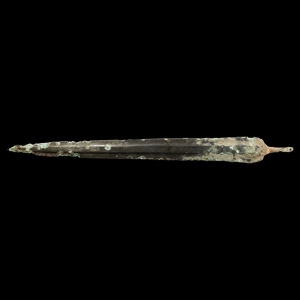
North-Western Persian Sword Blade
1st millennium B.C.Sold for (Inc. bp): £124
With rounded shoulders and square-sectioned mid-rib running to the blade tip; short tang with fastening hole. 345 grams, 46.5 cm
Acquired 1980-2015. Ex Abelita family collection.
The Luri people produced a quantity of fine metalwork, which according to Dr. Khorasani, could be due to a settled period which arose as a result of the defeat of the Elamites by the Babylonians, leaving the Luristani people in relative peace for a period of time after 1200 BC. According to Khorasani 'A culture of innovation and experimentation flourished, and the repertoire of the Luristan smiths expanded in the period between 1150–1050 BC.' -
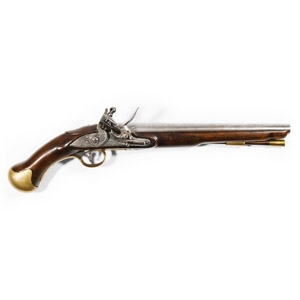
Tower Long Sea Service Flintlock Pistol
1800 A.D.Estimate: £2,000 - 3,000 (+bp*)
Opening Bid: £1,111
Napoleonic era with 30cm (12") round smooth bore barrel of .56" bore with London proof marks, the lock with 'TOWER', 'crown-over-GR' and 'crown-over-broad-arrow' marks fitted with brass-tipped wood ramrod and wood full stock and butt with brass butt cap, trigger guard, side plate and ferrule with steel belt hook; action working to half and full cock. 1.40 kg, 49 cm
Acquired from Andrew Bottomley, UK. The Kusmirek Collection, UK. Accompanied by a copy of the Bottomley listing. This lot has been checked against the Interpol Database of stolen works of art and is accompanied by search certificate no.204079.
Sold as an exempt item under Section 58 (2) of the Firearms Act, 1968, to be held as a curiosity or ornament. No license required but buyer must be over 18 years of age. Overseas bidders should note that, due to UK regulations governing export of all firearms, overseas buyers will need to make arrangements for shipping this lot out of the UK directly, by air freight, with a specialist company or agent. -
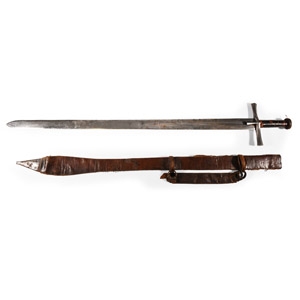
Sudanese Kaskara Sword
19th century A.D.Sold for (Inc. bp): £195
Of knightly form; composed of a straight double-edged blade of 35.5 inches in length and with central fuller, cruciform hilt, steel cross-guard and bound wooden handle; accompanied by a tooled leather scabbard. 1.3 kg, 1.07 cm
Acquired from MDL Historic Military Antiques, IK, 2015. The Kusmirek Collection, UK. Accompanied by copies of the purchase invoice and details.
