
Loading, please wait...
_900x900.jpg "Medieval Bronze Architectural Ring")
_200x200.jpg "Medieval Bronze Architectural Ring")
.jpg "Medieval Bronze Architectural Ring")
LOT 1556
Medieval Bronze Architectural Ring
CIRCA 15TH-16TH CENTURY A.D.
1 in. (9.63 grams, 24.50 mm overall, 16.04 mm internal diameter (approximate size British I 1/2, USA 4 1/2, Europe 7.44, Japan 7)).
With D-section hoop and domed bezel with pellets. [No Reserve]
ProvenanceFrom the collection of a Northern Ireland gentleman.
Ex private Merseyside, UK, collection.
Cf. Chadour, A.B., Rings. The Alice and Louis Koch Collection, volume I, Leeds, 1994, item 563, for type.
CONDITIONTimeLine Auctions follows a vetting process to ensure the authenticity and legality of all items, reinforcing our commitment to integrity and responsible trading. Each antiquity, antique, and coin lot undergoes thorough examination by a vetting committee of at least ten external specialists, professional trade association members, scientists, and archaeologists: Our Vetting Process
AUCTIONS:
TimeLine is a leading auction house specialising in antiquities, ancient art, collectables, natural history, coins, medals, and books. Our auctions offer museums, collectors, historians, and enthusiasts the opportunity to acquire unique and historically significant pieces.
-
.jpg)
Large Medieval Bronze Knight's Heraldic Seal Matrix of Count Robert in Full Armour
Circa 15th century A.D.Sold for (Inc. bp): £2,600
Featuring a large circular die face and hexagonal stem, with collars and pierced quatrefoil handle, incised orientation star to edge; the die bearing a knightly device of a helmet with chaplet on canted shield of arms bearing three bull's heads cabossed and chevron with surrounding ' LE * S * ROBERTI * LE CONTES' legend. 38.9 grams, 34 mm
Found near Stoke Ferry, Norfolk, circa 2008. This lot has been checked against the Interpol Database of stolen works of art and is accompanied by search certificate no.11901-204414.
'Sigillum Roberti le Contes ' is 'seal of Count Robert'. Three bulls' heads appear on the arms of the Beverley family. The chaplet or 'cap of maintenance' is a stylised fur-lined cap which appears in the heraldry of leading families; the helm of the Black Prince in Canterbury Cathedral is made with a chaplet and a lion standing on the rim. -
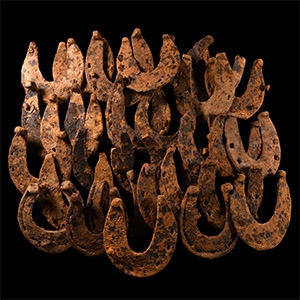
Medieval Iron Horse Shoe Group
14th-16th century A.D.Sold for (Inc. bp): £124
Comprising shoes of various sizes, possibly including examples for oxen. 8 kg total, 12-14.5 cm
Acquired 1990s-early 2000s. East Anglian private collection.
Late medieval and Renaissance horseshoes had an angular inner profile. These horse shoes were broadly C-shaped and rectangular in section. -
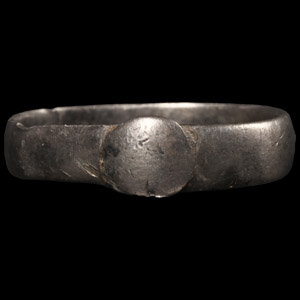
Medieval Silver Ring with Raised Bezel
14th-16th century A.D.Sold for (Inc. bp): £39
Plain D-sectioned hoop with round raised bezel. 2.33 grams, 21.20 mm overall, 18.89 mm internal diameter (approximate size British O 1/2, USA 7 1/4, Europe 15.61, Japan 15)
Found Sedgemoor, Somerset, UK. Accompanied by a copy of the British Museum's Portable Antiquities Scheme report no.SOM-01346D. Disclaimed under the Treasure Act with Treasure reference no.2017 T506.
