
Loading, please wait...
_900x900.jpg "Medieval and Later Buckle Collection")
_200x200.jpg "Medieval and Later Buckle Collection")
.jpg "Medieval and Later Buckle Collection")
LOT 1945
Medieval and Later Buckle Collection
CIRCA 15TH-20TH CENTURY A.D.
5/8 - 3 1/4 in. (688 grams total, 17-84 mm).
Including D-shaped, twin-loop, square and other types. [89, No Reserve]
ProvenanceFound Suffolk, UK. (UK buyers only, not for export)
CONDITIONTimeLine Auctions follows a vetting process to ensure the authenticity and legality of all items, reinforcing our commitment to integrity and responsible trading. Each antiquity, antique, and coin lot undergoes thorough examination by a vetting committee of at least ten external specialists, professional trade association members, scientists, and archaeologists: Our Vetting Process
AUCTIONS:
TimeLine is a leading auction house specialising in antiquities, ancient art, collectables, natural history, coins, medals, and books. Our auctions offer museums, collectors, historians, and enthusiasts the opportunity to acquire unique and historically significant pieces.
LOT 1945
Medieval and Later Buckle Collection
Estimate £20 - 30€23 - 35 (for guidance only)$27 - 41 (for guidance only)
-
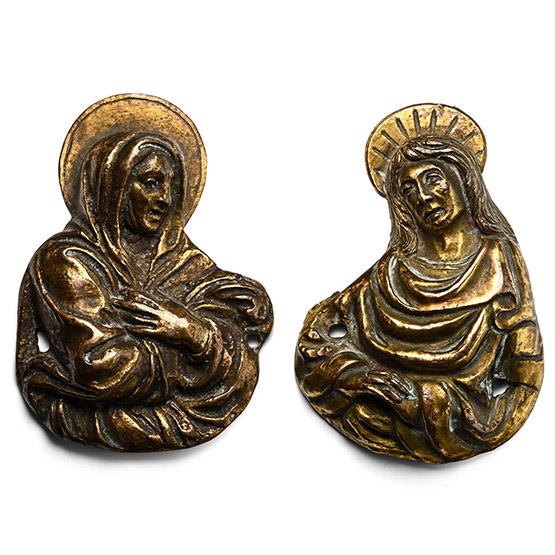
Medieval Gilt Bronze Plaques of Mary Magdalene and Saint John the Evangelist
Italian, 16th century A.D.Estimate: £200 - 300 (+bp*)
Opening Bid: £100
Comprising: nimabte figure of Mary, dressed in voluminous robes, arms crossed at the chest and pierced through the edges; nimabte figure of John wearing voluminous robes, gazing down with a solemn expression on his face, hands clasped at the waist, pierced through the edges. 57.2 grams total, 61 mm each
Private collection, UK. -
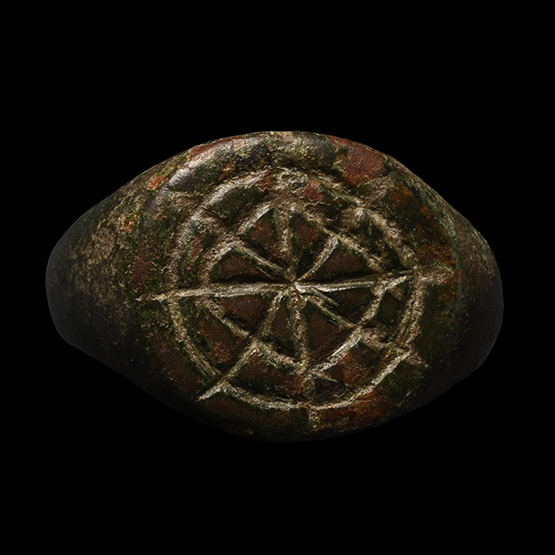
Medieval Signet Bronze Ring with Web
15th-16th century A.D.Sold for (Inc. bp): £85
Comprising a D-section expanding hoop and an oval bezel with a grid design resembling a spider's web. 7.99 grams, 23.53 mm overall, 18.97 mm internal diameter (approximate size British Q 1/2, USA 8 1/4, Europe 18.12, Japan 17)
Acquired on the UK and EU art market before 2000. From the private collection of a Surrey, UK, gentleman.
In the Middle Ages, the signet ring became a distinctive sign of belonging to a specific noble family or clan, or Guild. The ring, with the coat of arms or symbol of the Guild or Corporation engraved on the bezel, was pressed onto melted sealing wax to seal letters, edicts, and contracts, guaranteeing the document's authenticity. -
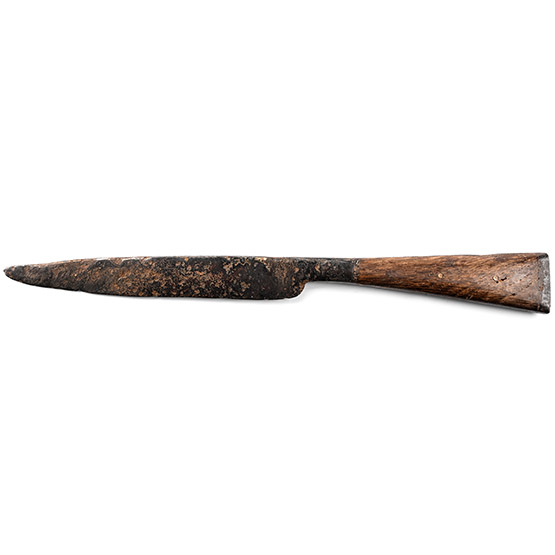
Medieval Iron Knife with Wooden Handle
Circa 1500 A.D.Sold for (Inc. bp): £130
Narrow single-edged blade with integral bolster, flared scale-tang hilt with integral finial; feint punched maker's mark 'ΛΛ' to one face. 49 grams, 21.8 cm
From an old English collection, 1980s.
