
Loading, please wait...


LOT 1938
Medieval and Later Bronze and Lead Artefact Collection
CIRCA 12TH-19TH CENTURY A.D.
3/8 - 4 in. (916 grams total, 10-99 mm).
Mixed group of items, including buckles, purse-bar fragments, pins, two 'sand dollar' fossils, and others. [No Reserve]
ProvenanceFrom the private collection of a Sussex, UK, gentleman.
CONDITIONTimeLine Auctions follows a vetting process to ensure the authenticity and legality of all items, reinforcing our commitment to integrity and responsible trading. Each antiquity, antique, and coin lot undergoes thorough examination by a vetting committee of at least ten external specialists, professional trade association members, scientists, and archaeologists: Our Vetting Process
AUCTIONS:
TimeLine is a leading auction house specialising in antiquities, ancient art, collectables, natural history, coins, medals, and books. Our auctions offer museums, collectors, historians, and enthusiasts the opportunity to acquire unique and historically significant pieces.
-
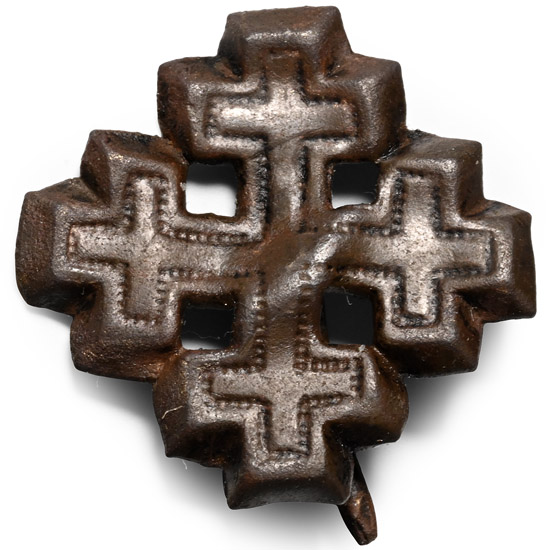
Medieval Bronze Knight's Holy Sepulchre Badge
Circa 13th-14th century A.D.Sold for (Inc. bp): £169
Formed as a cross-crosslet, the symbol of the Knights of the Holy Sepulchre, with a punched-point border and a stud on the reverse. 1.34 grams, 24 mm
Found Suffolk, UK. Property of a Suffolk, UK, gentleman.
The 'Equestrian Order of the Holy Sepulchre of Jerusalem' was an order of knighthood under the protection of the Pope, formed around 1099 AD by Duke Godfrey of Bouillon, the leader of the First Crusade. It was established for the protection of pilgrims travelling to the Holy Land and was recognised by a Papal Bull in about 1113 AD. -

Medieval Wooden Bench Finial in the Form of an Elephant and Castle
England, 15th century A.D.Estimate: £3,000 - 4,000 (+bp*)
Opening Bid: £1,500
Carved stylised elephant with elongated ears supporting a palanquin in the form of a castle with a carved cross, foliage motif to the reverse; mounted on a velvet-covered stand. 1.31 kg total, 34.2 cm including stand
Private collection, Europe. Acquired on the English art market. This lot has been checked against the Interpol Database of stolen works of art and is accompanied by search certificate number no.13088-248391.
The image of an elephant carrying warriors in a howdah originated from Alexander the Great's battle against King Porus's war elephants at the Battle of Hydaspes in 326 BC. This motif became widely known in European art through the spread of Bestiaries which were medieval texts combining natural history with moralising Christian stories. One of the most well known was Matthew Paris’s imagined depictions of elephants, most notable in this case is his war elephant illustrated in Chronica maiora II, circa 1240-1255 (Cambridge, Corpus Christi College, MS 016II). Another well known manuscript - The Rochester Bestiary, circa 1230-1240 (British Library, London, Royal MS 12 F.xiii) contains a miniature with a war elephant in the midst of battle, above another image of elephants supposedly in their natural habitat. Since very few live elephants were seen in Europe during the medieval period, their representations were often more imaginative than realistic. Other Medieval bench end carvings of elephants in English churches are known, amongst them are: St Peter and St Paul, Tuttington, Norfolk; St Andrew, South Lopham, Norfolk; St Edmund, South Burlingham, Norfolk; St Andrew, Holme Hale, Norfolk. Elephants can also be found on misericords, some examples can be found at: Cathedral Church of Saint Peter, Exeter; Cathedral Church of St Peter, Gloucester; and St Mary's Church, Beverley. -
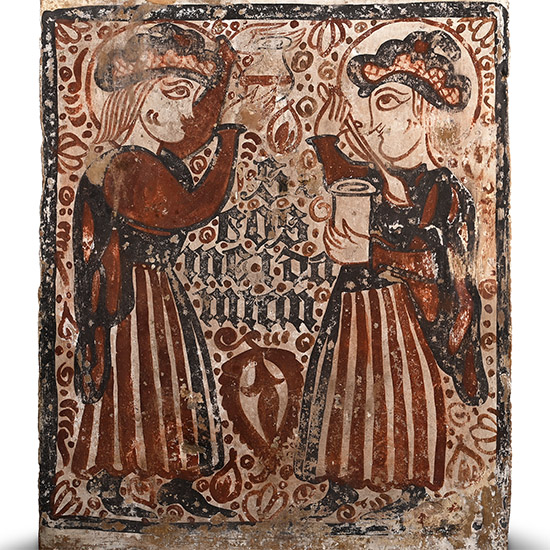
Spanish Medieval Socarrat Wall Tile Showing Saints Cosmas and Damian
Late 15th century A.D. or laterSold for (Inc. bp): £4,420
Showing two opposing surgeon saints, Cosmas and Damian, holding their medical attributes and shown nimbate, dressed in contemporary garments, with an inscription naming them at the centre, the background with densely arranged decorative motifs. 8.25 kg, 43 cm
Private collection, Spain. Private collection, London, UK.
Cosmas and Damian were two Arab physicians who were martyred in Syria during the persecutions under Emperor Diocletian.
