
Loading, please wait...
LOT 1201
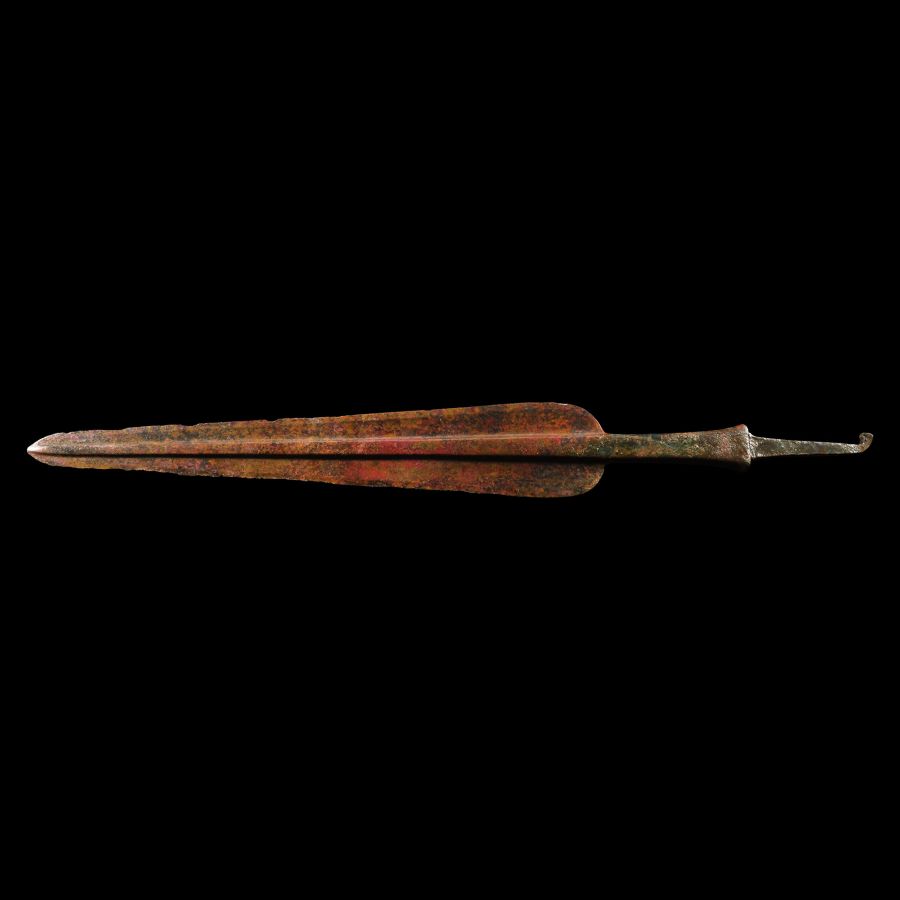
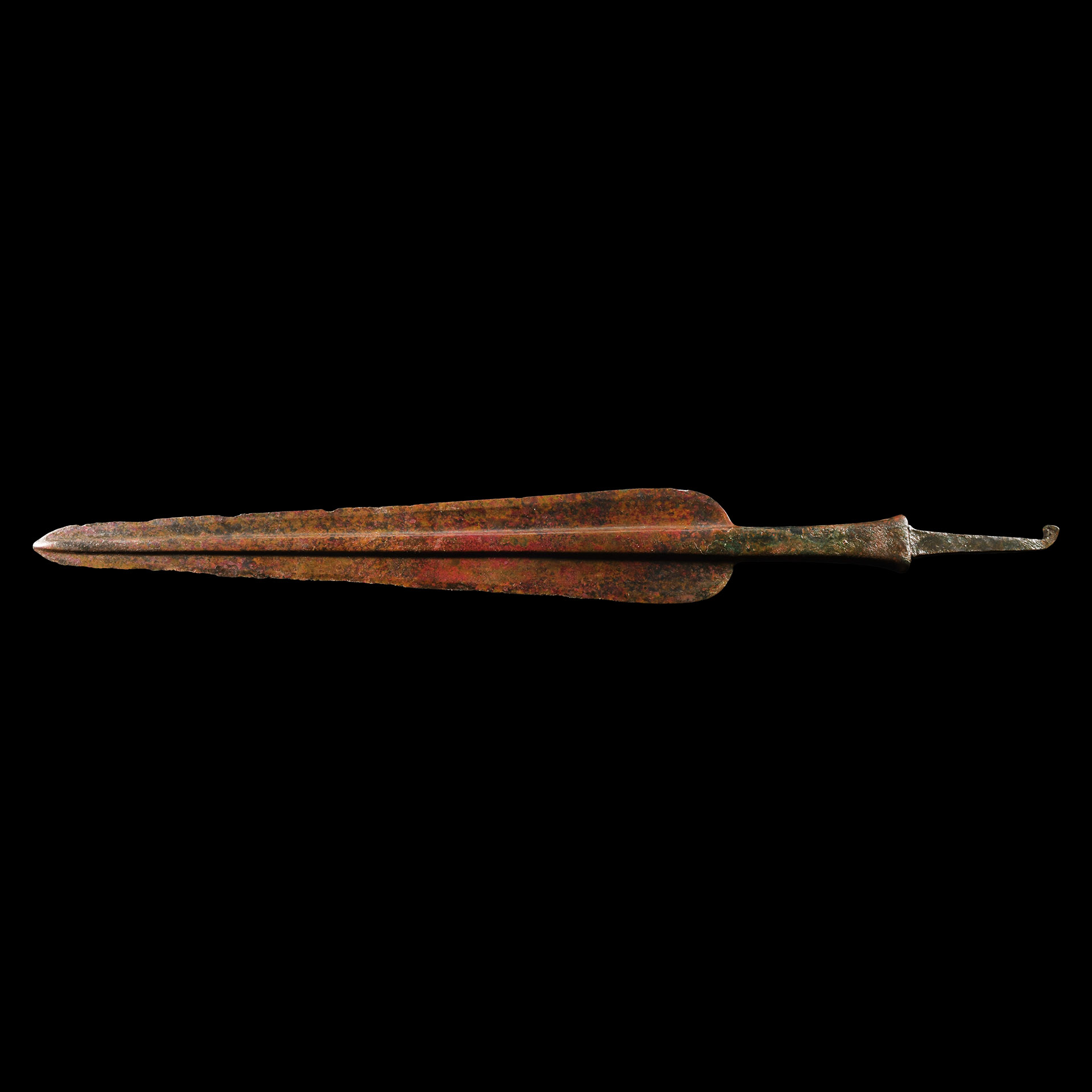
Massive West Persian Bronze Spearhead
CIRCA 12TH-10TH CENTURY B.C.
20 5/8 in. (674 grams, 52.5 cm).
With heavily ridged and tapered blade, short collared shaft and tapered bent tang with round stud terminal.
ProvenanceAcquired 1980-2015.
Ex Abelita family collection.
See Christie's, The Axel Guttmann Collection of Ancient Arms and Armour, part 1, London, 2002, p.36, no.40; Khorasani, M.M., Arms and Armour from Iran. The Bronze Age to the End of the Qajar Period, Tübingen, 2006, s. cat 280, for type.
FootnotesThe weapon belongs to the type 1 of the Khorasani spearhead classification, mainly from Marlik or Amlash areas. Similar pieces have been dated by Stutzinger to 1200-1100 B.C., but the period of use is attested at least until the 1000 B.C.
CONDITIONTimeLine Auctions follows a vetting process to ensure the authenticity and legality of all items, reinforcing our commitment to integrity and responsible trading. Each antiquity, antique, and coin lot undergoes thorough examination by a vetting committee of at least ten external specialists, professional trade association members, scientists, and archaeologists: Our Vetting Process
AUCTIONS:
TimeLine is a leading auction house specialising in antiquities, ancient art, collectables, natural history, coins, medals, and books. Our auctions offer museums, collectors, historians, and enthusiasts the opportunity to acquire unique and historically significant pieces.
LOT 1201
Massive West Persian Bronze Spearhead
Estimate £250 - 350€290 - 410 (for guidance only)$340 - 470 (for guidance only)
-
Pseudo-Illyrian Chalcidian Variant Bronze Helmet
4th-1st century B.C.Sold for (Inc. bp): £3,250
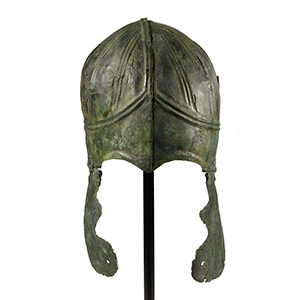
Large rounded two-part bowl rivetted beneath the repoussé crest extending across the brow and around the circumference; repoussé arches above the eyes extending to the nasal; lateral D-shaped cheek-pieces with scallop to the forward edge, pierced for a chin-strap; some restoration of the bowl; mounted on a custom-made display stand. 2.9 kg total, 48.5 cm high including stand
Acquired 1971-1972. From the collection of the vendor's father. Property of a London, UK, collector. Accompanied by an academic report by Dr Raffaele D’Amato. This lot has been checked against the Interpol Database of stolen works of art and is accompanied by search certificate number no.11752-202771.
According both to Symonenko and Dedjulkin (2014, p.189, fig.9, nn.4-5-6), this category of helmets derived from the Chalcidian type with elements of pseudo-Illyrian variants. Like the Chalcidian helmets, our specimen shows vertical decorative lines on the bowl and the triangular brow decoration which characterises similar specimens. -
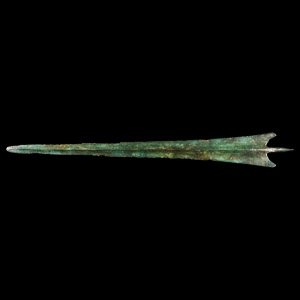
North-West Persian Bronze Dagger Blade
Late 2nd-1st millennium B.C.Estimate: £500 - 700 (+bp*)
Opening Bid: £250
With prominently curved guard extending out from the ricasso partly framing the hilt, thick midrib extending slightly above the ricasso. 464 grams, 52.2 cm
Acquired 1980-2015. Ex Abelita family collection.
The hilt of such swords was made separately and unfortunately is nearly always missing from the archaeological records. Similar daggers had a northern Iranian background and excavated examples have been recorded from the South Caspian area from Tomadjan and Ghalekuti. -
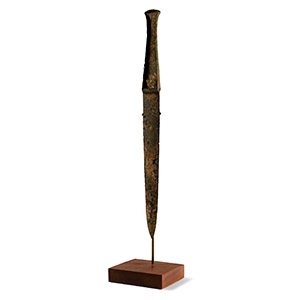
Canaanite Bronze Dirk
13th-12th century B.C.Estimate: £700 - 900 (‡+bp*)
Opening Bid: £375
With lentoid-section blade, tongue-shaped in plan, integral tapering hilt with flared finial, lateral flanges to accept a panel of bone or wood to each face forming the grip. 289 grams total, 39.5 cm high including stand
Ex Joseph J. Gancie (1923-2010), Washington, Silver Spring, Maryland. with Alex Cooper Auctioneers Inc., sale 1035, 27 January 2013, lot 162a.
The dirk belongs to the type III in the Medvedskaya classification, used in Near East from the 13th to the 6th century B.C. The type is the 32a of the Maxwell-Hyslop study. The Asiatic daggers of this type are confined to Syria and Persia, but Transcaucasia also provides an interesting analogy from Kalekent on the Baku peninsula, where a pointed straight-sided dagger blade has a flanged hilt with the whole of the side flanges bent over the centre.
