
Loading, please wait...
_900x900.jpg "Massive Painted Oak Framed Slate Altar Screen")
_200x200.jpg "Massive Painted Oak Framed Slate Altar Screen")
.jpg "Massive Painted Oak Framed Slate Altar Screen")
LOT 1485
Massive Painted Oak Framed Slate Altar Screen
19TH CENTURY A.D.
60 7/8 and 62 1/2 in. (73 kg total, 134.5 cm base and 159 cm high).
A magnificent and superb quality Victorian Gothic revival painted altar or reredos panel, as exemplified by the works and designs of Augustus Pugin, on Welsh slate depicting a large golden cross with latticed arms and squared quatrefoil terminals showing the emblems and names of the four Evangelists, Matthew, Mark, Luke and John; the cross set over a circle enclosing a quatrefoil background with the main discus showing a white cross trefoil on a red expanding cross against a green background with the Christogram letters 'IHS' entwined for Jesus Christ; the design set against a dark blue field ornamented with 48 golden radiant six-pointed stars; complete with the original carved oak frame together with the carved oak projecting base plinth shelf with quatrefoil perforations and another Christogram 'IHS' within a blue oval to the central projection. [No Reserve]
ProvenanceCollection formed in the 2000s.
Property of an East Anglia gentleman.
Cf. Stokes, M. (ed.), Didron, A.N., Christian Iconography, The history of the Christian Art in the Middle Ages, London, 1896, figs.36, 69, and p.452.
FootnotesFrom the 4th century A.D., the vision of Ezekiel and John's Apocalypse, assigned the lion, the angel, the eagle and the ox a stable place in the iconography of the tetramorph to represent the evangelist Mark (lion) next to the calf (Luke), the angel (Matthew) and the eagle (John). They are, in Christian iconography and theology, the four winged cherubs singing the triumphal hymn, exclaiming, proclaiming, and saying: 'Holy, holy, holy, Lord Sabaoth'. The oldest representations date back to the 5th century A.D., and are found in the mosaics of the baptistry of Naples and in the apse of S. Prudenziana in Rome. The tetramorph was a favourite subject in 12th century ecclesiastic art and its use has continued to the
present day.
TimeLine Auctions follows a vetting process to ensure the authenticity and legality of all items, reinforcing our commitment to integrity and responsible trading. Each antiquity, antique, and coin lot undergoes thorough examination by a vetting committee of at least ten external specialists, professional trade association members, scientists, and archaeologists: Our Vetting Process
AUCTIONS:
TimeLine is a leading auction house specialising in antiquities, ancient art, collectables, natural history, coins, medals, and books. Our auctions offer museums, collectors, historians, and enthusiasts the opportunity to acquire unique and historically significant pieces.
-
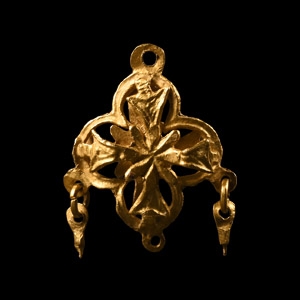
Elizabethan Gold Cross Pendant
16th-early 17th century A.D.Sold for (Inc. bp): £910
A gold bifacial cruciform pendant comprising: outer frame of four lobes confining a cross moline with saltire to the centre, pierced lug to three arms each with a gold dangle, fourth with larger pierced tab for suspension. 1.59 grams, 21 mm
Acquired 1980-2015. Ex Abelita family collection. -
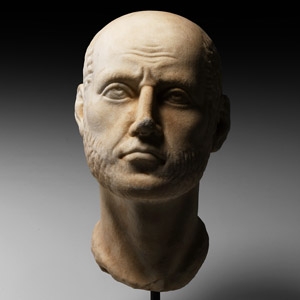
Marble Head of a Roman Emperor
20th century A.D.Estimate: £4,000 - 6,000 (+bp*)
Opening Bid: £2,000
A carved marble bust of a mature male with stern features, likely the emperor Carus, shown with short, neatly-dressed hair and beard; mounted on a custom-made display stand. 10.4 kg, 38 cm high including stand
French collection, 1960s-early 2000s. From an important Paris gallery, France. This lot has been checked against the Interpol Database of stolen works of art and is accompanied by search certificate number no.11694-199338.
Carus reigned 282-283 A.D. He served as a prefect of the guard to emperor Probus, whom he succeeded. Whilst leading a campaign against the Sassanians, Carus died suddenly and under mysterious circumstances, leading to the belief that he was struck by lightning. Little is known of his life, owing to the relative instability of that time period. Whether he had Probus murdered, or whether he was killed by mutinous troops was disputed even by his contemporaries. Carus was succeeded by his sons Carinus and Numerian, although their reigns were short-lived and his dynasty was soon supplanted. Carinus’ lasting legacy was principally the suppression of the authority of the senate. He has gone down in history as one of the tyrants of ancient Rome. -
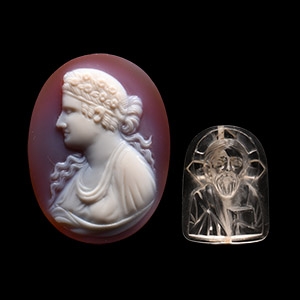
Gemstone Group
19th-20th century A.D.Estimate: £100 - 140 (+bp*)
Opening Bid: £50
A group of two carved gemstones: an ellipsoid plaque with reserved profile bust of a young female with elaborately dressed hair; a miniature rock crystal stele with bust of Christ holding a book to the obverse, and to the reverse a high-relief cross aiguisée visible behind the bust. 12.8 grams total, 24-39 mm
English private collection.
