
Loading, please wait...
_900x900.jpg "Massive Iron Age Celtic Iron La Tene Socketted Spearhead")
_200x200.jpg "Massive Iron Age Celtic Iron La Tene Socketted Spearhead")
.jpg "Massive Iron Age Celtic Iron La Tene Socketted Spearhead")
LOT 0267
Massive Iron Age Celtic Iron La Tene Socketted Spearhead
1ST CENTURY B.C.-1ST CENTURY A.D.
28 1/2 in. (825 grams, 72.5 cm).
Slender leaf-shaped blade with median rib, rounded tip, short shoulder, socket with lateral holes to accept a fixing peg.
ProvenanceEx German art market, 2000s.
Acquired from an EU collector living in London.
From the collection of Surrey, UK, gentleman.
This lot is accompanied by an illustrated lot declaration signed by the Head of the Antiquities Department, Dr Raffaele D’Amato.
TimeLine Auctions follows a vetting process to ensure the authenticity and legality of all items, reinforcing our commitment to integrity and responsible trading. Each antiquity, antique, and coin lot undergoes thorough examination by a vetting committee of at least ten external specialists, professional trade association members, scientists, and archaeologists: Our Vetting Process
AUCTIONS:
TimeLine is a leading auction house specialising in antiquities, ancient art, collectables, natural history, coins, medals, and books. Our auctions offer museums, collectors, historians, and enthusiasts the opportunity to acquire unique and historically significant pieces.
LOT 0267
Massive Iron Age Celtic Iron La Tene Socketted Spearhead
Estimate £1,000 - 1,400€1,160 - 1,620 (for guidance only)$1,350 - 1,890 (for guidance only)
-
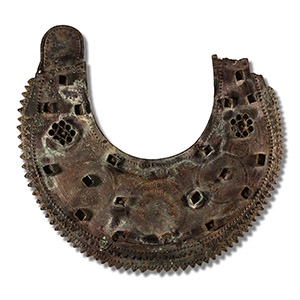
Western Asiatic Decorated Bronze Pectoral Collar
12th-14th century A.D.Sold for (Inc. bp): £1,430
Broad sheet-bronze halter-shaped collar with dentilled outer edge, in two offset overlapped layers; bands of repoussé domed pellets to the outer and inner edges, rectangular cells to accept glass or organic inserts, two clusters of circular cells surrounding rectangular ones; the surface with dense hatching and reserved tendril and leaf motifs; attachment loops to reverse. 638 grams, 34.5 cm
German art market. European private collection, 1970s-early 2000s. Acquired from the above; thence by descent. Private collection, London. This lot has been checked against the Interpol Database of stolen works of art and is accompanied by a search certificate number no.12282-221445. This lot has been cleared against the Art Loss Register database, and is accompanied by an illustrated lot declaration signed by the Head of the Antiquities Department, Dr Raffaele D’Amato. -
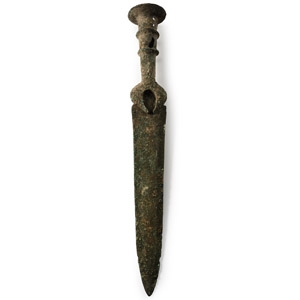
North-Western Persian Bronze Dagger
Late 2nd-early 1st millennium B.C.Sold for (Inc. bp): £1,170
The blade with shallow midrib, hilt cast with two horizontal grooves and crescentic guard. 354 grams, 31.5 cm
Acquired 1980-2015. Ex Abelita family collection. This lot is accompanied by an illustrated lot declaration signed by the Head of the Antiquities Department, Dr Raffaele D’Amato.
Moorey, Gordon and Khorasani created a classification of bladed weapons, according to which daggers are edged weapons not greater than 36cm in length, dirks (short swords) are between 36cm and 50cm in length, and swords are edged weapons greater than 50cm in length. -
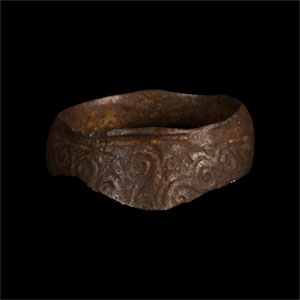
Medieval Bronze Archer's Thumb Ring
14th-15th century A.D.Sold for (Inc. bp): £72
Applied boss to the base of the hoop, triangular extension with foliate scrolls. 2.77 grams, 28.57 mm overall, 19.77 mm internal diameter (approximate size British T, USA 9 1/2, Europe 21.26, Japan 20)
From an English collection formed before 2000. This lot is accompanied by an illustrated lot declaration signed by the Head of the Antiquities Department, Dr Raffaele D’Amato.
