
Loading, please wait...
LOT 0408
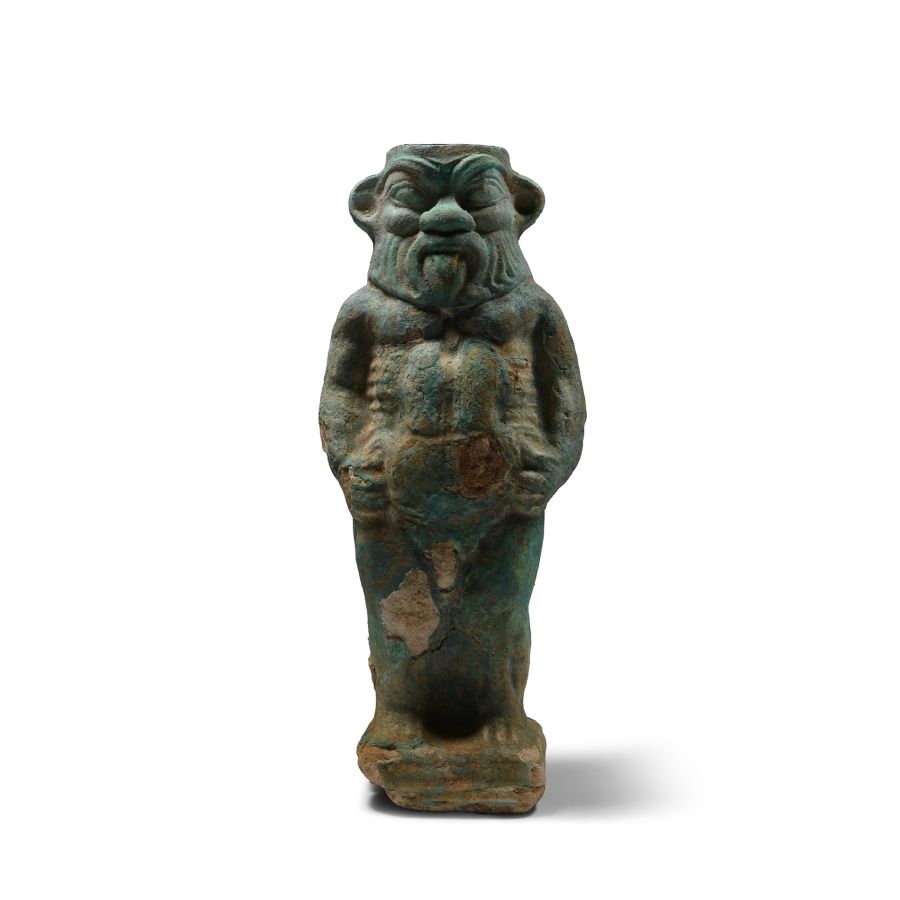
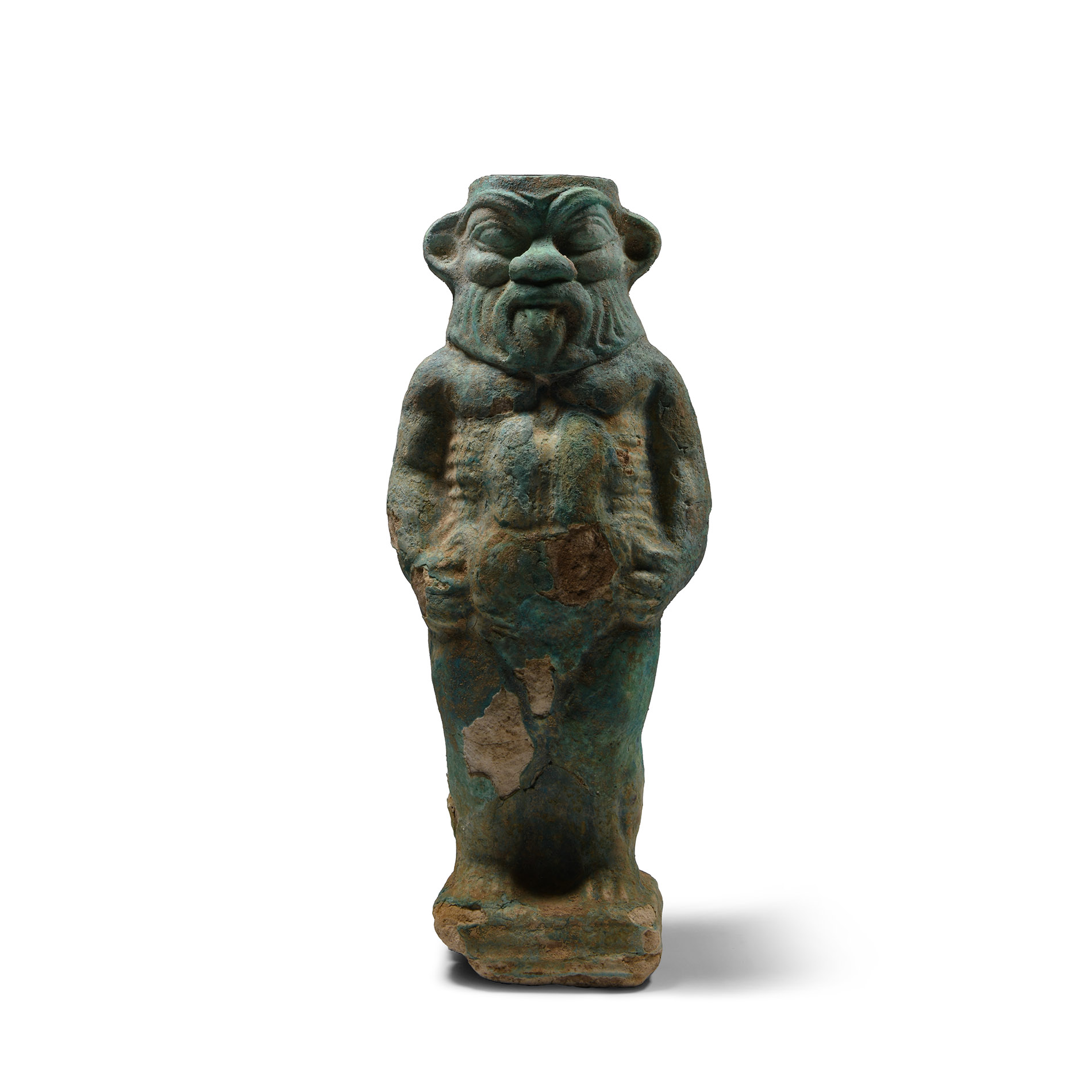
Massive Egyptian Blue Faience Bes Statue
LATE PERIOD, 664-332 B.C.
12 3/4 in. (1.6 kg, 32.2 cm high).
With integral square base and shallow socket to the top of the head; Bes shown standing nude with hands on hips, bearded and with grotesque features, protruding tongue, lattice to the rear of the head; face restored. [No Reserve]
ProvenanceAcquired 1970s-1996.
Property of a North American collector.
London collection, 2016.
Cf. similar statue in the collection of the Louvre under accession no.N 437 (IM 228 ; S 962).
FootnotesDue to its size, this is more probably an architectural and devotional item than a purely amuletic one, probably from a domestic context. It is an ambitious example of moulding in the round in faience (glazed composition).
CONDITIONTimeLine Auctions follows a vetting process to ensure the authenticity and legality of all items, reinforcing our commitment to integrity and responsible trading. Each antiquity, antique, and coin lot undergoes thorough examination by a vetting committee of at least ten external specialists, professional trade association members, scientists, and archaeologists: Our Vetting Process
AUCTIONS:
TimeLine is a leading auction house specialising in antiquities, ancient art, collectables, natural history, coins, medals, and books. Our auctions offer museums, collectors, historians, and enthusiasts the opportunity to acquire unique and historically significant pieces.
-
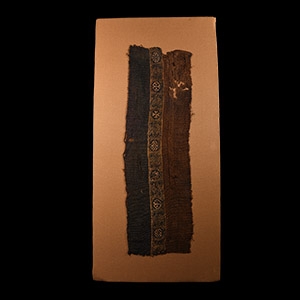
Egyptian Mounted Coptic Textile
Circa 7th-8th century A.D.Sold for (Inc. bp): £78
The fragment of a vertical band (clavus) from a tunic (probably an ecclesiastic garment), woven in linen and wool, the central segment embroidered with polygonal patterns and arabesques, with four crosses inscribed in rhomboids, alternating with floral motifs, edged with two plain bands in dark green and medium brown, probably part of the original garment to which the band was applied. 185 grams, 58 x 27 cm
Acquired 1970s-1996. Property of a North American collector. London collection, 2016.
Yellow wool and linen. In this period, when Egypt passed from Roman to Arabian rule, the garments were still conspicuously decorated with stylised foliage, arabesques and meanders, geometric figures, often made in yellow or white wool over a linen background. -
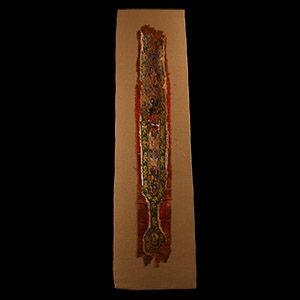
Egyptian Mounted Coptic Textile with Animals
Circa 6th-7th century A.D.Sold for (Inc. bp): £169
Comprising a clavus decorated with various bright colours (green, brown, pink, blue, yellow) with stiff animal figures (dragons and stylised eagles) and a cockerel(?) inside the orbiculus. 138 grams, 70 x 18.2 cm
Acquired 1970s-1996. Property of a North American collector. London collection, 2016.
Tabby technique on linen and wool. It is highly probable that this tapestry was part of a tunic decoration, the clavus with preserved orbiculus, running vertically on the breast and on the back of it. -
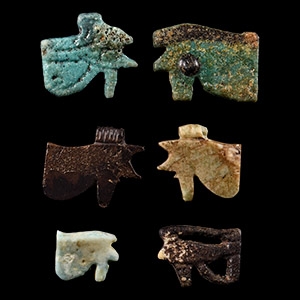
Egyptian Hardstone and Faience Wedjat Eye Collection
Late Period, 664-332 B.C.Sold for (Inc. bp): £312
Including examples with applied black detailing and openwork bands. 8.68 grams total, 12-21 mm
Acquired 1970s-1996. Property of a North American collector. London collection, 2016.
