
Loading, please wait...


LOT 0037
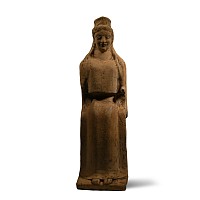
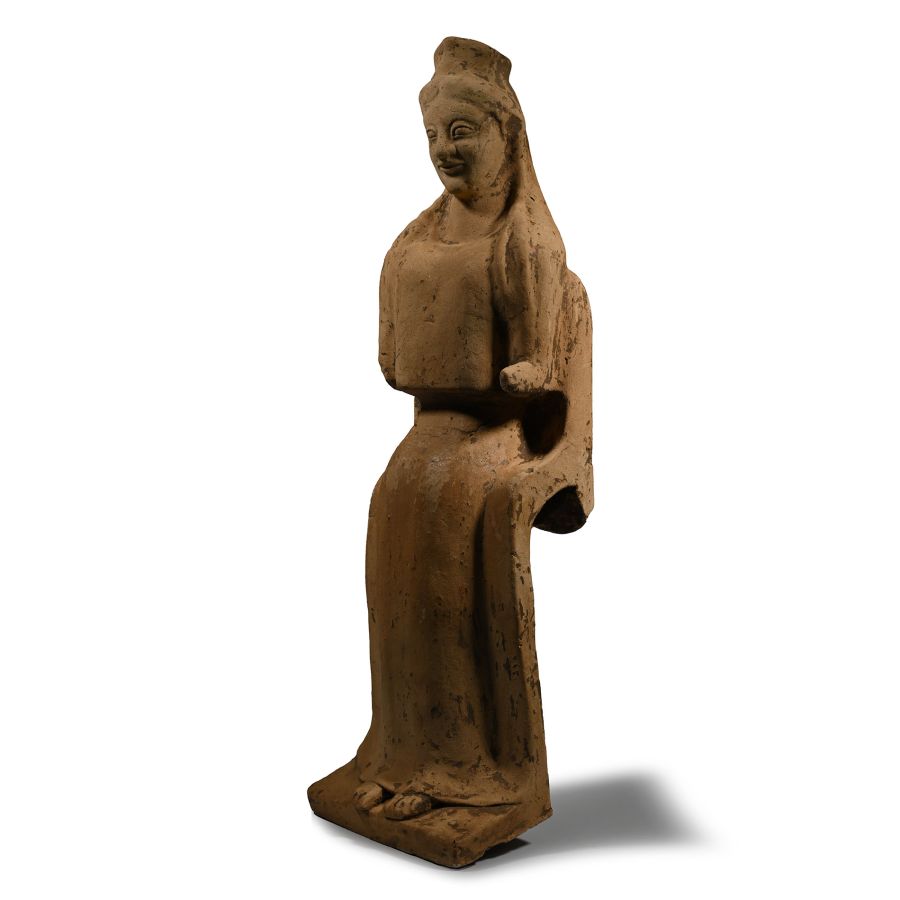
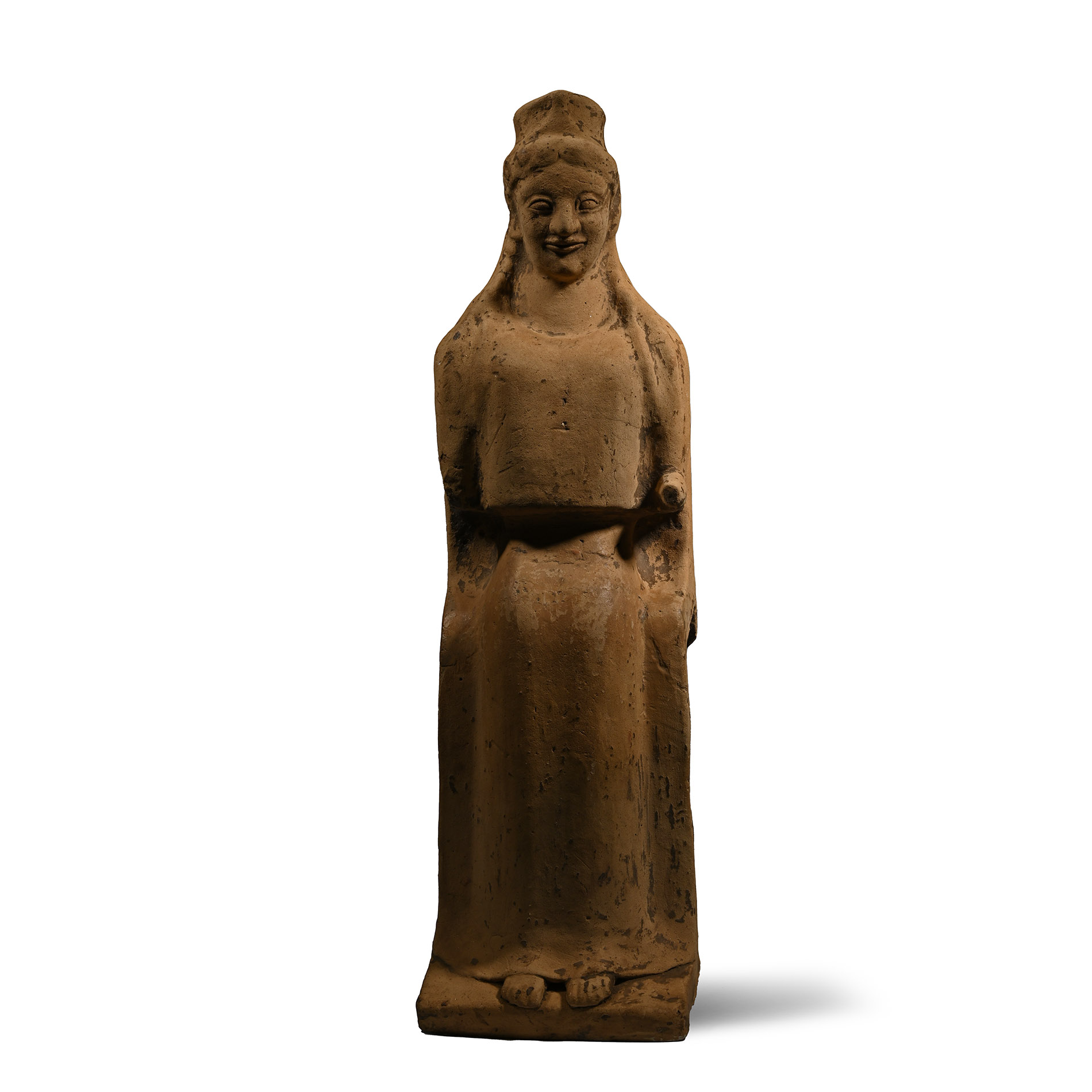
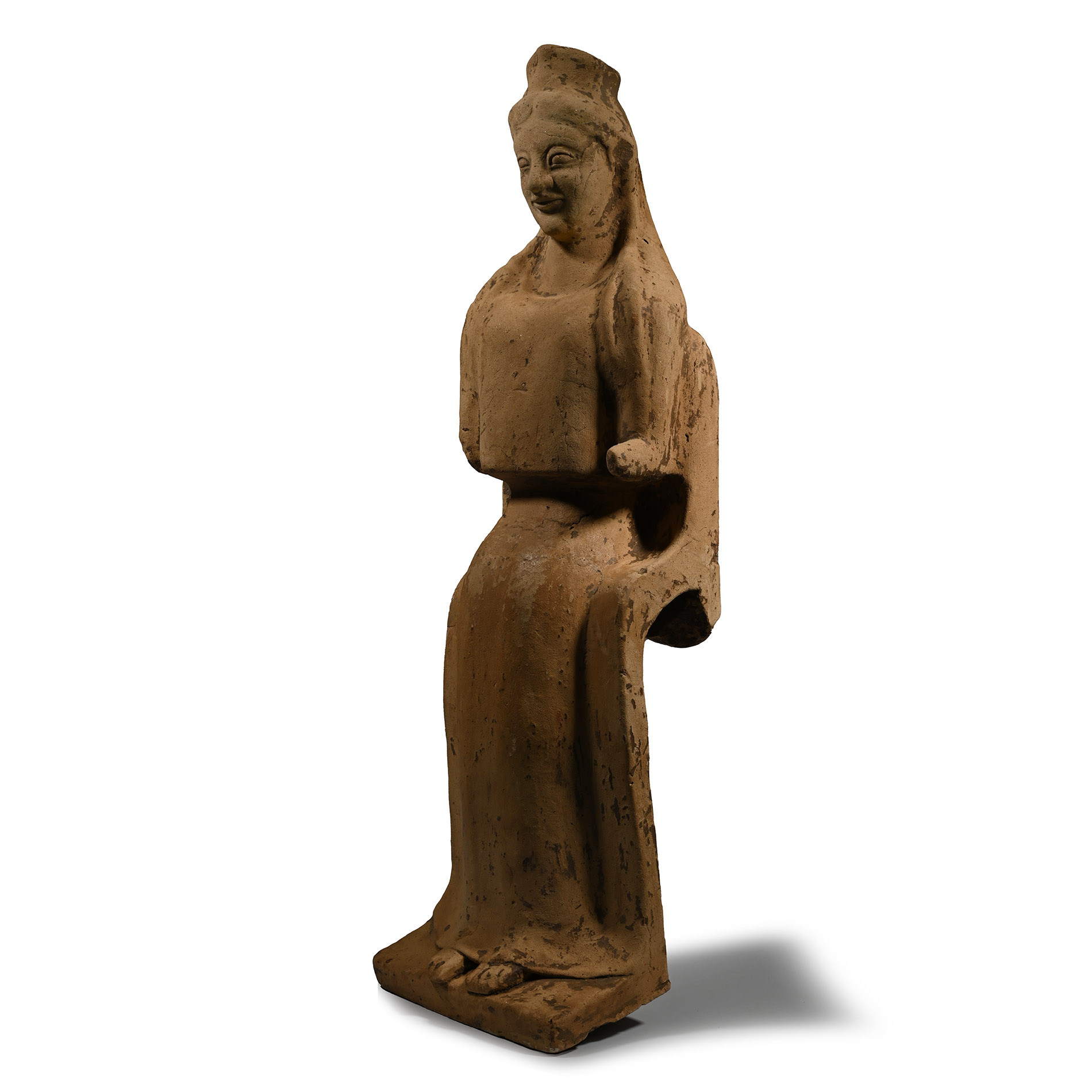
Massive Archaic Greek Terracotta Statuette of a Seated Goddess Demeter
LATE 6TH CENTURY B.C.
22 3/4 in. (2.02 kg, 57.7 cm).
Seated on a high-backed throne, wearing a polos headdress with two long braids falling from underneath the headdress, wearing a long chiton fastened by a belt, the left arm raised, possibly once holding a dove; well marked facial features, slightly almond-shaped large symmetrical eyes with slightly raised eyelids, straight nose, strongly pronounced mouth with fleshy lips and shallow ears; traces of brown slip, repaired.
Provenancewith H.A.C., Basel, prior 1999.
Accompanied by a thermoluminescence analysis report no.N125a51 from Oxford Authentication.
Accompanied by an academic report by Dr Raffaele D'Amato.
This lot has been checked against the Interpol Database of stolen works of art and is accompanied by search certificate no.12461-228712.
This lot has been cleared against the Art Loss Register database, and is accompanied by an illustrated lot declaration signed by the Head of the Antiquities Department, Dr Raffaele D’Amato.
Cf. Biers, W.R., The Archaeology of Greece. An Introduction, Ithaca-London, 1987, fig.8.63, p.236, for a similar statuette; see a similar terracotta of seated Demeter at the Brooklyn Museum, accession no.34.689; other similar terracottas at the British Museum, London, accession nos. GR 1863, 0728, 273, 274, 266, 268 and 269.
FootnotesOne of the most typical 6th century B.C. terracotta female figurines was that of a standing or seated woman wearing a chiton and a himation over it. It was a votive figure offered at the shrines or temples, usually representing the goddess Demeter. Attica was one of the principal centres of figurine production, but Corinth continued to produce solid standing or seated females with moulded fronts and flat backs. The mass production of such terracotta was also typical of Magna Graecia.
CONDITIONTimeLine Auctions follows a vetting process to ensure the authenticity and legality of all items, reinforcing our commitment to integrity and responsible trading. Each antiquity, antique, and coin lot undergoes thorough examination by a vetting committee of at least ten external specialists, professional trade association members, scientists, and archaeologists: Our Vetting Process
AUCTIONS:
TimeLine is a leading auction house specialising in antiquities, ancient art, collectables, natural history, coins, medals, and books. Our auctions offer museums, collectors, historians, and enthusiasts the opportunity to acquire unique and historically significant pieces.
LOT 0037
Massive Archaic Greek Terracotta Statuette of a Seated Goddess Demeter
Estimate £4,000 - 6,000€4,640 - 6,960 (for guidance only)$5,400 - 8,100 (for guidance only)
-
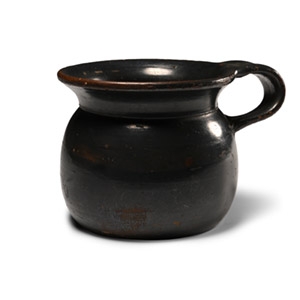
Greek Attic Black-Glazed Terracotta Mug
5th century B.C.Estimate: £400 - 600 (‡+bp*)
Opening Bid: £180
Squat, flat-bottomed with everted rim and single strap handle; reserved underside offset by a groove at its edge, pierced at its centre within a small glazed circle. 102 grams, 93 mm wide
From an American estate, acquired between 1970-1989. Accompanied by a copy of an Art Loss Register certificate no.S00075794. This lot is accompanied by an illustrated lot declaration signed by the Head of the Antiquities Department, Dr Raffaele D’Amato. -
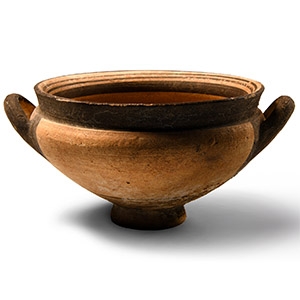
Greek Archaic Terracotta Skyphos with Concentric Circles
7th-early 6th century B.C.Sold for (Inc. bp): £468
Conical in form with rounded shoulder, everted rim and two round-section handles; painted with concentric bands around the interior and exterior. 243 grams, 15.5 cm wide
Acquired in Europe before 1992. European collection. This lot is accompanied by an illustrated lot declaration signed by the Head of the Antiquities Department, Dr Raffaele D’Amato.
The skyphos was already well known in Greece since the age of the Achaeans. In Homer, Eumaeus, the swineherd, prepares for his guest Ulysses a cyssibium filled with wine which the hero drinks during the meal and, when he is full, Eumaeus makes him drink from the cup in which he himself was using, a skyphos. Ulysses also offers Polyphemus a drink in a skyphos. -
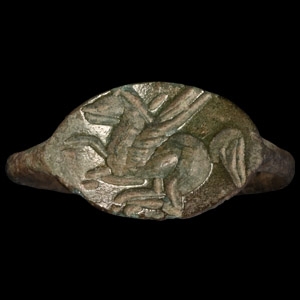
Greek Bronze Ring with Pegasus
5th-3rd century B.C.Sold for (Inc. bp): £286
Lentoid bezel with incuse winged horse motif. 1.33 grams, 19.42 mm overall, 16.97 mm internal diameter (approximate size British L, USA 5 3/4, Europe 11.24, Japan 10)
Ex German art market, 2000s. Acquired from an EU collector living in London. From the collection of Surrey, UK, gentleman. This lot is accompanied by an illustrated lot declaration signed by the Head of the Antiquities Department, Dr Raffaele D’Amato.
