
Loading, please wait...
LOT 1111
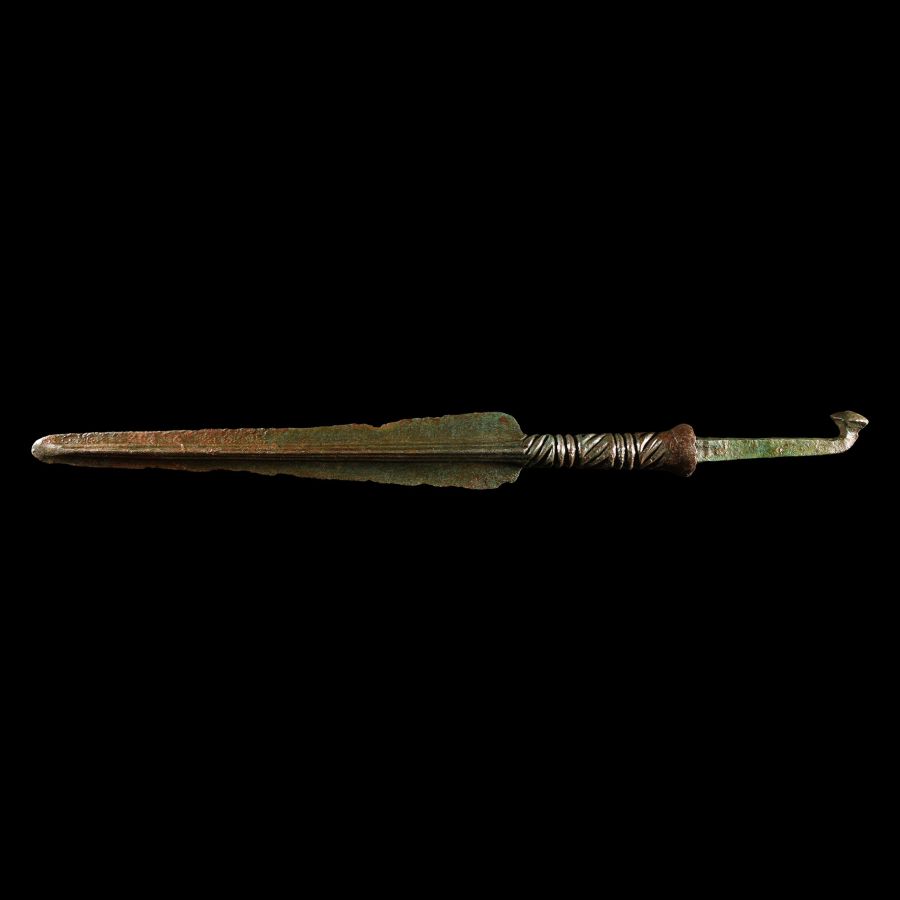
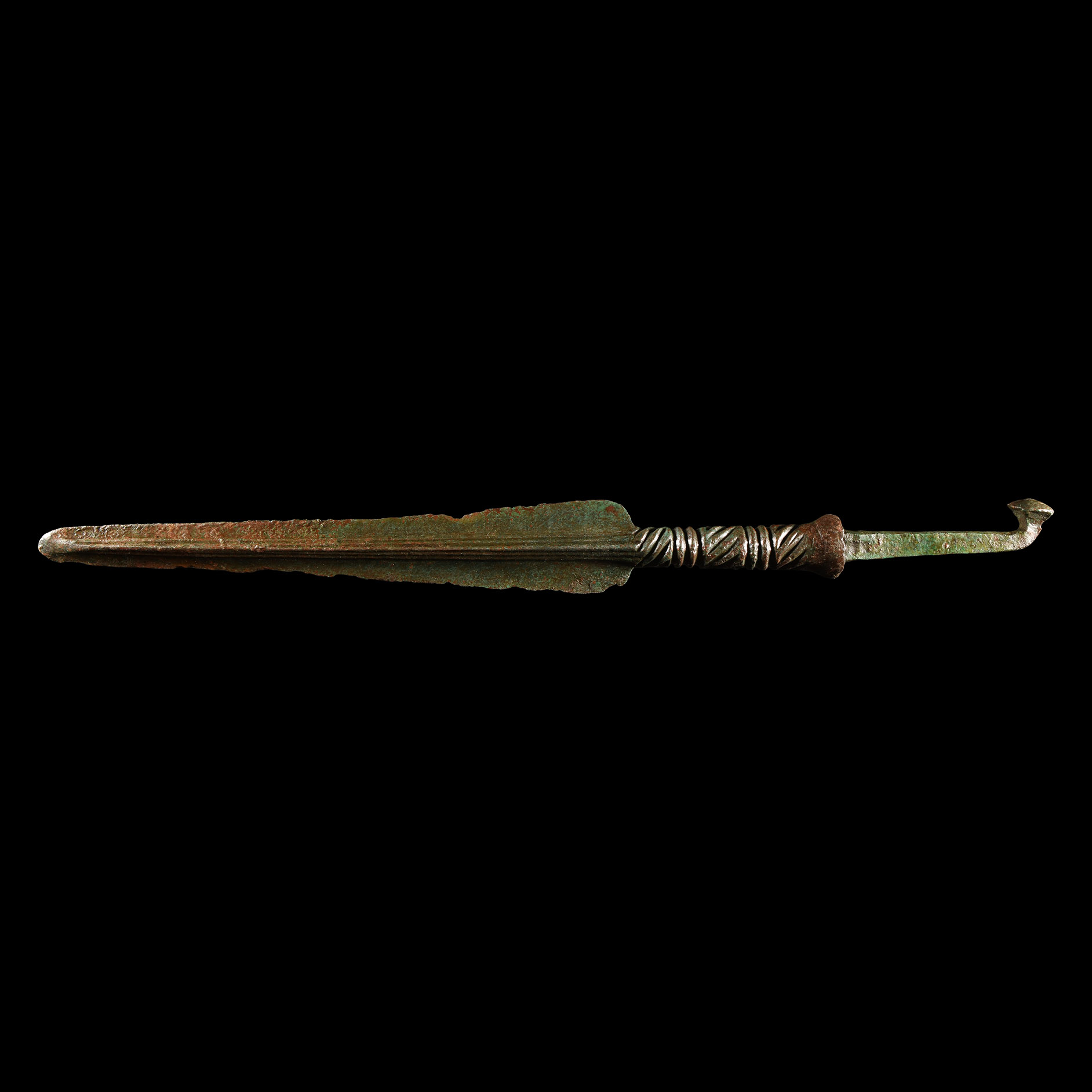
Marlik Type Bronze Decorated Spearhead
13TH-12TH CENTURY B.C.
17 in. (481 grams, 43 cm).
With a long blade, broad midrib, rectangular-section long tang, engraved reinforced shaft and rounded shoulders.
ProvenanceAcquired 1980-2015.
Ex Abelita family collection.
Cf. Khorasani, M.M., Arms and Armour from Iran - The Bronze Age to the End of the Qajar Period, Tuebingen, 2006, p.633, Cat.286, inventory no.11485, of National Museum of Iran in Tehran.
FootnotesIn this category (Type II of the Khorasani typology) the blade has three fullers, and the shaft is usually engraved with diagonal lines. Similar spearheads were excavated by Dr Negahban in Marlik.
CONDITIONTimeLine Auctions follows a vetting process to ensure the authenticity and legality of all items, reinforcing our commitment to integrity and responsible trading. Each antiquity, antique, and coin lot undergoes thorough examination by a vetting committee of at least ten external specialists, professional trade association members, scientists, and archaeologists: Our Vetting Process
AUCTIONS:
TimeLine is a leading auction house specialising in antiquities, ancient art, collectables, natural history, coins, medals, and books. Our auctions offer museums, collectors, historians, and enthusiasts the opportunity to acquire unique and historically significant pieces.
LOT 1111
Marlik Type Bronze Decorated Spearhead
Estimate £300 - 400€350 - 460 (for guidance only)$410 - 540 (for guidance only)
-
.jpg)
Pseudo-Illyrian Chalcidian Variant Bronze Helmet
4th-1st century B.C.Sold for (Inc. bp): £2,860
Large rounded two-part bowl rivetted beneath the repoussé crest extending across the brow and around the circumference; repoussé arches above the eyes extending to the nasal; lateral D-shaped cheek-pieces with scallop to the forward edge, pierced for a chin-strap; some restoration of the bowl and one cheek-piece; mounted on a custom-made display stand. 4.7 kg total, 48 cm high including stand
Acquired 1971-1972. From the collection of the vendor's father. Property of a London, UK, collector. Accompanied by an academic report by Dr Raffaele D’Amato. This lot has been checked against the Interpol Database of stolen works of art and is accompanied by search certificate number no.11751-202770.
According both to Symonenko and Dedjulkin (2014, p.189, fig.9, nn.4-5-6), this category of helmet derives from Chalcidian types (with pseudo-Illyrian elements). As with Chalcidian helmets, our specimen shows vertical decorative lines on the bowl and triangular brow ornament. Distinct from Attic types, it does not have a protruding neck guard introduced on variant III of such helmets (Symonenko, 2014, fig. 15,2-3). According to Dedjulkin, these helmets derive from Greek prototypes, but are simplifications of the original models and made by local artisans. They were widely worn by mercenaries in the Hellenised armies of Pontus and other Hellenistic kingdoms across the Eastern Mediterranean. -
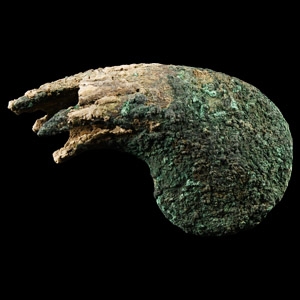
Bactrian Ceremonial Claw Macehead
2nd-1st millennium B.C.Sold for (Inc. bp): £156
Comma-shaped in plan with a lentoid-section head and clawed socket. 227 grams, 11.3 cm
Acquired 1980-2015. Ex Abelita family collection. -
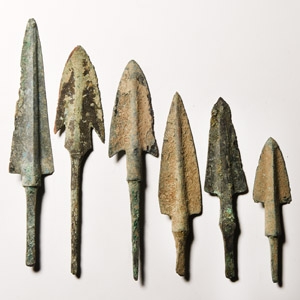
Luristan Bronze Arrowhead Group
12th-10th century B.C.Estimate: £100 - 140 (+bp*)
Opening Bid: £50
Comprising six tanged arrowheads, all with large elongated triangular blades and raised midrib, sharp central groove, cylindrical stem with handle for the shaft; three with barbed shoulders and convex or squared sides, two lanceolate with slightly rounded shoulders, one elongated triangular type. 105 grams total, 6.9-11.7 cm
Acquired 1980-2015. Ex Abelita family collection.
These arrowheads seem to belong to the type V, subcategory types A, B, C and D according to the classification of Khorasani and Negahban. In the four categories of triangular bronze arrowheads from Luristan, Marlik and Northern Iran individuated by Negahban, subtypes C and D of type V are larger arrow or javelin heads, C with barbed shoulders and D with round shoulders.
