
Loading, please wait...
LOT 1081
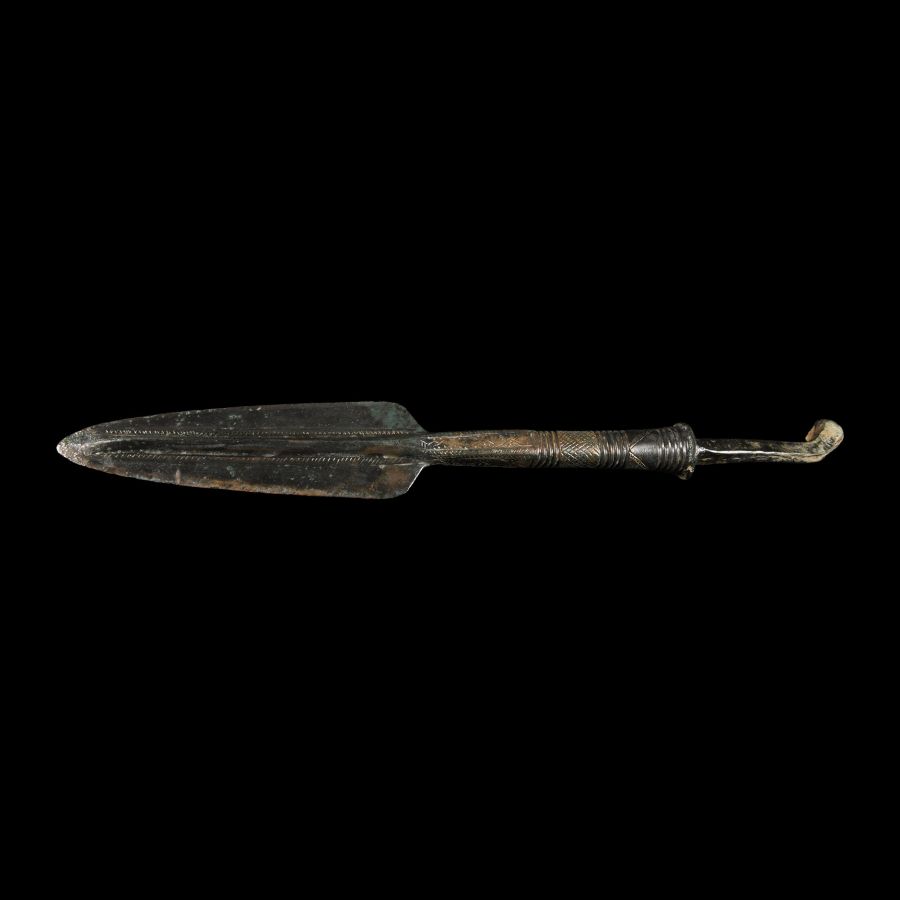
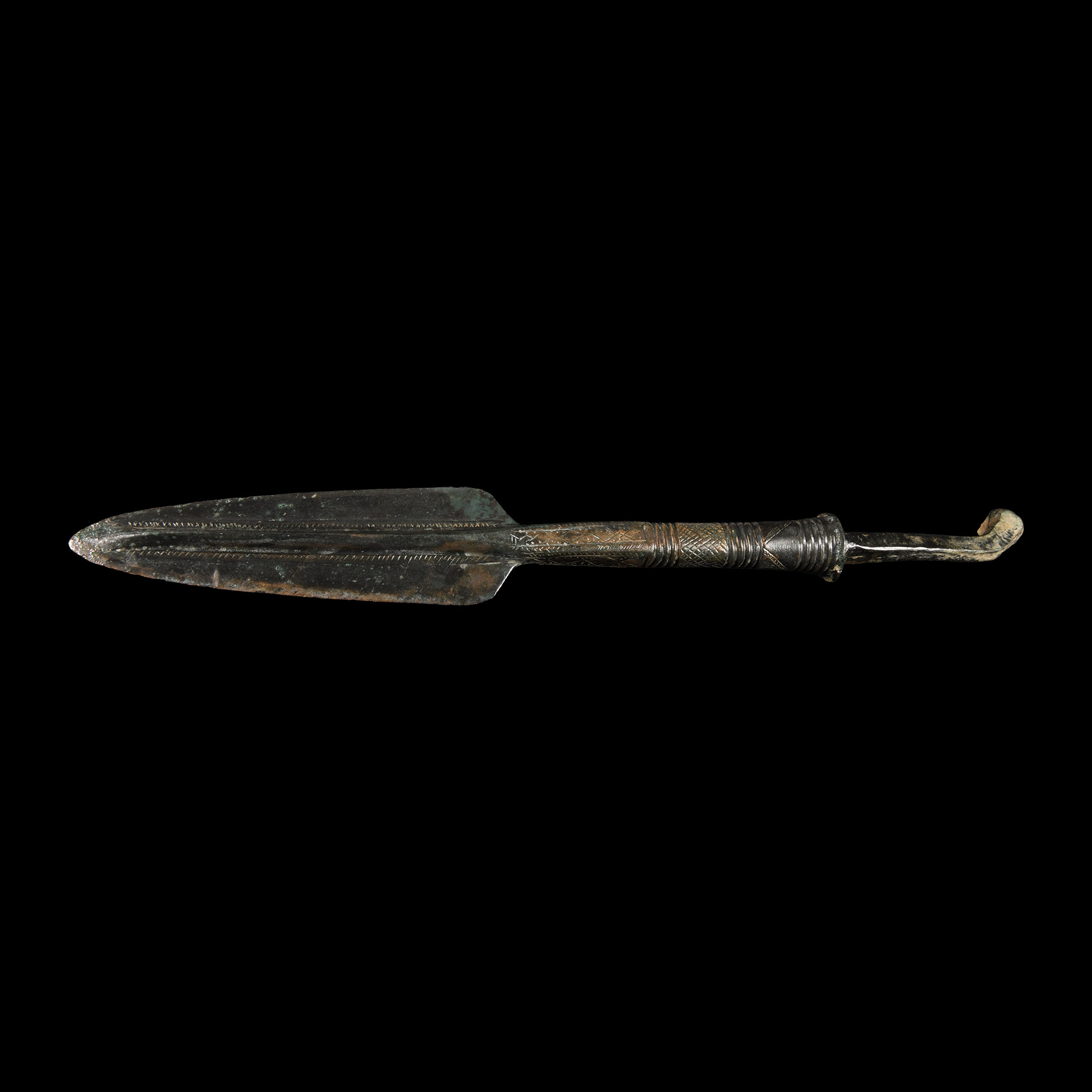
Marlik Decorated Spearhead
13TH-11TH CENTURY B.C.
12 7/8 in. (329 grams, 32.7 cm).
A bronze spearhead with long blade and broad midrib with incised decoration to each side, rectangular-section bent tang, reinforced shaft with ribbed horizontal bands interspersed with bands of geometric motifs.
ProvenanceEx S. Motamed collection.
with Bellman's Auctions, 20th-26th June 2015, lot 2482.
Property of a London gentleman.
Cf. Khorasani, M.M., Arms and Armour from Iran - The Bronze Age to the End of the Qajar Period, Tübingen, 2006, p.633, cat.286, for similar type.
FootnotesIn this category (Type II of the Khorasani typology) the shaft has a tang with a bend towards the end. The blade has three fullers, and the shaft is usually engraved with diagonal lines. Similar pieces were excavated by Dr Negahban in Marlik.
CONDITIONTimeLine Auctions follows a vetting process to ensure the authenticity and legality of all items, reinforcing our commitment to integrity and responsible trading. Each antiquity, antique, and coin lot undergoes thorough examination by a vetting committee of at least ten external specialists, professional trade association members, scientists, and archaeologists: Our Vetting Process
AUCTIONS:
TimeLine is a leading auction house specialising in antiquities, ancient art, collectables, natural history, coins, medals, and books. Our auctions offer museums, collectors, historians, and enthusiasts the opportunity to acquire unique and historically significant pieces.
-
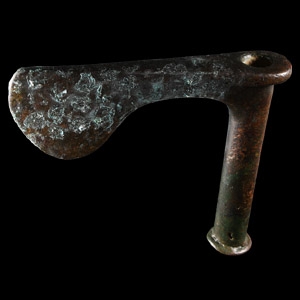
Western Asiatic 'Crescentic' Axehead
1st millennium B.C.Estimate: £200 - 300 (+bp*)
Opening Bid: £100
A bronze axehead with slender tubular socket, horizontal upper cheek and curved lower one, scooped profile to blade with convex cutting edge. 330 grams, 12.5 cm
Acquired 1980-2015. Ex Abelita family collection. -
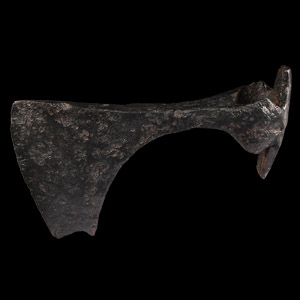
Viking Period Bearded Type Axehead
Circa 9th-11th century A.D.Sold for (Inc. bp): £598
A hand-forged iron skeggöx (bearded axe) with asymmetrical triangular section narrow blade widening to a broad bevelled edge with square chin, curved edge, flared wings to the scooped socket and dorsal bar. 855 grams, 20 cm
Acquired 1971-1972. From the collection of the vendor's father. Property of a London, UK, collector.
Iron axeheads of this typology show a sub-trapezoidal asymmetrical blade, often perforated through the centre. They are characterised by two projections spurs from the top and the bottom of the back of the shaft-hole. -
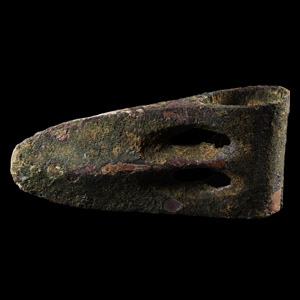
Babylonian Bronze Axehead
2nd millennium B.C.Sold for (Inc. bp): £416
A bronze duck-billed shaft-hole axe head featuring a curved, beak-shaped blade with two pierced eyes and a raised median ridge. 204 grams, 10.5 cm
Acquired early 1990s. Ex private American collection; thence by descent. Private Swiss collection since 1998.
