
Loading, please wait...
LOT 1202
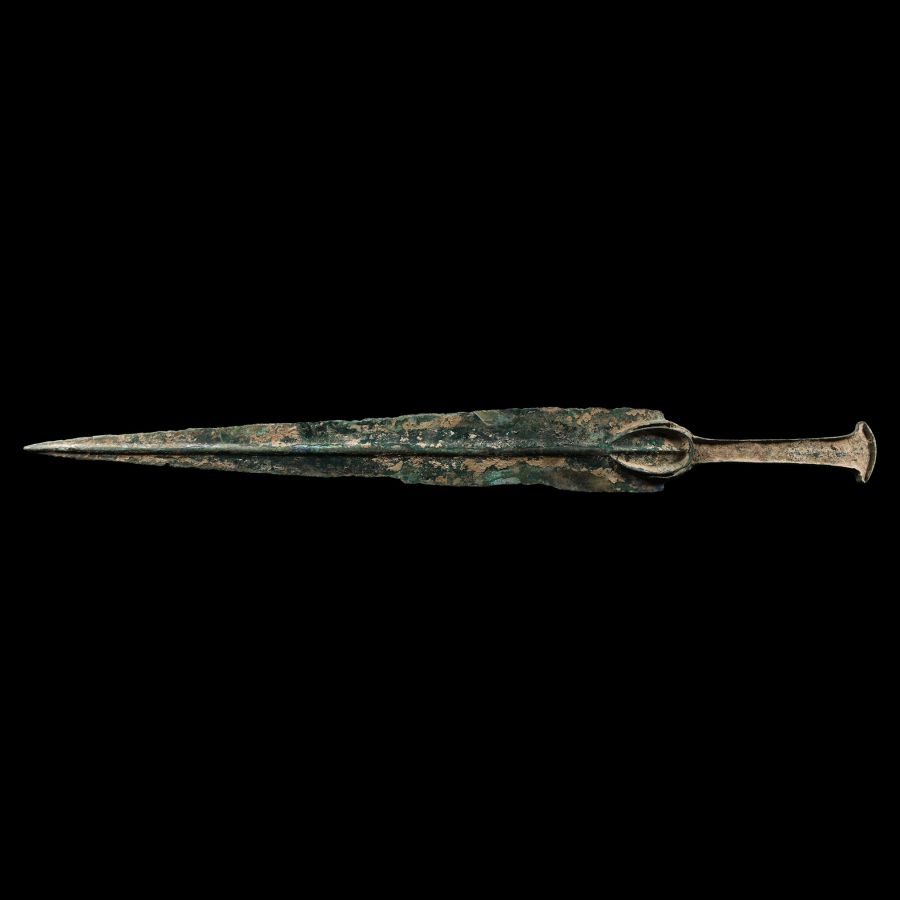
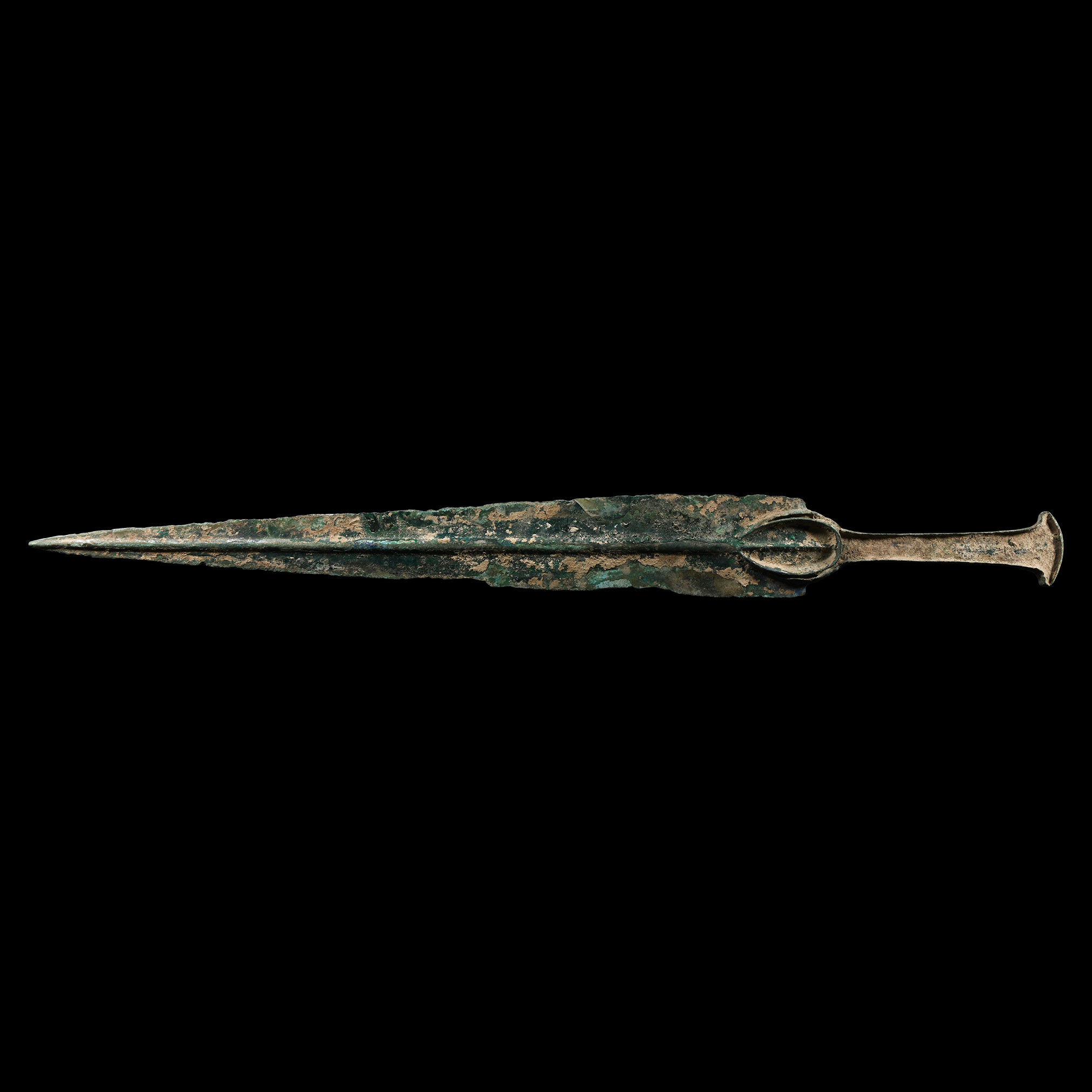
Marlik Bronze Sword
14TH-10TH CENTURY B.C.
18 1/8 in. (265 grams, 46 cm).
With a slender triangular blade, raised midrib, penannular guard and scooped shoulders, columnar grip with two gusseted hoops, crescent pommel.
ProvenanceAcquired 1980-2015.
Ex Abelita family collection.
Cf. Khorasani, M.M., Arms and Armour from Iran. The Bronze Age to the End of the Qajar Period, Tübingen, 2006, items 41-43.
FootnotesThis short sword or dagger belongs to the category of blades with pennanular guard, with hilt and guard cast in one piece with the grip. Negahban excavated similar weapons from the Marlik cemeteries. Often this type combines grip and penannular guard with flanged hilts open to accept inlays.
CONDITIONTimeLine Auctions follows a vetting process to ensure the authenticity and legality of all items, reinforcing our commitment to integrity and responsible trading. Each antiquity, antique, and coin lot undergoes thorough examination by a vetting committee of at least ten external specialists, professional trade association members, scientists, and archaeologists: Our Vetting Process
AUCTIONS:
TimeLine is a leading auction house specialising in antiquities, ancient art, collectables, natural history, coins, medals, and books. Our auctions offer museums, collectors, historians, and enthusiasts the opportunity to acquire unique and historically significant pieces.
-
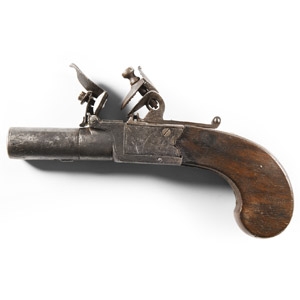
Flintlock Pocket Pistol
18th century A.D.Sold for (Inc. bp): £338
With 40mm (1½") turn-off barrel, box-lock with sliding safety marked 'CLARK' left and 'LONDON' right; fitted with plain wood butt and octagonal escutcheon; action working. 280 grams, 16 cm
Acquired on the UK market. Property of a Kent collector.
Sold as an exempt item under Section 58 (2) of the Firearms Act, 1968, to be held as a curiosity or ornament. No license required but buyer must be over 18 years of age. Overseas bidders should note that, due to UK regulations governing export of all firearms, overseas buyers will need to make arrangements for shipping this lot out of the UK directly, by air freight, with a specialist company or agent. -
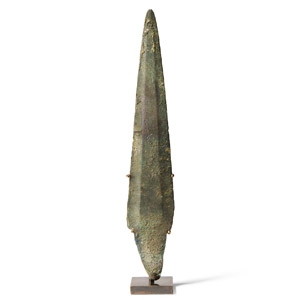
Western Asiatic Bronze Dagger
2nd millennium B.C.Estimate: £200 - 300 (‡+bp*)
Opening Bid: £100
With narrow pointed blade and wide raised flange down centre, straight sides, well marked shoulders with wide tang, one upper hole for rivet. 149 grams total, 21 cm high including stand
From the possessions of a member of a German princely family, gathered in the late 19th century, until the 1930s. with Auction House CUSP, Vienna, Auction Antique Art from Asia and from the Eastern Mediterranean, 16 June 2012, lot 75 [Part].
The type was technically more advanced than previous types of blades in the Near East due to its shape and its slightly convex sides widening out near the point, which combined the advantages of the leaf-shaped and straight-sided forms. -
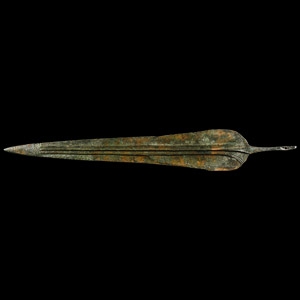
North-West Persian Bronze Short Sword Blade with Blood Channels
Late 2nd-1st millennium B.C.Estimate: £400 - 600 (+bp*)
Opening Bid: £200
Leaf-shaped with short rectangular tang, corrugated midrib with five grooves extending almost to the tip and flared at the rounded shoulders. 347 grams, 47.5 cm
Acquired 1980-2015. Ex Abelita family collection.
The metalworking techniques used in making bronze weapons in early Iran were very complex. Surfaces were often finished in repoussé work, and some of the weapons were chased, others engraved. The function of the ridges here was not only decorative, but principally to reduce suction and thus allow the blade to be withdrawn speedily. The ruling elites of warrior horsemen were buried in the graves with their weapons and horses.
