
Loading, please wait...
LOT 0405
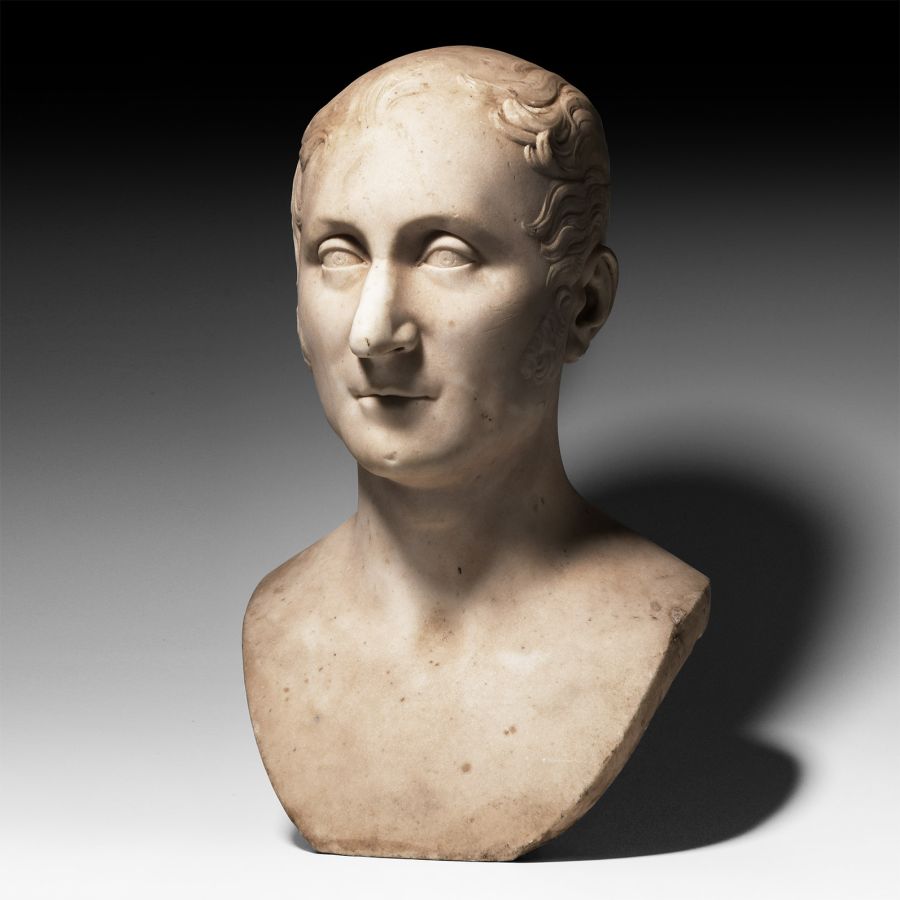
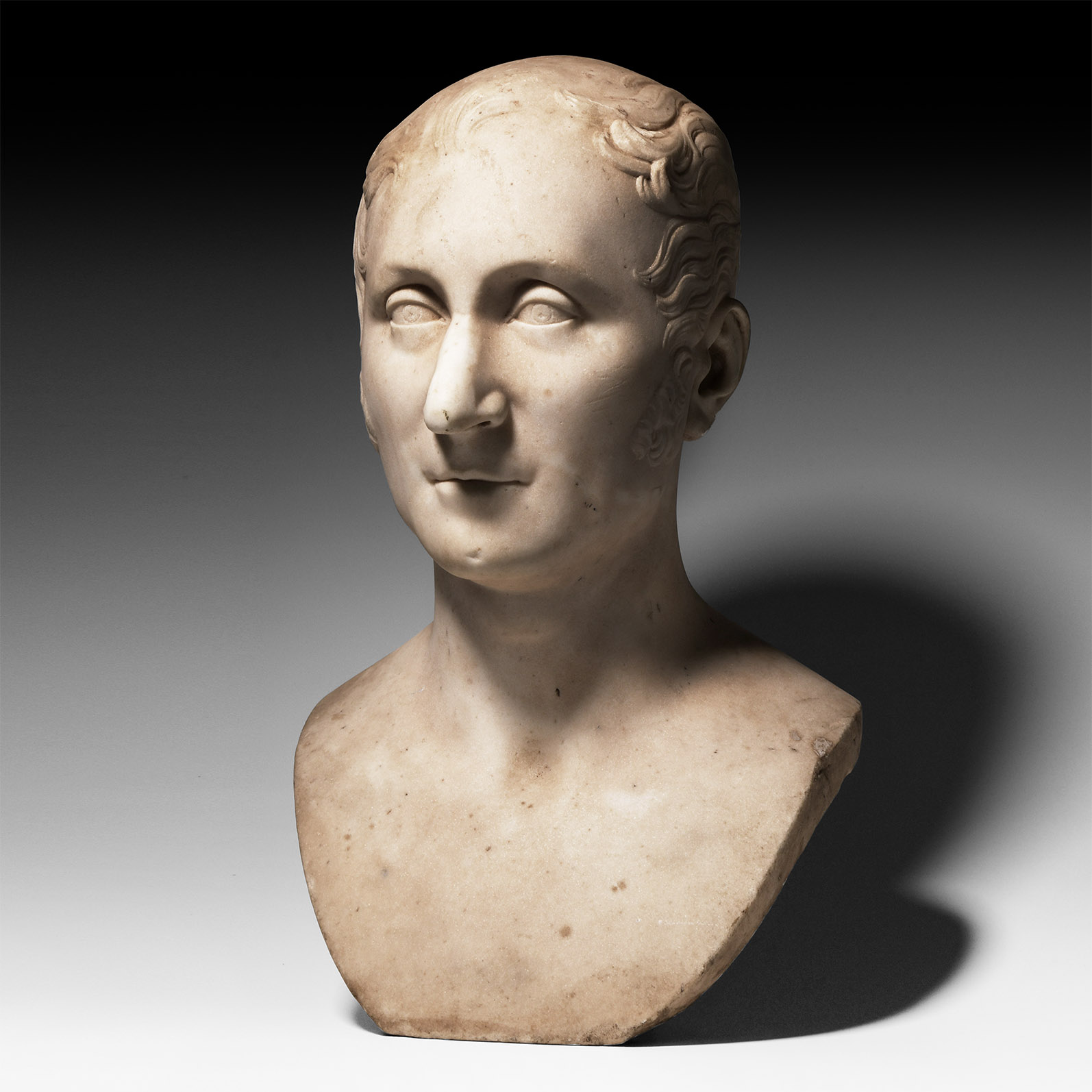
Marble Portrait Bust
19TH CENTURY A.D.
17 in. (22.6 kg, 43 cm high).
A marble bust of a middle-aged man with short hair combed over his forehead, the face shown with a slight smile.
ProvenanceFrench collection, 1960s-early 2000s.
From an important Paris gallery, France.
with Hampel Fine Art Auctions GmbH & Co KG, 12 December 2014, lot 1919.
This lot has been checked against the Interpol Database of stolen works of art and is accompanied by search certificate number no.11693-199346.
TimeLine Auctions follows a vetting process to ensure the authenticity and legality of all items, reinforcing our commitment to integrity and responsible trading. Each antiquity, antique, and coin lot undergoes thorough examination by a vetting committee of at least ten external specialists, professional trade association members, scientists, and archaeologists: Our Vetting Process
AUCTIONS:
TimeLine is a leading auction house specialising in antiquities, ancient art, collectables, natural history, coins, medals, and books. Our auctions offer museums, collectors, historians, and enthusiasts the opportunity to acquire unique and historically significant pieces.
LOT 0405
Marble Portrait Bust
Estimate £3,000 - 4,000€3,480 - 4,640 (for guidance only)$4,050 - 5,400 (for guidance only)
-
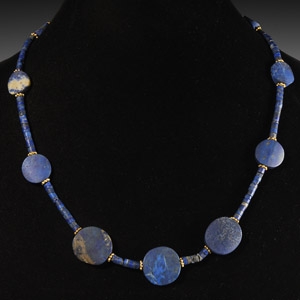
Bactrian Style Lapis Lazuli Bead Necklace String
19th-20th century A.D.Sold for (Inc. bp): £85
A necklace string composed of cylindrical lapis lazuli beads with gold-coloured spacer beads and graduated convex tabular beads. 43 grams, 55 cm long
Acquired 1980s-1990s. H.N. collection, Milton Keynes, UK. -
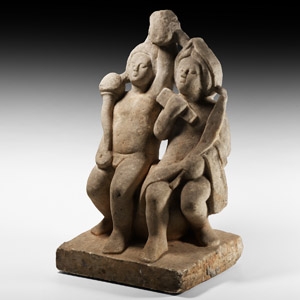
Roman Style Seated Putti
17th-19th century A.D. or earlierEstimate: £1,000 - 1,400 (+bp*)
Opening Bid: £500
A carved stone scene depicting a male and female putti pair seated on a globe, one figure holding a cornucopia; on a rectangular base. 17.6 kg, 40 cm high
English private collection. -
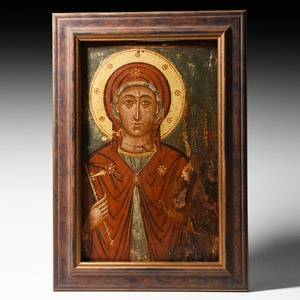
Greek Saint Paraskevi Icon
17th century A.D.Estimate: £1,200 - 1,700 (+bp*)
Opening Bid: £500
A tempera on wood icon depicting Saint Paraskevi of Rome holding a gold cross in her right hand, dressed in a light blue chiton and a red maphorion embroidered with stars and worn over a light blue veil, the gilt halo with red spot decoration; mounted on a later frame. 990 grams, 35.3 x 24.5 cm
Property of a London lady, part of her family's collection.
Saint Paraskevi is considered in the Orthodox world as the protector of sick people. Religious icon images of the saint were considered to hold powers to help in healing from various ailments, keeping the family well, and protecting against evil intentions. There was an ancient custom in the Orthodox world of bringing fruit and vegetables to the church to sanctify them on the day of Saint Paraskevi and keep them in the house as a talisman.
