
Loading, please wait...
LOT 0351
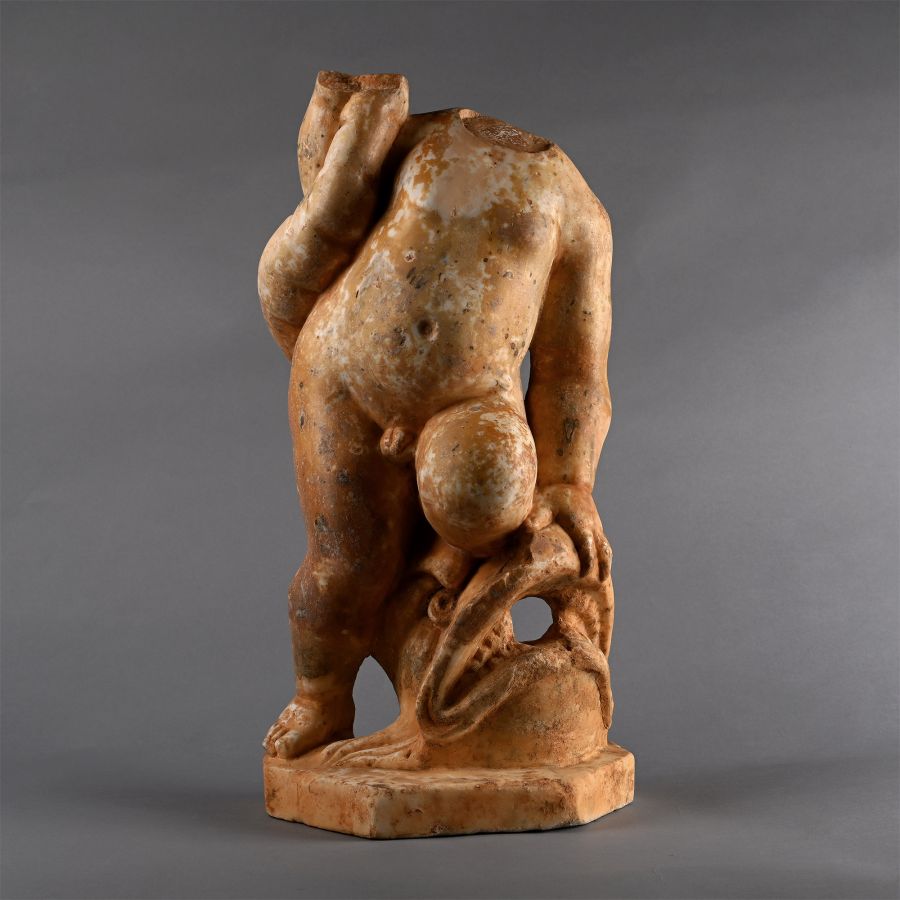
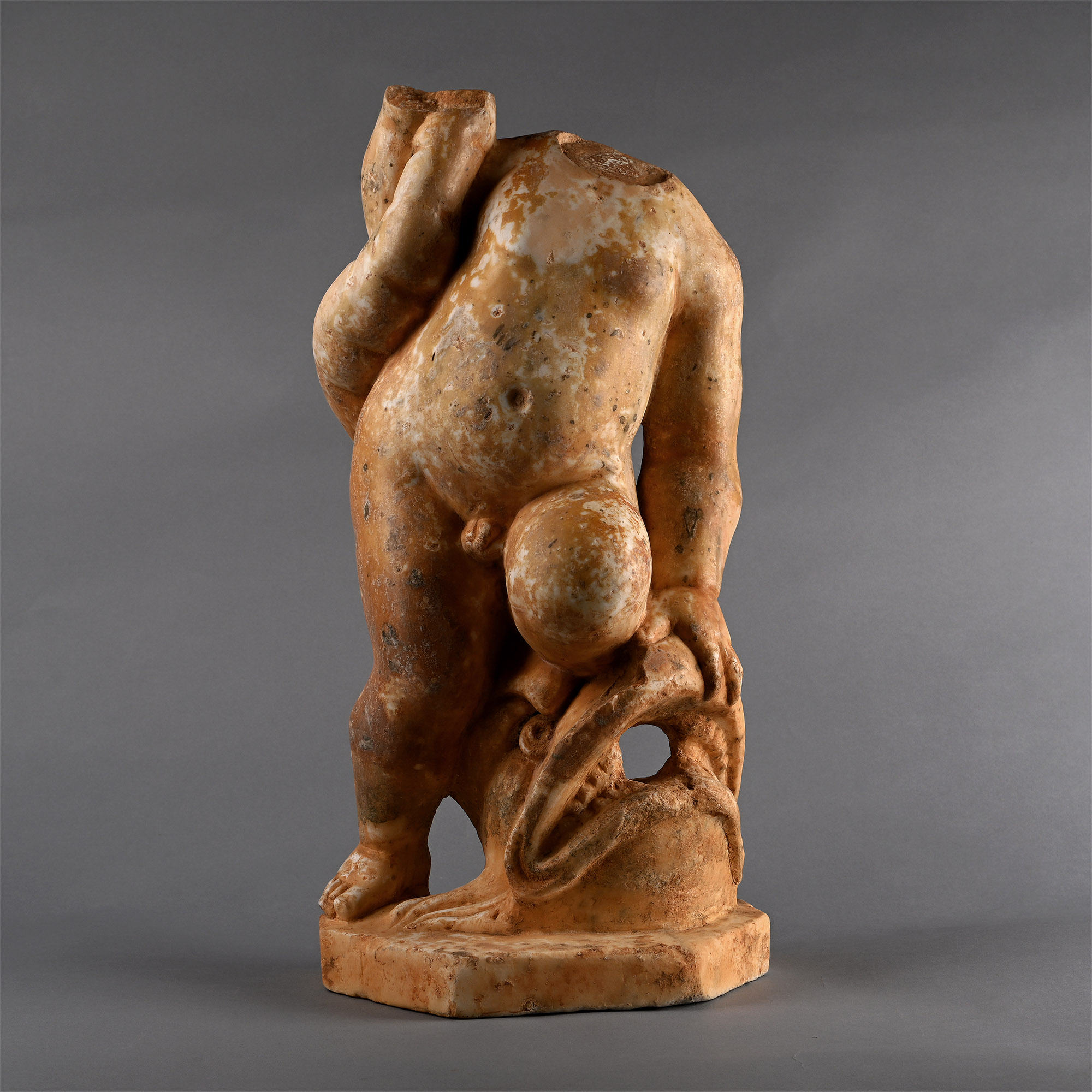
Marble Fountain Sculpture of a Putto Wrestling a Fish
BAROQUE, 17TH CENTURY A.D.
18 7/8 in. (20.75 kg, 48 cm).
Standing on an angular base resting his left knee on the open jaws of a fish, his left arm holding the jaws open, the body and tail held upright be the raised right hand (partly absent); with heavy sulphured patina. [No Reserve]
ProvenanceAcquired prior to 1970.
From the estate of a Swiss gentleman, Ticino.
Private collection, Zurich, Switzerland.
This lot has been checked against the Interpol Database of stolen works of art and is accompanied by a search certificate number no.12790-240308.
Cf. for similar Roman original sculptures Balász Kapossy, Brunnenfiguren der hellenistischen und römischen Zeit, Juris Druck & Verlag Zurich, 1969; E. Curtius, 'Brunnenfiguren im Museum zu Neapel' in Archäologische Zeitung 1879, Tafel 1, boy with frog.
FootnotesIn ancient Roman art and architecture, fountains were often decorated with sculptures of young boys or putti holding fish. These sculptures were known as 'putti with fish' or 'boy with fish' and were a popular motif in the decoration of fountains. The young boy or putto was shown holding a fish or a shell, which would spout water into the fountain basin below. The fish was a particularly popular motif because it symbolised abundance, fertility, and prosperity, which were all important values in ancient Roman society. Overall, the putti with fish sculptures are a notable example of the art and architecture of ancient Rome and have continued to be an enduring symbol of beauty, abundance, and prosperity throughout the centuries. Archaeological excavations in Pompeii have revealed many examples of sculptures of putti with fish. The putti with fish sculptures from Pompeii were usually made of bronze, marble, or terracotta. They were often placed in the centre of the fountain, surrounded by other decorative elements such as flowers, plants, and other sculptures. Many of these putti with fish sculptures are now on display in the National Archaeological Museum of Naples. The museum also houses a famous mosaic of a putto with a fish, which was discovered in the House of the Faun in Pompeii. The putti with fish sculptures from Pompeii and those in the Naples Museum provide valuable insights into the art and culture of ancient Rome. They demonstrate the importance of beauty and abundance in ancient Roman society and offer a glimpse into the everyday life of the people who lived in Pompeii over two thousand years ago. In the 17th and 18th centuries these sculptures were imitated and used to decorate the fountains of royal palaces and palaces.
CONDITIONTimeLine Auctions follows a vetting process to ensure the authenticity and legality of all items, reinforcing our commitment to integrity and responsible trading. Each antiquity, antique, and coin lot undergoes thorough examination by a vetting committee of at least ten external specialists, professional trade association members, scientists, and archaeologists: Our Vetting Process
AUCTIONS:
TimeLine is a leading auction house specialising in antiquities, ancient art, collectables, natural history, coins, medals, and books. Our auctions offer museums, collectors, historians, and enthusiasts the opportunity to acquire unique and historically significant pieces.
-
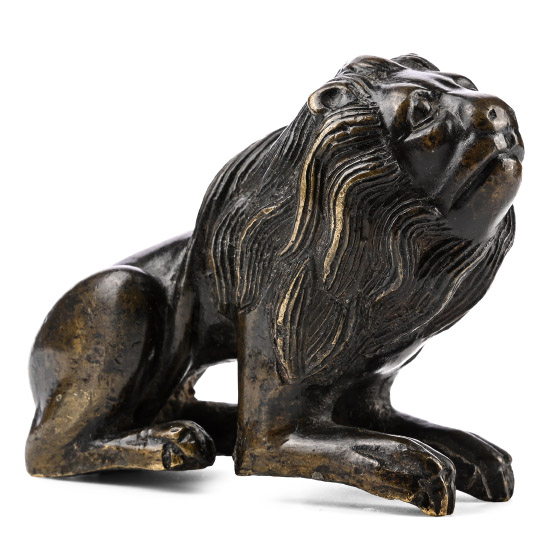
Nuremberg Brass Lion Statue
Germany, 16th century A.D.Estimate: £500 - 700 (+bp*)
Opening Bid: £250
Modelled in a half-seated pose, gazing upwards with compact body, broad forequarters, the mane rendered in long, parallel strands; the tail emerging from underneath the body and resting diagonally on top of the neck. 855 grams, 96 mm
Acquired on the European art market.
The treatment reflects the continuation of late Gothic conventions within German workshops, while also aligning with the more classicising tendencies found in North Italian bronze production of the period. The anatomical structure is simplified yet purposeful, characteristic of functional or cabinet bronzes produced across central Europe in the sixteenth century. Its scale and form correspond to small bronzes intended for Kunstkammer settings or as elements within larger composite objects such as inkstands or caskets, where the lion served as an emblem of vigilance, authority, and learned taste. -

Melody Maker Magazine Original Advertising Poster
1950s A.D.Estimate: £80 - 100 (+bp*)
Opening Bid: £40
Off-white ground with dark blue masthead 'Meldoy Maker / World's Largest Net Sale ' red blocked text and dark blue footer 'Every Friday - 6d'; footnote 'Printed and issued by Odhams Press, Long Acre, London WC2'. 22 grams, 76.2 x 50.6 cm
Acquired on the UK art market. Property of a Harwich, UK, collector.
'Melody Maker' was an important music-industry weekly magazine which was founded in 1926 by the publisher Lawrence Wright, aimed at dance band musicians under the title 'The Melody Maker and British Metronome'. The footnote reference is to the Odhams publishing venture which folded in 1968. -
.jpg)
Large Framed Book Plate with Egyptian Amulets
19th century A.D.Sold for (Inc. bp): £13
Large-format engraved plate illustrating amulets of various types (figures of Bes and Pataikos, multiple wedjat, Taweret with dorsal pillar, etc.), from the book series La Description de l'Egypte published after the French army's Egyptian campaign (1798-1801), Book A, Volume V, plate 88; mounted in a modern glazed frame. 3 kg total, 70.6 x 53 cm including frame
Ex private collection, London, UK.
Produced between February 1802 and 1830 on the orders of Napoleon Bonaparte; published between 1809 and 1828. Just 1,000 copies were distributed to various institutions, printed on laid paper with an 'Égypte ancienne et moderne' watermark. The book is subtitled Recueil des observations et des recherches qui ont été faites en Égypte pendant l’expédition de l’Armée française, publié par les ordres de Sa Majesté l’Empereur Napoléon le Grand (Gathering of observations and discoveries which were made in Egypt during the expedition of the French army, published on the orders of His Majesty the Emperor Napoleon the Great). It was the world's first encyclopedia devoted exclusively to the remains of ancient Egypt.
