
Loading, please wait...
LOT 0382
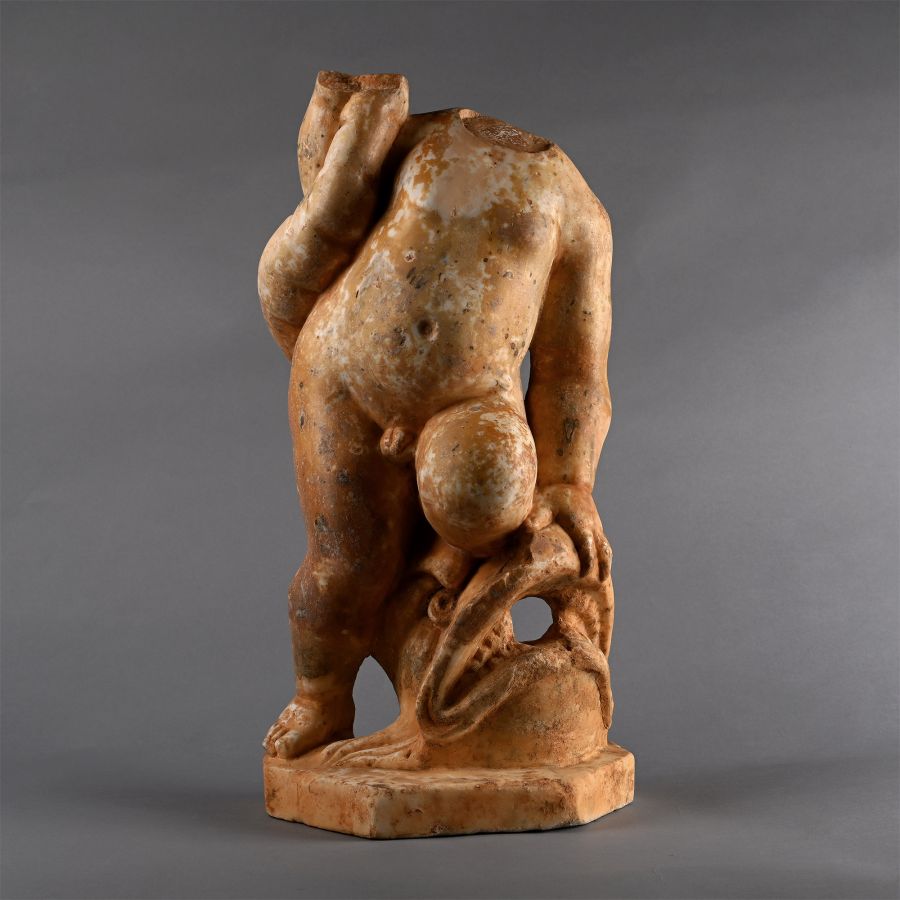
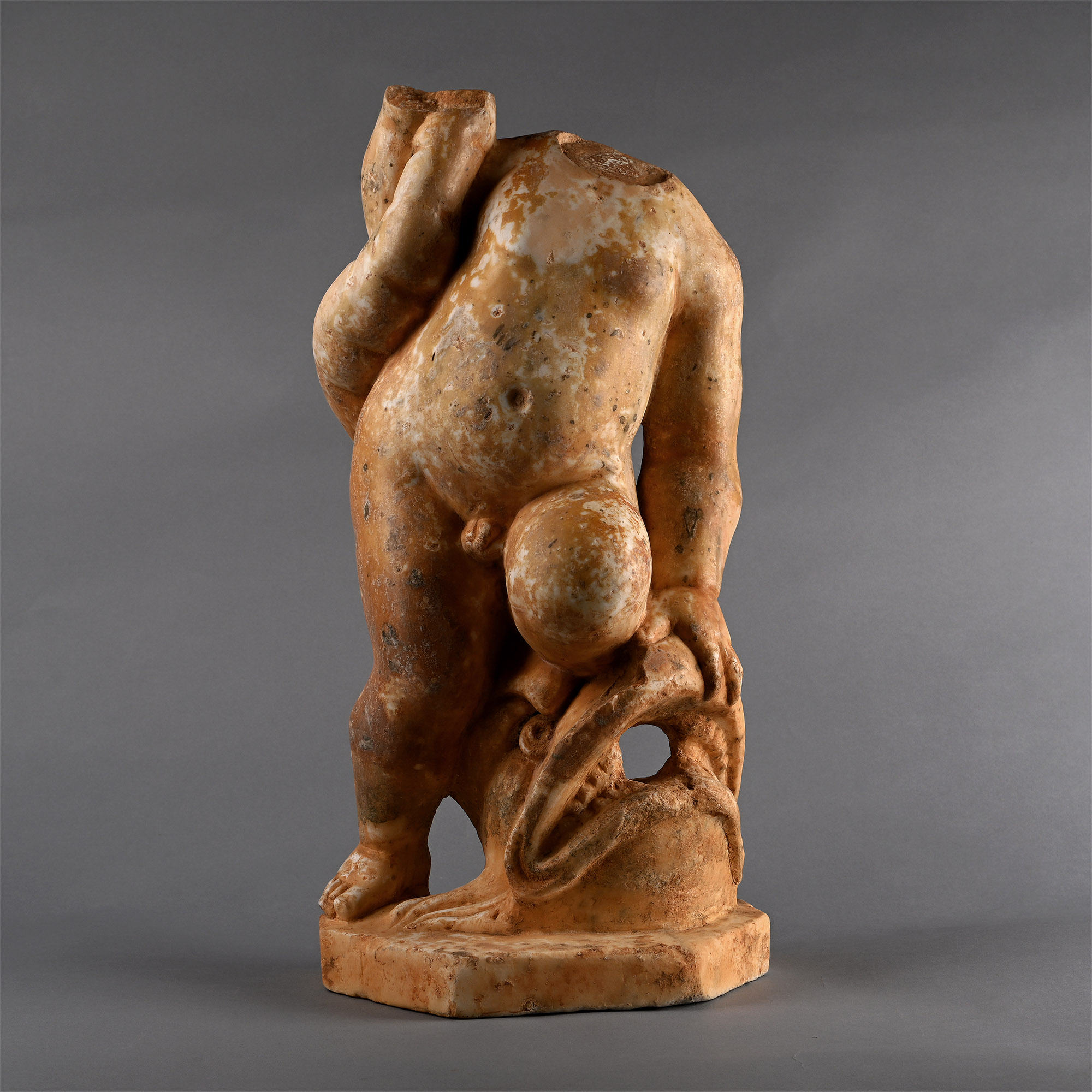
Marble Fountain Sculpture of a Putto Wrestling a Fish
BAROQUE, 17TH CENTURY A.D.
18 7/8 in. (20.75 kg, 48 cm).
Standing on an angular base resting his left knee on the open jaws of a fish, his left arm holding the jaws open, the body and tail held upright be the raised right hand (partly absent); with heavy sulphured patina.
ProvenanceAcquired prior to 1970.
From the estate of a Swiss gentleman, Ticino.
Private collection, Zurich, Switzerland.
This lot has been checked against the Interpol Database of stolen works of art and is accompanied by a search certificate number no.12790-240308.
This lot has been cleared against the Art Loss Register database, and is accompanied by an illustrated lot declaration signed by the Head of the Antiquities Department, Dr Raffaele D'Amato.
Cf. for similar Roman original sculptures Balász Kapossy, Brunnenfiguren der hellenistischen und römischen Zeit, Juris Druck & Verlag Zurich, 1969; E. Curtius, 'Brunnenfiguren im Museum zu Neapel' in Archäologische Zeitung 1879, Tafel 1, boy with frog.
FootnotesIn ancient Roman art and architecture, fountains were often decorated with sculptures of young boys or putti holding fish. These sculptures were known as 'putti with fish' or 'boy with fish' and were a popular motif in the decoration of fountains. The young boy or putti was shown holding a fish or a shell, which would spout water into the fountain basin below. The fish was a particularly popular motif because it symbolised abundance, fertility, and prosperity, which were all important values in ancient Roman society. Overall, the putti with fish sculptures are a notable example of the art and architecture of ancient Rome and have continued to be an enduring symbol of beauty, abundance, and prosperity throughout the centuries. Archaeological excavations in Pompeii have revealed many examples of sculptures of putti with fish. The putti with fish sculptures from Pompeii were usually made of bronze, marble, or terracotta. They were often placed in the centre of the fountain, surrounded by other decorative elements such as flowers, plants, and other sculptures. Many of these putti with fish sculptures are now on display in the National Archaeological Museum of Naples. The museum also houses a famous mosaic of a putto with a fish, which was discovered in the House of the Faun in Pompeii. The putti with fish sculptures from Pompeii and those in the Naples Museum provide valuable insights into the art and culture of ancient Rome. They demonstrate the importance of beauty and abundance in ancient Roman society and offer a glimpse into the everyday life of the people who lived in Pompeii over two thousand years ago. In the 17th and 18th centuries these sculptures were imitated and used to decorate the fountains of royal palaces and palaces.
CONDITIONTimeLine Auctions follows a vetting process to ensure the authenticity and legality of all items, reinforcing our commitment to integrity and responsible trading. Each antiquity, antique, and coin lot undergoes thorough examination by a vetting committee of at least ten external specialists, professional trade association members, scientists, and archaeologists: Our Vetting Process
AUCTIONS:
TimeLine is a leading auction house specialising in antiquities, ancient art, collectables, natural history, coins, medals, and books. Our auctions offer museums, collectors, historians, and enthusiasts the opportunity to acquire unique and historically significant pieces.
LOT 0382
Marble Fountain Sculpture of a Putto Wrestling a Fish
Estimate £6,000 - 8,000€6,960 - 9,280 (for guidance only)$8,100 - 10,800 (for guidance only)
-
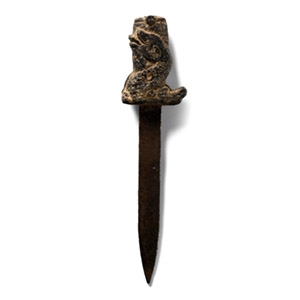
Roman Style Bronze Model Knife
18th century A.D. or laterSold for (Inc. bp): £91
With narrow tongue-shaped iron blade and copper-alloy hilt formed as a hippocamp. 10.7 grams, 87 mm
From the collection of a gentleman, acquired on the London art market in the 1990s. This lot is accompanied by an illustrated lot declaration signed by the Head of the Antiquities Department, Dr Raffaele D'Amato. -
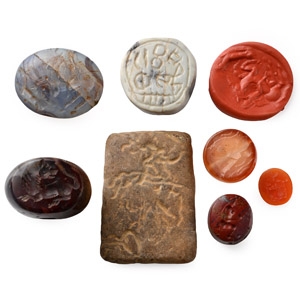
Group of Seals and Scaraboids
20th century A.D.Sold for (Inc. bp): £111
Including rectangular, plano-convex and other types, each with a carved low-relief motif; after the antique. 77 grams total, 12-45 mm
From the late S M collection, London, UK, 1969-1999. This lot is accompanied by an illustrated lot declaration signed by the Head of the Antiquities Department, Dr Raffaele D'Amato. -
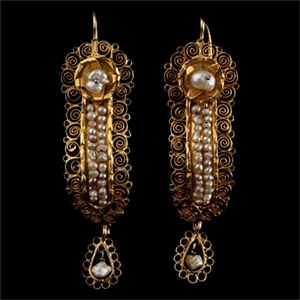
Sicilian Gold Earrings with Pearls
South Italian, 1860-1910 century A.D.Sold for (Inc. bp): £780
Matched pair, each formed as a ring enclosing a natural irregular pearl above a tongue-shaped arched panel with two strands of smaller pearls, band of filigree coils to the outer edge, teardrop dangle below with pearl to the centre; hoop and catch to the reverse. 7.81 grams total, 58-60 mm
Ex Georgie Chrischilles. Private collection, London. This lot is accompanied by an illustrated lot declaration signed by the Head of the Antiquities Department, Dr Raffaele D'Amato.
