
Loading, please wait...
LOT 0385
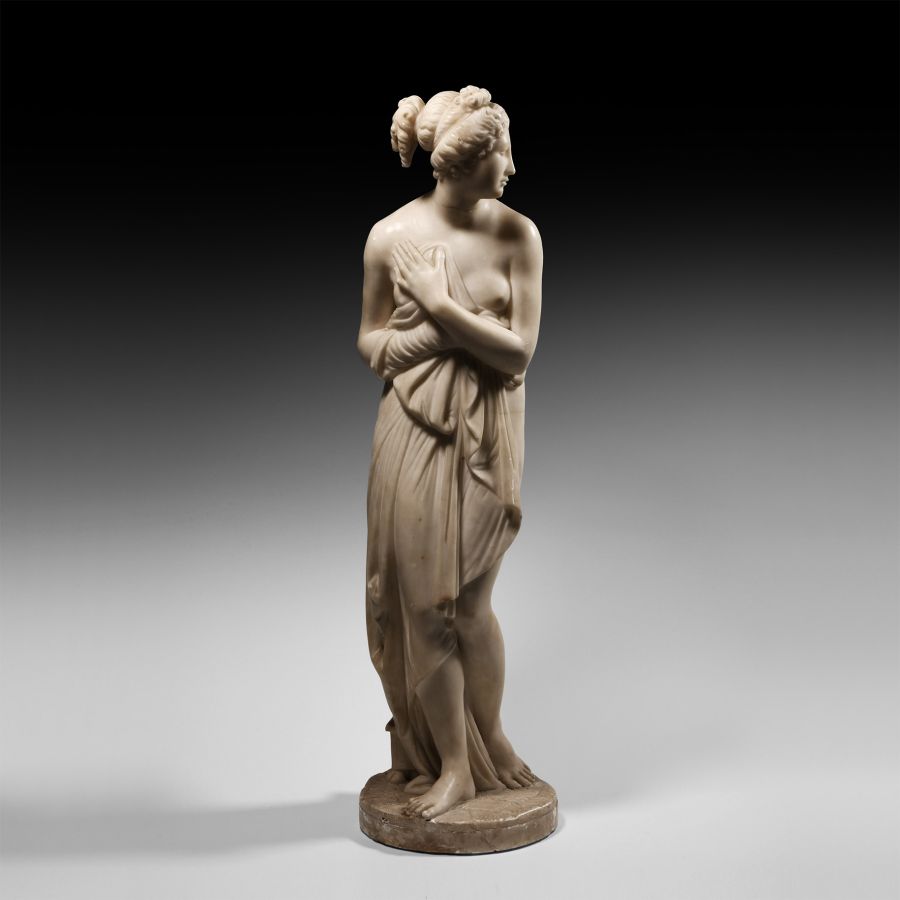
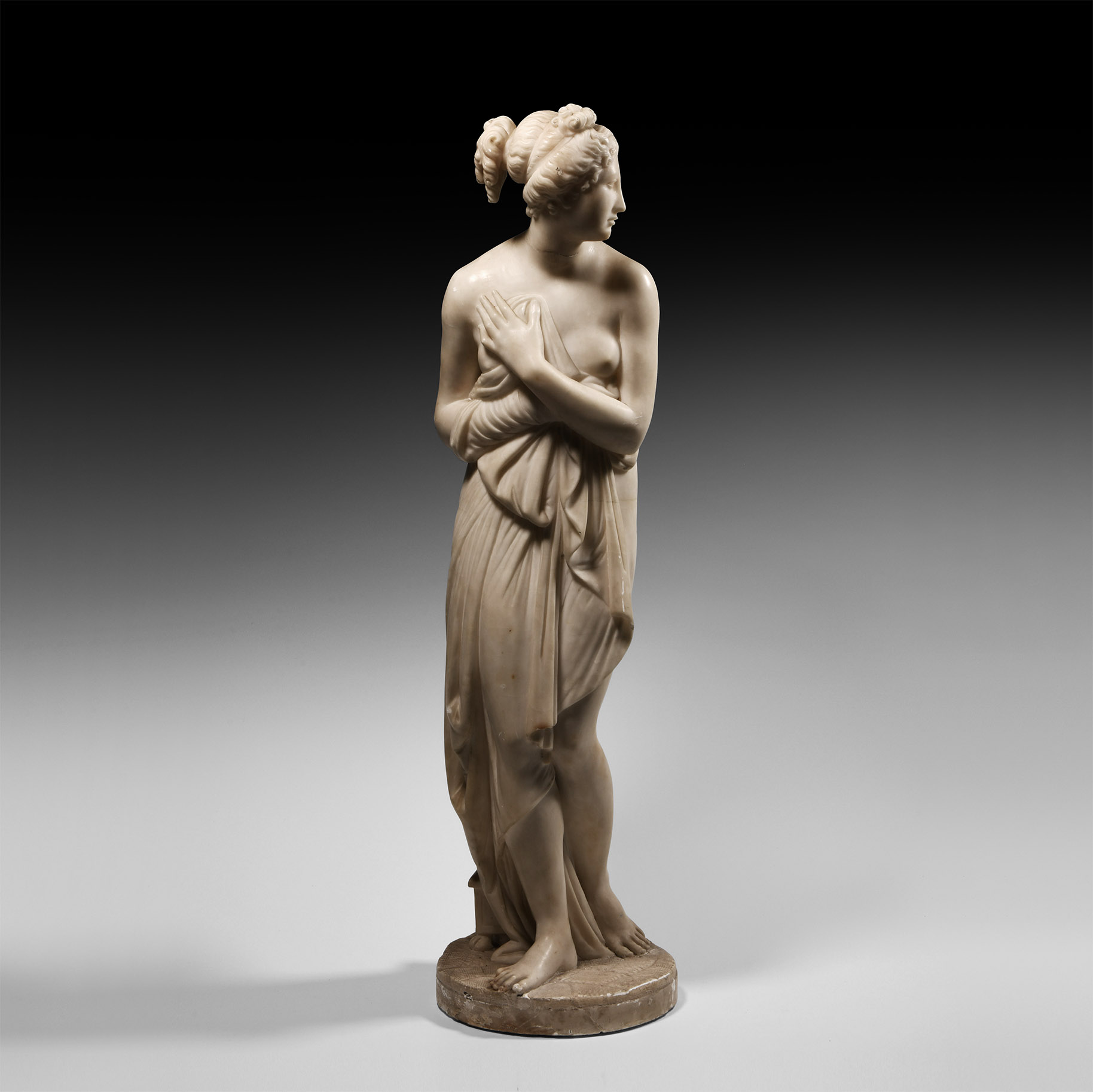
Marble Bathing Venus
NEOCLASSICAL, 19TH CENTURY A.D.
30 3/4 in. (21.2 kg, 78 cm high).
A marble interpretation of the famous 'Bathing Venus' (Pudica Venus) statue, modelled naturalistically in the round, nude, hair piled behind her head, holding her garment to her breast, standing on a composite discoid base imitating a stone pavement, with a casket at her feet; after Giambologna's Renaissance original; restored.
ProvenanceFrench collection, 1960s-early 2000s.
From an important Paris gallery, France.
The original 'Bathing Venus' statue in bronze has been attributed to Giambologna (Giovanni da Bologna) (1529-1608), and was probably created for King Henry IV of France as a diplomatic gift from Ferdinando I de’ Medici, Grand Duke of Tuscany. This is a neoclassical interpretation of that Renaissance statue.
CONDITIONTimeLine Auctions follows a vetting process to ensure the authenticity and legality of all items, reinforcing our commitment to integrity and responsible trading. Each antiquity, antique, and coin lot undergoes thorough examination by a vetting committee of at least ten external specialists, professional trade association members, scientists, and archaeologists: Our Vetting Process
AUCTIONS:
TimeLine is a leading auction house specialising in antiquities, ancient art, collectables, natural history, coins, medals, and books. Our auctions offer museums, collectors, historians, and enthusiasts the opportunity to acquire unique and historically significant pieces.
-
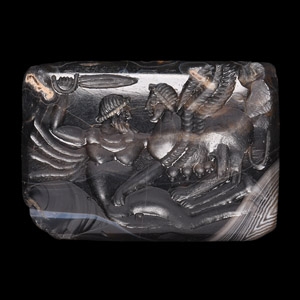
Neoclassical Gemstone Plaque
18th-19th century A.D.Sold for (Inc. bp): £279
A banded agate intaglio engraved with an ancient Assyrian(?) style figural scene showing a man with sword in hand battling a sphinx-like mythical winged creature with the head of a woman and body of a lion, swollen teats lining the creature's belly; pair of drilled holes for suspension; chipped. 21.6 grams, 43 mm
Fine condition.
Property of a North London gentleman.
Likely an allusion to ancient tales of the monstrous and treacherous sphinx attacking the hero. -
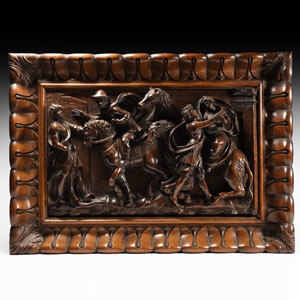
Renaissance Wooden Panel with Horse and Figures
Italian, circa 18th century A.D.Estimate: £1,500 - 2,000 (+bp*)
Opening Bid: £750
A carved wooden panel depicting a dynamic figural scene composed of mounted horse rider together with a rider mounted on a mythical creature with two heads, the body and hindlegs of a horse and head and forelegs of a lion or other creature, two standing figures beside them; egg-and-dart style frame with leaves to each corner. 4 kg, 54.5 x 38.5 cm
English private collection.
The timber shows some old insect flight holes and we are advised that this piece has been recently treated with Permethrin, as a precaution. -
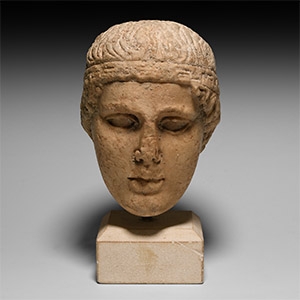
Post Medieval Marble Head
20th century A.D. or earlierSold for (Inc. bp): £1,170
A marble head carved naturalistically in the round with cropped hair, wearing a taenia headband seemingly featuring Greek key motif; possibly representing a deity, a muse or even a female satyr; mounted on a carved stone base. A marble head carved naturalistically in the round with cropped hair, wearing a taenia headband seemingly featuring Greek key motif; possibly representing a deity, a muse or even a female satyr; mounted on a carved stone base.
with Arts D'Orient, Artcurial, Paris, 19 May 2014, lot 138. English private collection.
