
Loading, please wait...
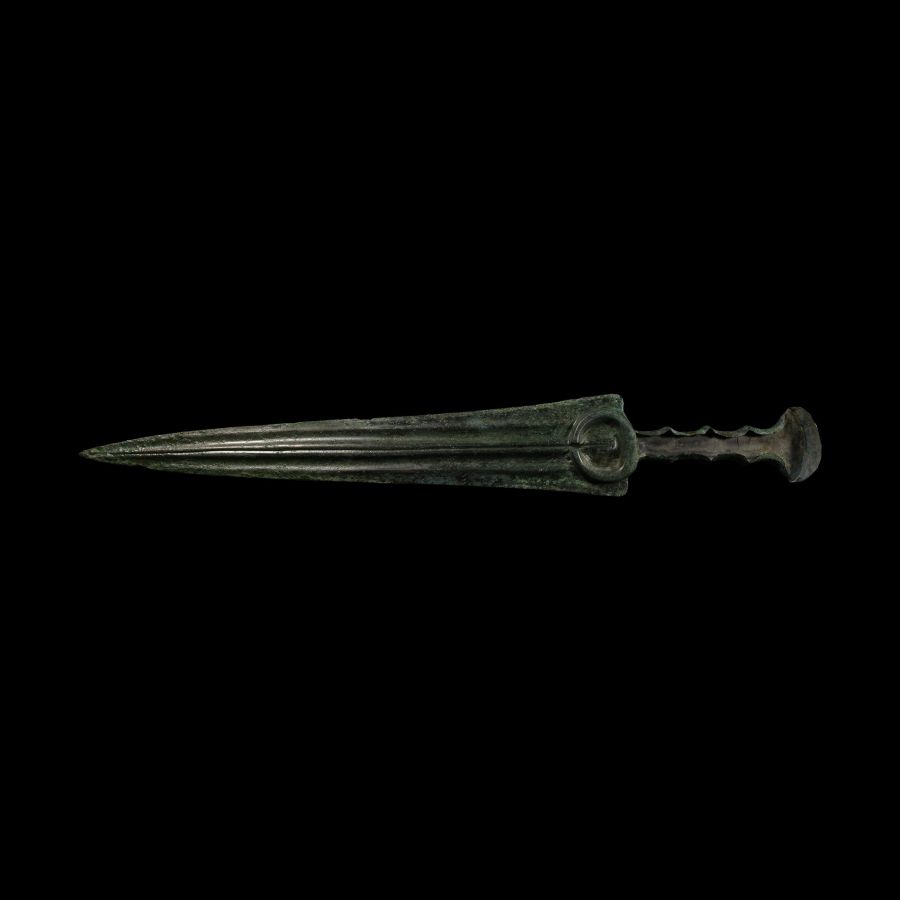
_900x900.jpg "Luristan Sword with Decorated Hilt")
_200x200.jpg "Luristan Sword with Decorated Hilt")
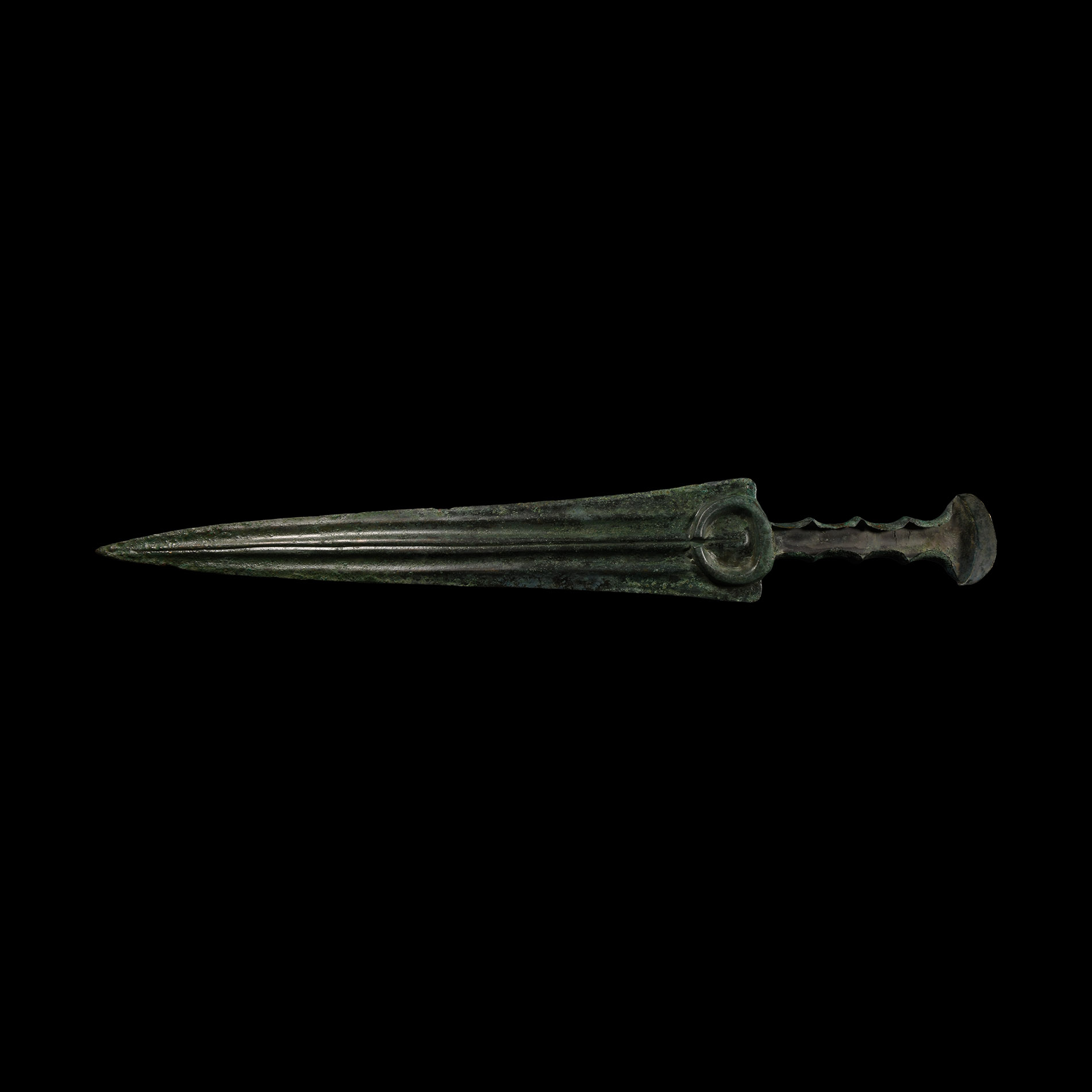
.jpg "Luristan Sword with Decorated Hilt")
LOT 0225
Luristan Sword with Decorated Hilt
10TH CENTURY B.C.
17 1/4 in. (464 grams, 44 cm).
A bronze short sword or dirk with tapering blade and square shoulders, flanged hilt with crenellated grip, widening slightly to a fan-shaped pommel, strong midrib and penannular guard.
ProvenanceEx S. Motamed collection.
with Bellman's Auctions, 20th-26th June 2015, lot 2482.
Property of a London gentleman.
Cf. Khorasani, M.M., Arms and Armour from Iran - The Bronze Age to the End of the Qajar Period, Tübingen, 2006, p.380, cat.12. for identical type.
FootnotesAccording to Khorasani and Moorey, this type of dirk probably originated from the north and appeared in Western Iran towards the end of the Late Bronze Age, remaining in use alongside with the early examples of iron dirks. Medveskaya stated that usually this type of daggers and dirks were cast in one piece, meaning the penannular grip was cast on later to the dagger or dirk.
CONDITIONTimeLine Auctions follows a vetting process to ensure the authenticity and legality of all items, reinforcing our commitment to integrity and responsible trading. Each antiquity, antique, and coin lot undergoes thorough examination by a vetting committee of at least ten external specialists, professional trade association members, scientists, and archaeologists: Our Vetting Process
AUCTIONS:
TimeLine is a leading auction house specialising in antiquities, ancient art, collectables, natural history, coins, medals, and books. Our auctions offer museums, collectors, historians, and enthusiasts the opportunity to acquire unique and historically significant pieces.
-
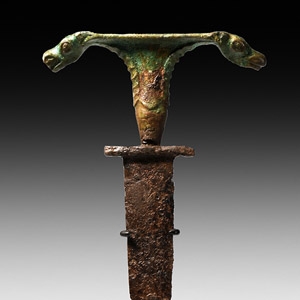
Heniochi Dagger with Beast Heads
4th-2nd century B.C.Sold for (Inc. bp): £520
A short iron dagger with triangular blade, short straight guard surmounted by a bronze pommel characterised by twinned beast heads projecting from each side; accompanied by a custom-made display stand. 170 grams, 28 cm (753 grams total, 39 cm high including stand)
Acquired 1971-1972. From the collection of the vendor's father. Property of a London, UK, collector.
The tribe of the Heniochs, according to Artemidorus of Ephesus, existed during the 5th-1st century B.C., on the Black Sea littoral that is part of present-day Abkhazia. Aristotle describes the Heniochi as a group of people "ready enough to kill and eat men." The dagger shows similarities with the pommel of a sword from Akhul Abaa grave 4 with twinned beast heads. These weapons of subtype I, according to the classification of Gamkrelidze-Shatberashvili-Pirtskhalava-Charkviani, were popular not only in Abkhazia, but throughout the territory of west Georgia during the 4th-1st century B.C. -
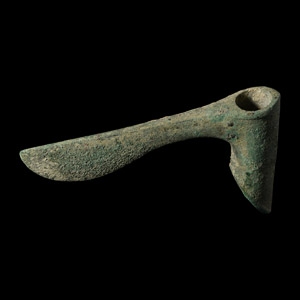
Luristan Sar-e Tabar Socketted Axehead
2nd millennium B.C.Estimate: £200 - 300 (+bp*)
Opening Bid: £111
A bronze axe with plain cylindrical socket and staff, off-set at the base, of simple undecorated shape with a long lentoid-section D-shaped blade with scooped profile. 465 grams, 18 cm
Fine condition, regular patina on the surface.
Earlier 20th century collection. London Mayfair gallery, UK. Dr D.G. collection, 1990s-2019.
Many examples of bronze axeheads are attributed to the Luristan culture and various shapes have been discussed by different scholars. Moorey (1971, pp.39-41) shows similar axeheads, stating that the texts executed on some specimens have shown them made of arsenical bronze, and attributes them to the late 3rd millennium B.C. or 2nd millennium B.C., period in which this alloy was used abundantly. -
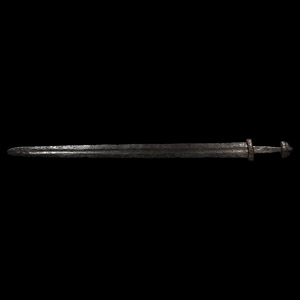
Viking Age Sword with Three-Lobed Pommel
Early 11th century A.D.Sold for (Inc. bp): £4,940
A double-edged cutting sword of Oakeshott Type XII with inlaid hilt and tapering blade with shallow fullers; the lower guard gently curving and decorated with copper inlaid dots, upper guard and three-lobed pommel with similar decoration, traces of silver inlay to the hilt. 720 grams, 90 cm long
Acquired 1971-1972. From the collection of the vendor's father. Property of a London, UK, collector. Accompanied by an academic report by Dr Raffaele D’Amato. This lot has been checked against the Interpol Database of stolen works of art and is accompanied by searcher certificate no.11575-198856.
The sword belongs to the Type XII of the Oakeshott classification (Oakeshott, 1998, pp.37ff.), the characteristics of which are a broad, flat, evenly tapering blade, generally with a good sharp point and tending to widen perceptibly below the hilt. After the publication of the Finnish specimen, Peirce, due to the inlaid inscriptions of this latter, noted a close parallel, both in style and content, with a sword in the Schweizerischen Landesmuseum in Zurich. In the expanded context including the example from Finland, Peirce was able to re-date them to the 11th century.
